Honest, paywall-free news is rare. Please support our boldly independent journalism with a donation of any size.
As part of the first phase of the U.S.-brokered ceasefire in Gaza in October last year, the Israeli army withdrew to what it called the “Yellow Line” — a temporary demarcation line inside the Gaza Strip that separated areas under Israeli military control from areas where people in Gaza are allowed to live and move. At the time, the Israeli military controlled 53 percent of the Gaza Strip. Under the agreement, the Israeli army was expected to carry out further withdrawals from Gaza during subsequent phases of the ceasefire. Plans released by the Trump administration in October 2025 showed future withdrawals would reduce Israel’s control to approximately 40 percent and then 15 percent of Gaza. However, Israeli Defense Minister Israel Katz said in February 2026 that Israel would not move “one millimeter” from Gaza before the disarmament of Hamas.
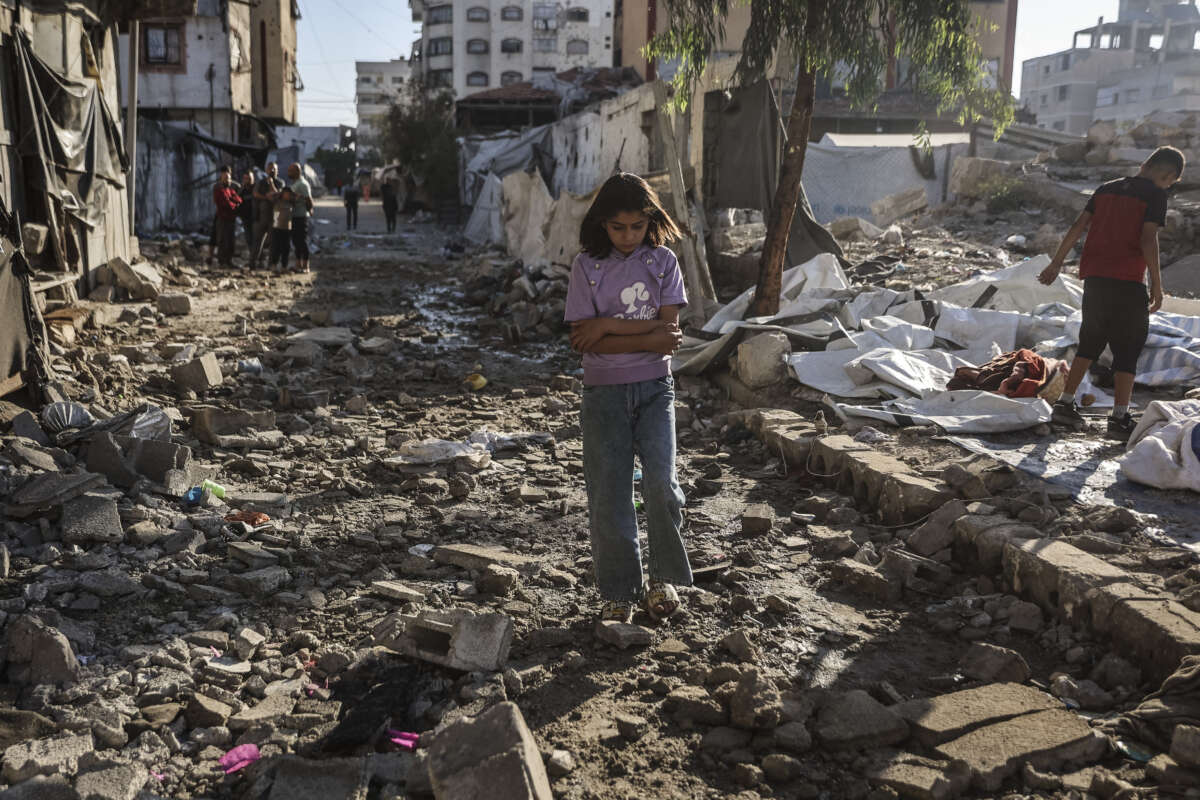
Over the six months since the ceasefire, maps and testimonies from Gazans indicate that Israel has not adhered to its delineated areas of control. Instead, it continued to move slowly, pushing the yellow concrete blocks marking the dividing line deeper into residential neighborhoods and establishing new fortifications and military positions beyond the agreed limits in the original ceasefire maps.
At the end of May, Israeli prime minister Benjamin Netanyahu appeared at a conference in a settlement in the Jordan Valley, stating that Israel currently controls 60 percent of the Gaza Strip and confirming that he has instructed the military to expand its control to 70 percent of the territory. The announcement spread rapidly among Gazans, fueling fear and uncertainty about the further displacement of thousands of families and the permanent removal of Palestinians from Gaza. These concerns have been validated by repeated statements from Israeli officials promoting what they describe as “voluntary migration.”
Netanyahu’s instructions for expanded control would leave more than 2 million Gazans crammed into overcrowded tent camps in less than 30 percent of the territory. Hadja Lahbib, the EU Commissioner for Equality who also serves as EU Commissioner for Preparedness and Crisis Management, said Israel is suffocating Palestinian families and hindering the delivery of aid. She also added that the expansion of Israeli control obstructs the work of humanitarian relief staff, stating that families in Gaza are “trapped between borders that move without warning.”
For now, it remains unclear which areas of Gaza Israel intends to bring further under its control. Many people in Gaza worry that the expansion could include the Bureij and Maghazi refugee camps, both of which are already densely populated and overcrowded.
If the expansion extends west of Salah al-Din Street into the Al-Zaytoun, Tuffah, and Daraj neighborhoods, Israeli forces would be in direct proximity to overcrowded displacement camps spread throughout Gaza City, which could result in military escalation and the mass displacement of thousands of Gazans to the remaining habitable areas of Gaza — such as the western part of Gaza City, Al-Mawasi in Khan Younis, and the central governorates. These areas are extremely small and already heavily overcrowded with residents and displaced families.
Over the six months since the ceasefire, maps and testimonies from Gazans indicate that Israel has not adhered to its delineated areas of control.
The final — and perhaps most alarming — scenario is the possible reestablishment of Israeli control over the Netzarim Corridor. This would effectively restore Israel’s division of the Gaza Strip into northern and southern sections before the ceasefire, severely restricting movement between the two areas and further deepening the humanitarian crisis.
Intisar Touta, 53, who lives near the so-called “Yellow Line,” told me that once the ceasefire took effect in October, she left Al-Mawasi in Khan Younis and immediately returned to live in a tent beside the rubble of her home in the Al-Zaytoun neighborhood, approximately 500 meters from the Yellow Line:
I returned to my neighborhood even though the situation was extremely dangerous. Every day, Israeli forces stationed nearby advance a little further, placing yellow concrete blocks beyond their previous positions. Right now, they are only about 200 meters from my tent. Every day, we face live fire from soldiers and tanks, as well as explosions from drones dropping bombs nearby. Day by day, the situation is getting worse.
I really want to leave because I fear that one day we may find ourselves inside the Yellow Line. But the problem is that I have nowhere to go. There is no available space in what remains of Gaza to set up our tent. Even the sides of the streets are now crowded with tents.
I felt overjoyed when the ceasefire was announced because it meant I could finally return to my destroyed neighborhood and never be forced to leave it. I believed that Israeli forces would be placed in the positions stated in the ceasefire maps. I never imagined that the Yellow Line itself would slowly expand and seize more areas.
Where is the ceasefire they keep talking about? Where can we go? Israel has left no stone unturned in making our lives unbearable. Isn’t it enough that we are living in tents that lack even the most basic necessities, while receiving inadequate humanitarian assistance? Now they want to displace us from our land once again. We are suffocating — enough is enough.
Ahmed Badwan, 25, told me that in November 2025, he and his family returned to what remained of their home on the eastern side of Salah al-Din Street, approximately 600 meters from the Yellow Line according to the original ceasefire maps:
At first, I felt relieved to finally return to what little remained of my home after months of suffering in displacement camps in Deir al-Balah. During the first two months after our return, the bombardment was largely confined to areas under Israeli control. However, over time, we began to see quadcopters dropping bombs near our neighborhood, along with smoke bombs.
We decided to stay because we had nowhere else to go, and we had not yet fulfilled our longing to return home. Despite the destruction, we managed to repair enough of the house to make it livable again. However, since the beginning of May, we endured extremely difficult nights as the intensity of bombardment increased, including artillery shelling and heavy fire from tanks and quadcopters. We survived those nights by nothing short of a miracle, only to discover that the “Yellow Line” had moved to just 100 meters away from us. Once again, we and many of our neighbors were forced to leave. We could no longer risk our lives.
“Since the beginning of May, we endured extremely difficult nights as the intensity of bombardment increased, including artillery shelling and heavy fire from tanks and quadcopters.”
The expansion of the “Yellow Line” is only one of innumerable violations Israel has committed with impunity since the so-called ceasefire took effect in October 2025. Since the announcement of the truce, the Israeli military has continued to carry out attacks against anyone approaching the Yellow Line, in addition to ongoing bombardment across the Strip. Gaza’s Ministry of Health has reported that more than 900 people have been killed and over 2,700 injured since the so-called ceasefire began.
These ongoing violations come amid growing international warnings about the worsening humanitarian crisis in Gaza, driven by severe shortages of essential services and continued restrictions on the entry of humanitarian aid. According to a May 2026 Humanitarian Situation Report published by the United Nations Office for the Coordination of Humanitarian Affairs, humanitarian operations in Gaza are being undermined by restrictions on the entry of critical spare parts, backup power generators, and other essential equipment, as well as by shortages of fuel and motor oil. Aid operations also face additional obstacles, including restrictions on the work of key humanitarian partners, limitations on freedom of movement within the Gaza Strip, and damage to roads and infrastructure.
The report further noted that ongoing military operations in Gaza continue to affect civilians, forcing families in eastern Khan Younis and eastern Gaza City to flee due to tank movements and shelling.
In Gaza, we had hoped that the announcement of the ceasefire would ease our suffering. Israel, however, has only used it to divert the world’s attention, and has quietly and persistently continued its policy of killing, displacement, deprivation, and destruction that has been in place since the very first day of the war.
Press freedom is under attack
As Trump cracks down on political speech, independent media is increasingly necessary.
Truthout produces reporting you won’t see in the mainstream: journalism from the frontlines of global conflict, interviews with grassroots movement leaders, high-quality legal analysis and more.
Our work is possible thanks to reader support. Help Truthout catalyze change and social justice — make a tax-deductible monthly or one-time donation today.