Part of the Series
Struggle and Solidarity: Writing Toward Palestinian Liberation
Did you know that Truthout is a nonprofit and independently funded by readers like you? If you value what we do, please support our work with a donation.
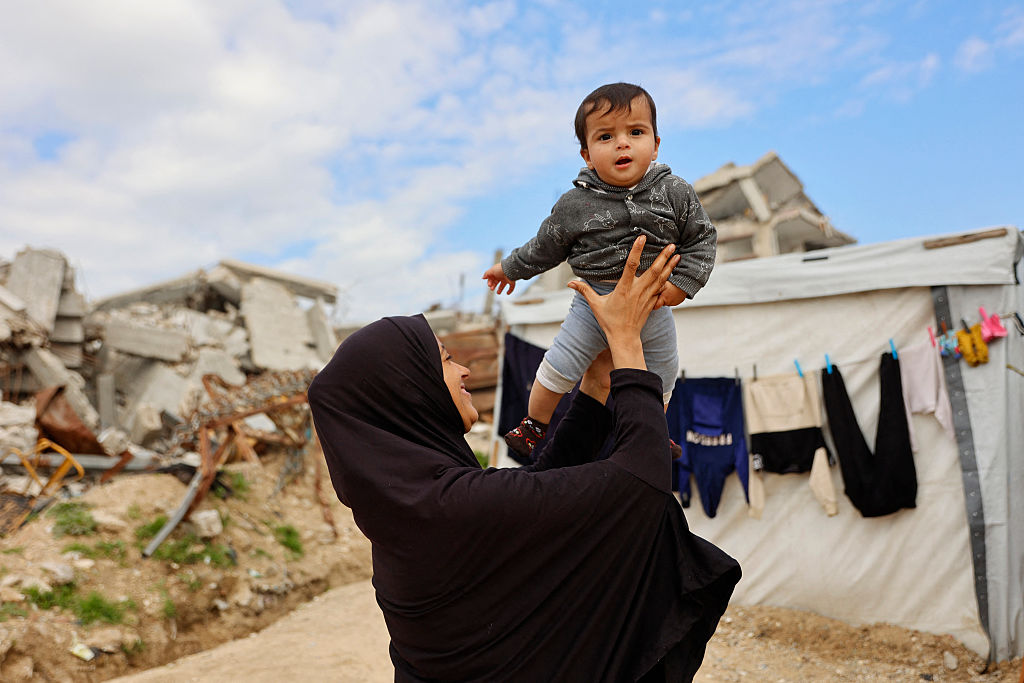
In Gaza, motherhood does not exist separately from fear. It unfolds inside it — even now, during what is called a ceasefire.
I think about this when I speak to my mother from a distance. I try to picture her day as she shares it with me, and the parts of it she doesn’t. The effort it must take to keep going — to care, to cook, to reassure, while carrying a weight of exhaustion — is hard to describe.
My mother is 41. In another life away from wars, she could sound young, but through my eyes I only see her with everything she has to hold together through the war.
War in Gaza has reshaped motherhood, pushing it beyond routine into something more constant, more urgent. Care is no longer just part of the day — it becomes something that cannot be set aside, even when there is nothing left to give.
It is a quieter side of the war, happening between mothers and their children.
Four months have passed since I left Gaza and my entire family. I go through my daily routine here in Italy, while constantly imagining theirs and trying to picture how my mother and family move through their days now.
I am constantly making comparisons between everything in my life and theirs, and I am doing it unintentionally. And in that comparison, my life, in a way I never wanted, feels easier, softer, happier, and less stressful than theirs. I see mothers with their children here — playing in parks, shopping together, walking safely through ordinary streets. It makes me happy to witness it, and at the same time, it reminds me of what my mother and other mothers in Gaza cannot easily have: simple, unguarded moments with their children.
Even everyday things like a walk or a day outside carry a different meaning there. Mothers continue to care for their children under conditions that demand constant strength, even when their own bodies and lives are under stress.
“Sara, I didn’t go out for two weeks,” my 7-year-old brother said during a video call.
Those simple words stayed with me long after the call ended. I felt a mix of sadness and guilt that I couldn’t easily distinguish or explain.
My mother then began telling me about how difficult transportation has become in Gaza. I listened, trying to hold both their voices at once, thinking about how much the everyday has shifted for them.
Mothers in Gaza often carry the heaviest burden of war. Many, like my mother, make the hard decision to send their sons and daughters abroad on scholarships, hoping to secure a safer tomorrow for us.
In addition, they pay the painful price of being separated from their loved ones. “I sent my four children outside Gaza to secure a better future for them,” science teacher Safinaze Al Baghdadi told me in a conversation. “My husband and I chose to remain in Gaza, even though it means missing our children every day.”
These mothers become everything at once — protector, provider, and a source of emotional support — while they themselves are in need of all three.
In the aftermath of the war, thousands of women in Gaza have been left widowed, forced to carry the burden of survival alone. These mothers become everything at once — protector, provider, and a source of emotional support — while they themselves are in need of all three.
One example is Nour Abu Nada, a mother of three young boys. Her husband, Belal, was killed at the beginning of the war. Since then, she has become the sole pillar in her children’s lives, dedicating herself entirely to their care and future.
“For them, I keep going, even when life feels meaningless,” Abu Nada said.
Nour is not alone. Across Gaza, more than 16,000 women are now the sole heads of their households, raising their children under extremely difficult conditions, with a hope of a better future for them.
It is hard for us, as children, to witness our mothers living in such inhumane circumstances. For me, the most heartbreaking moment was seeing my mother cooking over firewood, choking on the smoke and dust.
“My mother lost half of her body weight during the starvation period,” my roommate told me, describing the devastating impact of the war on her mother’s health.
Despite everything, mothers in Gaza are the exemplars of motherhood. They are role models of resilience and strength. In Palestine, Gaza specifically, women have no weapons to defend themselves, but they are raising children in a land shaped by occupations and wars, and showing the new generations that Israel cannot erase their identities.
According to reports from the United Nations Population Fund, more than 50,000 pregnant women have lived in Gaza during the war and its aftermath. They face a severe lack of basic necessities, including medical supplies, health care services, and properly functioning hospitals. Many women are forced to live — and even give birth — in tents under extremely difficult conditions.
During the war, I often found myself saying, “Thank God I am not a mother,” because witnessing what my own mother and other mothers endured was too painful for me to bear.
As I write this article, I am far from my beloved mother, who is preparing to undergo surgery on her leg.
I was with my mother throughout her recovery from injuries she sustained during the war, supporting her step by step until she reached a better state of health. Now, she will be in the operating room alone, without me waiting outside the door, praying for her as I did before.
I feel helpless, wishing I could be by her side.
I asked her in which hospital she would undergo the surgery, and I immediately regretted this question, as her answer still feels difficult to fathom: “In a field hospital.” My mother would undergo a very important operation in a makeshift medical facility, where the conditions are far from ideal.
I am hopeful that she will recover quickly and return to my five siblings, caring for them, cooking for them, and continuing to spread her belief in a better tomorrow — as she always does.
Media that fights fascism
Truthout is funded almost entirely by readers — that’s why we can speak truth to power and cut against the mainstream narrative. But independent journalists at Truthout face mounting political repression under Trump.
We rely on your support to survive McCarthyist censorship. Please make a tax-deductible one-time or monthly donation.