Part of the Series
Struggle and Solidarity: Writing Toward Palestinian Liberation
Honest, paywall-free news is rare. Please support our boldly independent journalism with a donation of any size.
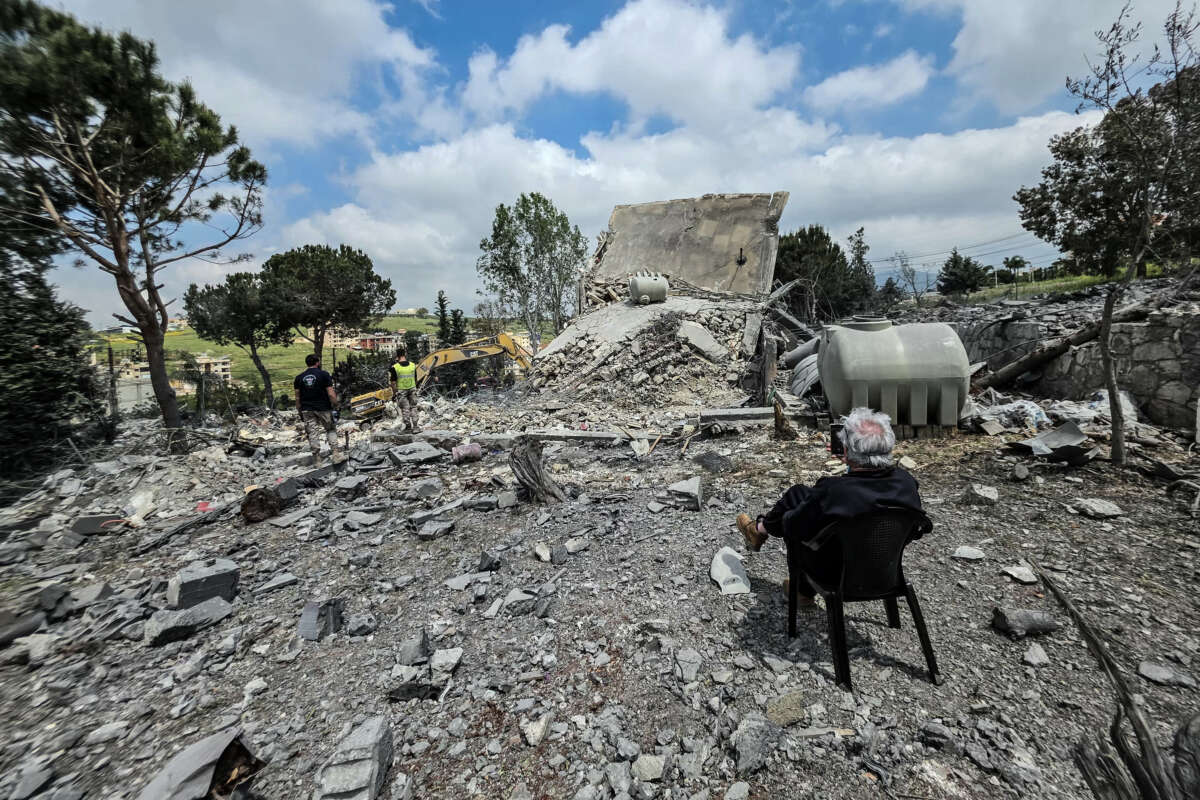
With the escalation of shelling in southern Lebanon since early March 2026, hundreds of thousands of Lebanese once again find themselves in a cycle of forced displacement. Official estimates indicate that more than 1 million people were forced to leave their homes within just the first few weeks, marking one of the fastest waves of displacement the country has experienced in decades. In this shifting reality, the crisis cannot be captured by numbers alone; it extends into intertwined human stories of families losing stability, mothers searching for shelter, and elderly people left to face hardships alone.
With every new wave of displacement, the same experience is repeated in different forms. For those who have lived through displacement before, these scenes are not unfamiliar. As a Palestinian from Gaza, I know well what it means to leave your home without knowing whether you will return or what will become of it. In such moments, the street becomes a temporary shelter, the ground becomes an open bed, and a deep sense of disorientation takes hold as multitudes of displaced people find themselves without a clear destination. The suffering becomes even more severe when children or elderly people are involved, as they are less able to endure constant movement and harsh conditions.
In southern Lebanon, specifically in the town of Nabatieh, a family of six — a father, a mother, and their four children — was forced to leave their home abruptly after evacuation leaflets were circulated in their area amid intensified shelling. They had no time to make a considered decision; they quickly gathered basic belongings and placed them in their car, not knowing where they were heading.
The mother, Yara Qanou, said the moment of departure came after heavy shelling intensified around the family, with shells landing close to their building. “The sound was very close, and everything was shaking around us,” she recalled. Fear was no longer a possibility but a daily reality. She witnessed painful scenes, with injured people lying nearby while rescue teams struggled to reach them amid chaos and panic. “I couldn’t bear it … I was afraid for my children,” she said, noting that she decided to leave immediately.
Despite leaving, Qanou still felt a strong attachment to her home, adding: “If I were given a choice, I would stay in my house … steadfast.” But between the desire to stay and the fear for her children, the decision was final — leaving, even toward an unknown destination.
In southern Lebanon, near the city of Tyre, Sandy Qanoaa, a mother of three, found herself facing an impossible choice between staying under bombardment or fleeing into the unknown. She said she had been living with her family in a spacious three-story house before her life turned within moments into a race against death.
Qanoaa recalled that the day of displacement did not begin differently; she was preparing lunch for her children when a powerful explosion shook the area. “We felt the ground shaking beneath us,” she said. Soon after, it became clear that shelling had struck a nearby house, resulting in casualties. Her children fell into a state of intense panic, “screaming and crying hysterically,” while she was unable to process the scene or calm them amid the escalating bombardment.
At that moment, there was no room for hesitation. Qanoaa grabbed her children and rushed out of the house without taking any belongings. “We left with just the clothes we were wearing,” she said, explaining that they headed to what are referred to as “safe areas,” hoping to find shelter.
But the shock did not end with displacement. Upon arrival, she was confronted with unprecedented rental prices, with some apartments reaching around 2,000 U.S. dollars per month — far beyond her means and several times higher than what she previously paid. “There was no real option,” she said, lamenting that all doors seemed closed.
“We went back against our will,” she said, capturing the contradiction of her experience — staying is not safe, but leaving is not possible.
Faced with this reality, Qanoaa was forced to make a decision she did not want: returning home despite the risks. It was not a choice driven by safety, but by the inability to afford displacement. “We went back against our will,” she said, capturing the contradiction of her experience — staying is not safe, but leaving is not possible.
In southern Lebanon, specifically in the district of Marjayoun, elderly people face a different form of displacement, where their suffering is not limited to losing their homes but extends to loneliness and lack of options. Mohammed Hariri found himself forced to leave his home after shelling intensified in his village, without having any clear destination.
Hariri said he had spent many years in his house, which was not just a place to live, but a place where he organized the details of his daily life in a calm and steady routine. He describes his days there as starting with difficulty, as he relied on himself for the simplest tasks due to his limited mobility, from preparing simple meals to moving slowly and carefully between rooms. “I have lived my whole life here,” he said in a voice mixed with exhaustion and nostalgia.
As the shelling intensified around the area, staying inside the house became increasingly difficult and dangerous, especially given his limited ability to move and the absence of anyone to help him leave or meet his basic needs, leaving him with no real choice but to evacuate.
Hariri added that his children live abroad, leaving him to face displacement alone. “There is no one to help me,” he said, explaining that he was forced to leave without a clear plan, moving between temporary places that often do not provide even the minimum level of comfort or stability. For him, displacement is not merely geographical movement, but a gradual loss of safety.
He pointed out that constant movement places an additional burden on him due to his need for stability and daily care. “The exhaustion is not just from the road … it’s from everything,” Hariri said, referring to the physical and psychological strain he has endured since leaving home.
As he continues searching for a place to settle, Hariri’s options remain limited in a reality that does not account for the needs of the elderly, who often find themselves outside the circle of attention, in spite of being among the most vulnerable groups in times of displacement.
Despite the announcement of a ceasefire in Lebanon, the threats of injury and death remain for various groups, including journalists who continue to cover events from the field. Southern Lebanon has witnessed repeated targeting of civilians and infrastructure in recent months, placing media workers in highly dangerous conditions while performing their duties.
In Gaza, recent wars have seen similar patterns, with journalists facing direct risks in the field, including reporters and cameramen working with Al Jazeera such as journalist Mohammed Washah, who continued to document events amid ongoing bombardment, restricted movement, and the absence of safe zones until his murder by an Israeli drone in April. These conditions reflect a broader reality experienced by journalists in conflict zones, where reporting the truth itself becomes a perilous mission.
Reports from international press freedom organizations indicate that media workers in war zones face extremely high levels of risk amid a lack of effective protection guarantees, jeopardizing their ability to continue under military escalation.
The experience of displacement in Lebanon cannot be captured by official statistics and statements. It’s families leaving their homes under fire, children facing fear and instability for the first time, and elderly people confronting deep isolation after losing both stability and place.
Despite differences in context between Lebanon and Gaza, both experiences converge in a shared essence: the loss of safety and the persistence of suffering even after declared truces, where peace remains fragile and the return to normal life remains incomplete.
In this reality, the humanitarian crisis continues to assert itself as a daily fact, as displaced people attempt to rebuild their lives from scratch.
Fundraiser Deadline: Missed
Truthout is one of only a few platforms for justice-oriented, grassroots journalism. Today, as political censorship from the right intensifies, we have no choice but to ask for your help.
We missed our fundraising deadline, but there’s still time to help us meet our basic operating expenses before the end of the month. If you can support Truthout with a one-time or monthly donation, you will make a significant impact on our work. Anything you can do makes a difference — we appreciate your support.