Truthout is an indispensable resource for activists, movement leaders and workers everywhere. Please make this work possible with a quick donation.
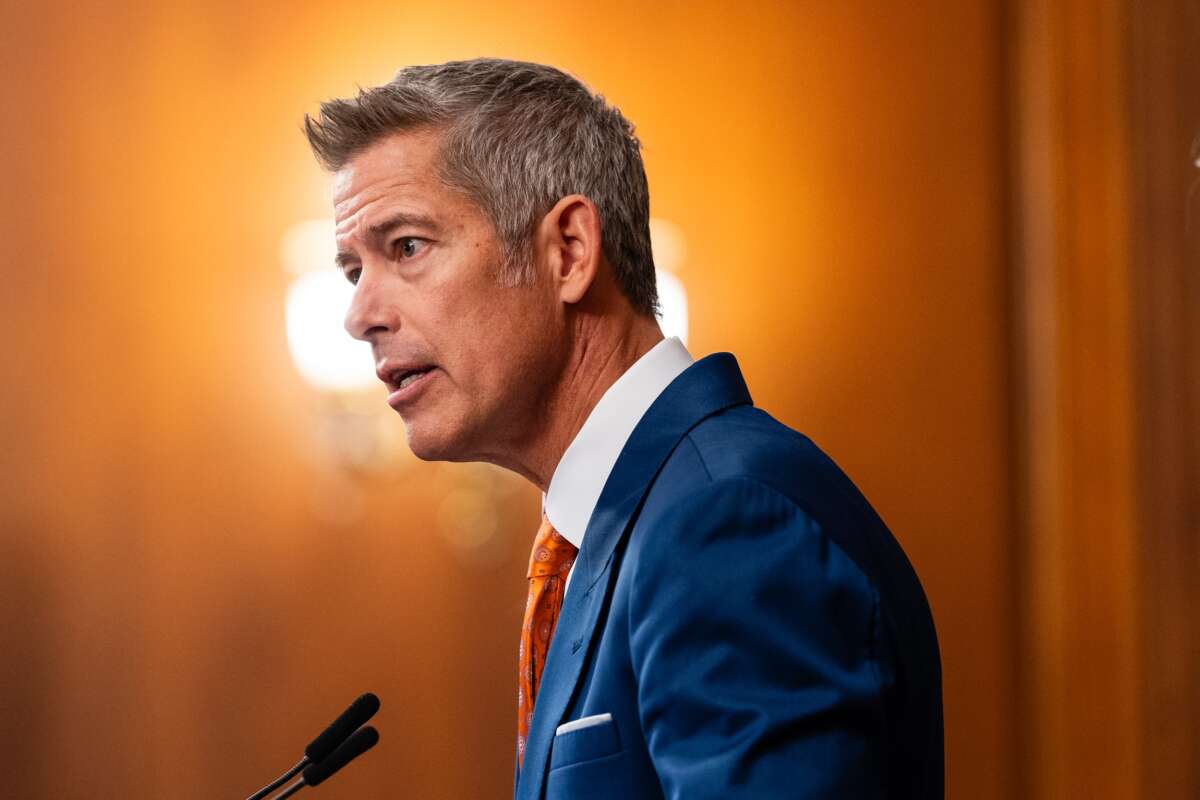
On Sunday, Transportation Secretary Sean Duffy baselessly assured Americans that gas prices would be lowered immediately upon resumption of oil shipments through the Strait of Hormuz, which have been severely restricted due to the U.S. and Israel’s war on Iran.
Duffy’s claim, however, contradicts public reports from other agencies within the Trump administration, which have noted that, even with an immediate reopening of the strait, gas prices likely won’t return to pre-war levels for many months, perhaps years.
As of Monday, the price for regular-grade gasoline across the U.S. stands at $4.457 per gallon, on average — a 51 percent increase compared to prices a week before the war started.
“You’re going to start to see immediate relief once the strait opens and supply flows again,” Duffy said on ABC News’s “This Week” program over the weekend.
Admitting that prices at gas pumps have gone up, Duffy implied the costs would be temporary, and were worth it to support the war.
“You have to look at the president to say, what does a leader do? What does a president do when he sees a potential nuclear Iran? He’s not going to tolerate it,” Duffy said.
The same line of defense for the war and justification for rising gas prices is frequently invoked by President Donald Trump himself. Last month, for example, Trump acknowledged that gas prices will remain high “for a little while.”
“You know what [Americans] get for that? Iran without a nuclear weapon,” Trump added.
Importantly, military assessments before the war started indicated that Iran didn’t pose an imminent threat to the U.S. or its interests in the region, and nuclear experts have also stated that Iran wasn’t anywhere close to building a nuclear weapon. Some assessments on the U.S.’s decision to launch a war with Iran have also noted that it may have emboldened the country (and other countries) to pursue nuclear weapons in the future.
Duffy’s claims that gas prices will drop soon are also rosier than what the administration is projecting in its public reports. In early April, the Energy Information Administration (EIA) projected that gas prices would remain above pre-war levels through the rest of 2026 and likely through 2027, even with a best-case outlook for the war that presumed it would end before the start of May.
On Monday, Iranian media announced that the country had fired upon U.S. ships in the strait, preventing them from escorting shipments through the waterway. The U.S. has denied that the event took place.
Duffy’s comments are the latest in a series of statements from the administration that seek to downplay the economic harms of the war and the realities most Americans face when it comes to rising costs.
In a speech at a wealthy retirement community in Florida this weekend, Trump mocked Democrats for focusing on affordability. “They’ve got one good line of bullshit,” Trump said, complaining that the issue would become a talking point of the 2026 midterms.
Trump — who will soon begin his 16th month as president, during which time he has also had Republican majorities in both houses of Congress — further claimed that Democrats “are the ones that caused the problem,” ignoring that his tariffs last year played a major role in escalating the crisis. He also claimed he had first heard the term “affordability” in the first two days of his return to the White House.
The president may have been referencing a letter from Democrats, a week into his second term, in which they chided Trump for prioritizing issues other than the economic concerns he had campaigned on during the 2024 presidential race.
“During your campaign, you repeatedly promised you would lower food prices ‘immediately’ if elected president. But during your first week of office, you have instead focused on mass deportations and pardoning January 6 attackers,” that letter said.
Recent polling on the economy shows that most Americans are more pessimistic than Duffy or Trump.
Only 24 percent of Americans rate the economy as “excellent” or “good,” an Economist/YouGov poll published last week found. Thirty-four percent rated it as “fair,” and a plurality, 39 percent, said the current state of the economy is “poor.”
In a separate question, only 14 percent of Americans said the economy is “getting better,” while 58 percent said things are “getting worse.”
An urgent fundraising appeal: 4 Days to raise $34,000
Truthout is one of only a few platforms for justice-oriented, grassroots journalism. Today, we face an existential threat.
Due to Google’s launch of AI search, we’ve seen a drastic plunge in our site traffic and, as a result, our revenue. We lost 15 percent of our readership overnight. This was a readership we painstakingly built over decades, and it vanished because Google chose corporate greed over a healthy democracy.
We are fundraising right now to meet our basic operating expenses. If you can support Truthout with a one-time or monthly donation, you will make a significant impact on our work. Anything you can do makes a difference — we appreciate your support.