Honest, paywall-free news is rare. Please support our boldly independent journalism with a donation of any size.
On April 16, U.S. President Donald Trump announced a 10-day ceasefire in Lebanon, set to begin later that day. Although Lebanese President Joseph Aoun and Prime Minister Nawaf Salam welcomed this announcement, it is unlikely to put a stop to Israel’s expanding occupation of south Lebanon. In the hours before the announcement, Israel continued to bomb Lebanon’s south, bombing a school as well as the last main bridge connecting the south of the country to the rest of Lebanon.
The announcement came after a meeting on April 14, in which U.S. Secretary of State Marco Rubio hosted Lebanon and Israel’s ambassadors for the first diplomatic talks between the two countries since the early 1990s, a move that is likely to cause further turmoil in Lebanon. In a statement after the meeting, the U.S. explained that direct negotiations would be launched at a later date, and that objectives included the disarming of Hezbollah. Additionally, it asserted that mediation would be limited to the U.S., and that Lebanon’s reconstruction would be linked to negotiations with Israel.
A day after the envoys met in Washington, D.C., Israel launched another round of strikes on southern Lebanon, pushing forward with its invasion of the south even as it purportedly moves toward “peace.” Israel’s strikes reportedly killed 20; at the same time, Israel issued yet another forced displacement order for residents of the south. Days earlier, protesters in Beirut mobilized against the Lebanese government’s planned negotiations with Israel.
The push for direct negotiations between Israel and Lebanon came after Israel’s massive attacks on Lebanon on April 8. Hours after a fragile ceasefire took effect in the U.S.-Israeli war with Iran on April 7, Israel escalated its attacks on Lebanon, unleashing the most violent assault of its six-week war on the country. Iran and Pakistan — which mediated the U.S. ceasefire with Iran — insisted that a halt to attacks on Lebanon was part of the agreement, but Israeli Prime Minister Benjamin Netanyahu and Trump claimed otherwise. Israel’s military declared that “the battle in Lebanon is ongoing,” while renewing expanded evacuation orders for southern Lebanon.
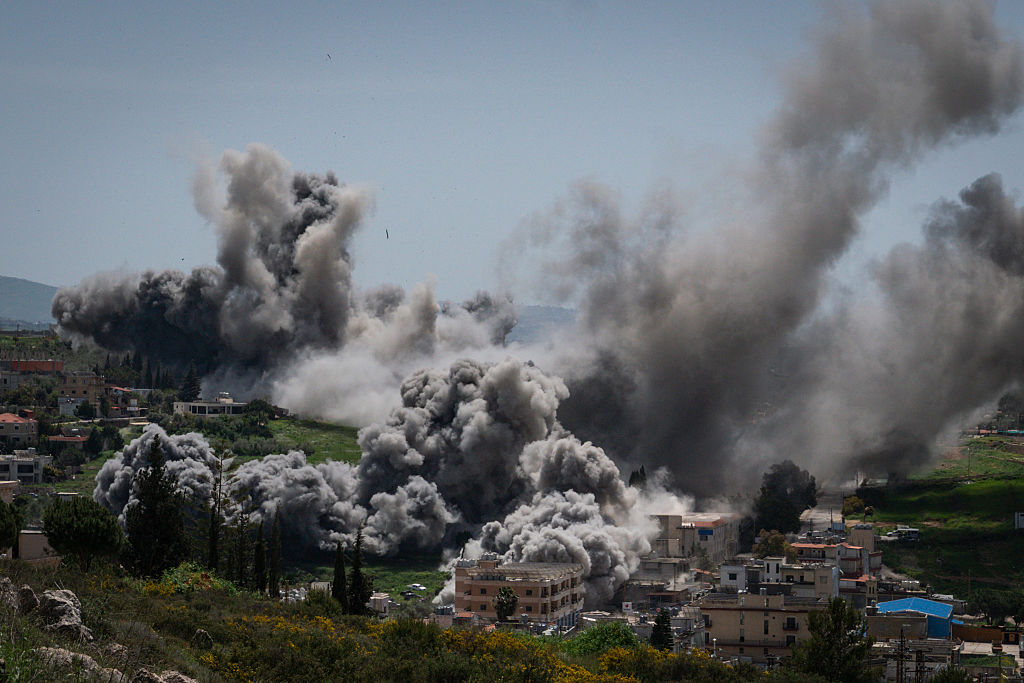
Israel’s wave of attacks on April 8 clearly aimed to pressure the Lebanese government to further capitulate to Israel’s wishes. Throughout that morning, Israel bombed areas of southern Lebanon, attacking residential buildings as well as medical vehicles and a medical center. In the early afternoon, Israel escalated, unleashing more than 100 airstrikes in less than 10 minutes, bombing residential and commercial areas across Beirut as well as in southern Lebanon and the eastern Bekaa Valley. These airstrikes killed at least 357 people and wounded more than 1,200, marking the deadliest day of Israel’s current assault on the country. Airstrikes struck residential complexes, bridges, grocery stores, a funeral procession in a cemetery, and a university hospital.
Freelance reporter and editor Lylla Younes described for Truthout what it was like to witness the attacks in Beirut: “Across the city, we could see plumes of smoke billowing from the sites of recent airstrikes. The air was smoky, and the city was full of the sounds of ambulance sirens and yelling beneath the buzz of drones overhead.”
The next day, Younes visited the site of one the airstrikes — “an apartment building in Ain al-Mreisseh where 27 people were killed. Children’s toys were scattered among the rubble. Medics were working to pull out four bodies that still lay beneath.”
Israel’s military spokesperson claimed that its expanded attacks across Lebanon were due to Hezbollah militants dispersing beyond Shia-majority areas, like Christian-majority Ain Saadeh, east of Beirut. This claim should be seen as a naked justification to escalate and expand attacks across the capital and Lebanon as a whole, and to attack civilian areas without warning. In addition, these attacks aim to turn non-Shia residents of the country against Hezbollah, goading sectarian strife, and pressuring the government to come to the negotiating table with their hands against the wall.
A Genocidal Aggression
Israel began its latest escalation in its war on Lebanon on March 2, when Hezbollah fired rockets at Israel after the U.S.-Israeli assassination of Iranian leader Ali Khamenei. In reality, Israel had already been waging a protracted war on southern Lebanon since 2024. The ceasefire that marked the end of Israel’s 2024 war on Lebanon did not see an end to Israel’s attacks on the south of the country. In a familiar pattern from Gaza, the agreement essentially became a one-way ceasefire, with Israel attacking south Lebanon on a regular basis and continuing to occupy areas of the south between November 2024 and March 2026. According to the UN, Israel violated the 2024 ceasefire more than 15,000 times.
Since March 2, Israel has carried out a campaign of collective punishment, particularly of the Shia-majority regions of Lebanon, and has expanded its occupation of the south of the country. Israel’s assaults, and in particular its occupation of the south, have forced 1.2 million people — 20 percent of the country’s population — to flee their homes, creating a severe displacement crisis. Israel is also working to exploit frustrations with Hezbollah and sectarian tensions within Lebanon to push the country toward civil strife or even civil war.
This current war adds to the prolonged list of catastrophes that Lebanon has already been facing: The country has been suffering from a severe economic crisis since 2019, with one of the world’s worst economic collapses seen since the 19th century. Lebanon was also still reeling from its 2024 war with Israel and had not yet managed to rebuild. Israel’s continued bombardment and occupation have thrust the country further toward political and civil chaos.
Younes described the general situation across the country over the past few weeks:
In the South, the bombing is relentless and the [Lebanese] army has fully pulled out, leaving the remaining residents to an unknown fate. In Beirut, hundreds of thousands of displaced are crowded into schools transformed into government shelters, relying on dwindling aid due to spiking food and fuel prices. The Israeli aggression is relentless and punishing, and has no regard for civilian life — there are countless examples of that now. The Israeli military’s killing of more than [80] first responders since March 2 alone indicates the genocidal nature of this aggression.
Israel’s expansion of its war on Shia-majority areas of Lebanon uses methods from its genocidal war on Gaza. Israel has waged mass ethnic cleansing of the population of the south of Lebanon, as well as the southern suburbs of Beirut — both of which have largely been depopulated throughout the course of the war. The Israeli military has issued numerous expulsion orders as it invades and pushes towards the Litani River — some 20 miles north of Lebanon’s border with Israel — while destroying civilian infrastructure.
Over the past weeks, Israel has strategically targeted bridges connecting the south to the rest of the country over the Litani River, managing to cut off and isolate the south from the rest of the country. As historian Zeead Yaghi, a postdoctoral fellow at the American University of Beirut, explained to Truthout, “The Israeli defense minister has said that he envisions Israeli forces to remain in southern Lebanon for a long period of time or until Israel feels Hezbollah no longer resembles a threat to it, repeatedly referencing the ‘Gaza example.’”
Israel’s method of mass expulsion, destruction, and flattening of civilian infrastructure has been dubbed the “Khan Younis option,” which it is now repeating over large parts of Lebanon. In fact, the “Khan Younis option” itself originated with the Dahiyah Doctrine, developed by Israel on its 2006 war on Lebanon only to be expanded on later in Gaza.
Echoes of Israel’s Past Occupation
Israel’s expanding invasion of south Lebanon is reminiscent of its previous invasion and occupation of the south of Lebanon in 1982. Throughout the 1970s, Israel had intervened in Lebanon in order to crush the Palestinian movement there — which was largely based in the refugee camps of Lebanon. That movement took the form of armed struggle carried out under the umbrella of the Palestine Liberation Organization (PLO), after the defeat of the 1967 war pushed more Palestinians into militant struggle from the diaspora. In the late 1970s, Lebanon became embroiled in a civil war that initially saw a strong left-wing movement made up of Nasserists, nationalists, Baathists, and communists — a cross-sect coalition made up of Sunni and Shia Muslims, as well as Christians of different denominations — allied with the Palestinian movement. But throughout the late 1970s and ‘80s, Israel intervened to weaken the Lebanese left and, most crucially, to destroy the Palestinian movement. This peaked with its 1982 invasion, which led to an 18-year Israeli occupation of the south of Lebanon.
Israel’s 1982 invasion, which included a two-month-long siege and bombardment of Beirut, managed to force the PLO to leave Lebanon entirely. While the siege of Beirut ended after two months — with the horrific Sabra and Shatila massacre in September 1982 as its epilogue — Israel’s occupation of the south of Lebanon continued. The ejection of the PLO further weakened the Lebanese left forces, including the resistance forces fighting Israel’s occupation in the south.
At first, the vacuum was filled by the Lebanese National Resistance Front (LNRF), established in 1982 to resist Israel’s occupation and to represent the left in the civil war, but it was weakened both by Israel and the Syrian state, ruled by Hafez al-Assad, which wanted a Lebanese resistance under its control. Hezbollah also emerged to resist Israel’s occupation of the south, quickly gaining the support of the Syrian and Iranian states. Sectarian dynamics were on the rise, and Hezbollah attacked the LNRF and other left-wing groups. By the end of the civil war, Hezbollah had maneuvered to become the sole resistance force in the south, eclipsing the cross-sectarian resistance movement that had existed in the late ‘70s and early ‘80s. Eventually, it made the Israeli occupation of the south costly enough for Israel that it was forced to pull out in May 2000 — 18 years after its occupation began.
Israel Pushes Lebanon Toward Civil Strife
Now people in Lebanon worry that today’s occupation might prove to be worse than 1982. According to Yaghi, in 1982, “Israel did not explicitly attempt to depopulate the villages in occupied southern Lebanon during its invasion. In fact, residents were allowed to stay and were governed by the IDF [Israel Defense Forces] and its local Lebanese militia ally, the South Lebanon Army.”
But today, Yaghi says, “Every indication so far, be it from statements from Israeli military and political officials to the actions of the IDF itself, demonstrates clearly Israel’s objective to depopulate and render uninhabitable the land south of the Litani River. By uninhabitable that also means destroying the possibility of economic activities and subsistence in the south, mainly agriculture. Israel sprayed pesticide on agrarian fields back in February, as well as in 2025.”
Ever since the 2024 war, which saw Israel assassinate the vast majority of Hezbollah’s leadership, the organization is weakened to the point that it will be more difficult for it to fight the Israeli occupation. Nonetheless, Hezbollah fighters have remained in the south, clashing with Israeli military forces, and Hezbollah has continued to direct missiles onto northern Israel.
Also reminiscent of the 1980s, the current war has seen Israel tug on sectarian dynamics and push the country towards civil strife. Divisions within Lebanon have taken a sectarian overtone, with discrimination against the internally displaced, who are largely Shia. Sectarian sentiments, which had decreased in particular during the cross-sectarian 2019 uprising in Lebanon, have returned to a high level. Many of the internally displaced face discrimination in finding shelter or apartments to rent in other areas. Among the 1.2 million displaced, only about 130,000 are residing in overcrowded shelters; most are either staying with relatives or sheltering in the open. For this reason, some have remained in the south, even as it has been isolated from the rest of Lebanon.
In addition to bombing non-Shia areas, in a clear attempt to pit people of different sects against each other, Israel and the U.S. have pressured the Lebanese government to push for Hezbollah’s disarmament and for negotiations and normalization with Israel.
Although Hezbollah is part of the current government and has been since 2005, other factions within Lebanon’s government have moved in the past year to pressure and disarm Hezbollah, even as it is the only force capable of resisting Israel’s attacks. On March 2, immediately after the start of the current, expanded war, Lebanese Prime Minister Salam blamed Hezbollah for the conflict, declared all military operations by Hezbollah illegal, and demanded that it disarm. The government then asked the Lebanese Army to leave the area south of the Litani River — ejecting another force that could at least protect the populations that remained in the south.
The Lebanese government’s move toward direct talks with Israel ignores the reality that no state can make peace with a genocidal neighbor that is determined to expand, both in order to crush any resistance and opposition to its policies, and to fulfill the designs of its expanded settler-colonial “Eretz Israel.” Any negotiations with Israel will not lead to the safety of the Lebanese population, but will instead push the country further toward civil strife.
Press freedom is under attack
As Trump cracks down on political speech, independent media is increasingly necessary.
Truthout produces reporting you won’t see in the mainstream: journalism from the frontlines of global conflict, interviews with grassroots movement leaders, high-quality legal analysis and more.
Our work is possible thanks to reader support. Help Truthout catalyze change and social justice — make a tax-deductible monthly or one-time donation today.