Did you know that Truthout is a nonprofit and independently funded by readers like you? If you value what we do, please support our work with a donation.
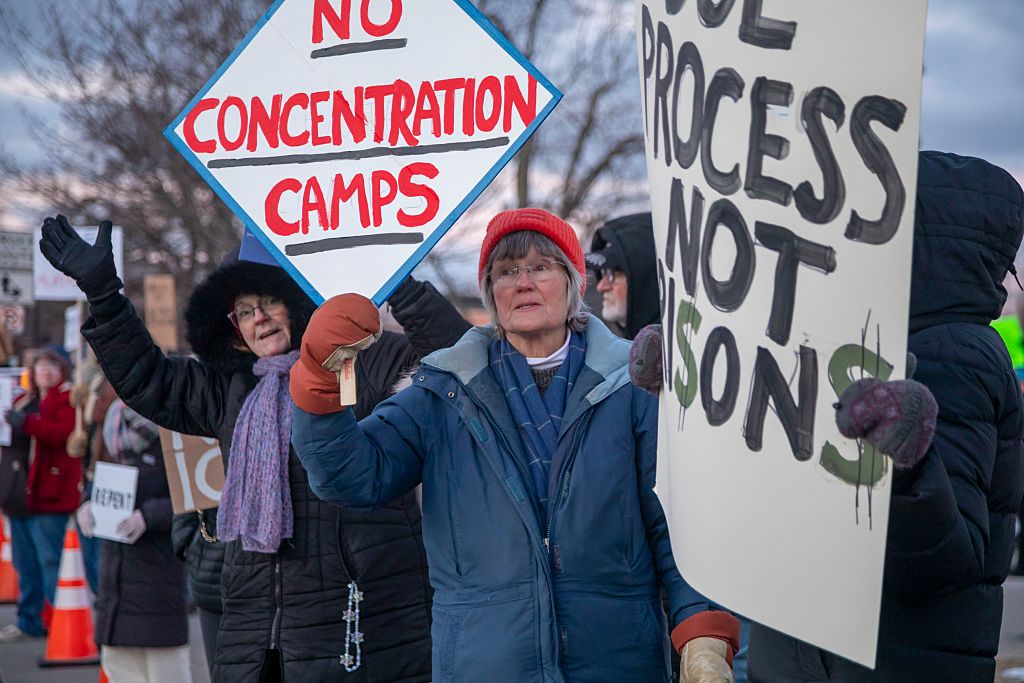
The recent move from the Department of Homeland Security (DHS) to convert empty or surplus warehouses into large-scale ICE detention centers has produced a new terrain of struggle in the fight against Immigration and Customs Enforcement (ICE). A notable departure from ICE’s existing detention system, which largely relies on contracts with county sheriff’s departments and privately run prison companies, this initiative is expanding and consolidating the federal government’s capacity to cage immigrants. Proposed ICE warehouses are largely in areas near logistics hubs, many of which are in towns that voted for Donald Trump in the 2024 election. However, from Western Maryland to Oklahoma City to rural Georgia, opposition has in many cases slowed down or even halted such proposals. This opposition has culminated in a national day of action on April 25 as part of a coordinated campaign of mobilizations to stop warehouse incarceration.
In the interview that follows, community organizers and officials in Oklahoma City recount their collective organizing to thwart an ICE warehouse conversion proposal earlier this year. Although initially seen as a longshot, grassroots mobilizations were successful in not only stopping this proposal but also connecting people’s outrage to long-haul organizing for immigration justice in Oklahoma and beyond.
JoBeth Hamon is a city councilor in Oklahoma City, serving Ward 6. CJ Garcia is a queer immigrant from Nayarit, Mexico, who has called Oklahoma home for over 20 years and combats detention and deportation at both local and federal levels with organizations such as Dream Action Oklahoma and Detention Watch Network. Cole McAfee is the executive director of Freedom Oklahoma and an organizer with the local abolitionist organization Home Base, whose work is rooted in disability justice and trans liberation. Katrina Ward is an abolitionist organizer with Home Base and a Ph.D. candidate researching Oklahoma’s carceral state.
This interview has been lightly edited for length and clarity.
Lydia Pelot-Hobbs: Can you tell me about the proposal to convert a warehouse to an ICE detention center in Oklahoma? Who owns this warehouse? How did this become available for conversion?
Cole McAfee: This warehouse was built in the early COVID-19 online shopping boom as a speculative development for e-commerce businesses. It’s owned by Flint Development which is based in Kansas and the brokerage firm is Oklahoma-based Newmark Robinson Park. Robinson Park is run by Mark Beffort, who is also on the board of the Greater Oklahoma City Chamber and runs the chamber’s economic development programs. DHS did buy a warehouse in El Paso from Flint Development so we think it is likely this company had been in talks with DHS about the various warehouses it has available. The warehouse in Oklahoma City has been sitting empty and was up for lease. The amount DHS offered for the warehouse was never public.
The proposal was for it to be an ICE processing facility that they claimed would not be for long-term stays, but we know that is not how things work and were concerned about conditions. There was never an official bed count for the size of this proposed detention center. We were told it could be between 500 to 1,500 beds for warehousing people.
How did folks find out this was happening?
JoBeth Hamon: Community organizations first found out what was happening from a Washington Post article that named Oklahoma City as one of the locations ICE was looking at for turning a warehouse into a detention facility. I contacted city staff and learned that they knew about this proposal a few weeks before the Washington Post story. DHS had sent a letter to the city planning department’s historic preservation officer to get a positive affirmation that no historic properties would be affected by this plan. She probably shared it with the planning director and then the news trickled up to the city manager’s office. It then got picked up by local media. If that Washington Post article hadn’t happened, it is unclear when the public would have known because the city government was not proactively sharing this letter.
How did people respond to this proposal?
Hamon: Different organizations such as the ACLU, the Oklahoma Policy Institute, and Dream Action Oklahoma reached out about what was happening to see what mechanisms or levers at the city council could be pulled.
CJ Garcia: It was unsurprising. This has been one way DHS is expanding detention capacity, especially with places that had taken a hit on COVID-era real estate. The repurposing of existing warehouses has given ICE a wide range of places they can access with property owners who are just trying to maximize profits. Also, I knew from my work against a detention center proposal in Leavenworth, Kansas, that zoning was a limited tool for stopping these plans.
I also wanted to make sure that we are connecting this warehouse struggle to the broader ICE ecosystem. My question was: How do we make sure folks don’t lose sight of the fact that we’ve also tripled the amount of 287(g) agreements in Oklahoma [in which state and local law enforcement agencies work with federal agents on immigration policing] and that they’re using state prisons to detain people at a much larger scale than the warehouse proposal? How do you bridge this moment of urgency to broader organizing?
McAfee: There was this urgency among groups that had been following increased criminalization, detention, and deportations. The biggest response I saw was people mobilizing around the Oklahoma City Council even as the mayor and council members said they had limited power. I thought if folks are driving people to council, what are the asks we can make? What are some of those longer-term organizing connections we can help build? If there isn’t anything on the agenda that is actionable, what is the broader narrative work we can do around immigration justice?
Katina Ward: When this information came out, the city started saying they were going to be open and transparent about their communication with DHS. That they were going to ask DHS to go through the city’s zoning process. City leaders’ narrative became “we’ve done our best.” The mayor said that he was talking with our federal delegation to request that DHS go through the formal city process. But at the same time, the city attorney made clear that the city didn’t have legal standing to deny this proposal.
Can you describe what happened at the city council?
McAfee: A mix of people came out. Some had come to council meetings before, along with people for whom this was their first time. People who were organized directly within impacted communities, people activated to show up by folks doing ICE watch, and some advocacy and policy organizations. We were there for several hours in a hot very full room that was over capacity with folks out in the lobby, too.
There was a sense that we have a limited window. People are already saying this is beyond our control. Were there asks that could be made to drive the political imagination of everyone in the room? Could we help council members envision action that was in their hands? For the people who felt compelled to show up, could we give them a broader framework to think about what else could be done? What are ways that we can plug people into other organizing, to get people to think about detention and deportation as a much bigger system that already operates in our community and has to be addressed beyond just this detention expansion plan?
Garcia: Something we haven’t named yet is people were also mobilized because of Renee Nicole Good and Alex Pretti’s murders, a click for a lot of the population in Oklahoma who is largely white and haven’t been activated before. I don’t want to dismiss that. Why were hundreds of people flooding the city council? Because they saw themselves in Renee Good and Alex Pretti. They did not see themselves in people who have died in detention. They have not seen themselves in the hundreds of people that die crossing the border every day. People are finally making sense that the violence this system has built is also coming for them when they betray whiteness, when they do not just comply. That agitation is underneath all of this — not just that ICE is coming for a warehouse.
Ward: There was also a tension at the meeting between symbolic action versus us providing some tangible actions that the city council could take. For instance, Durant, Oklahoma, recently passed a moratorium on detention facilities being built that were not municipal detention facilities. Our city council discussed something similar even though the city attorney said that didn’t have much legal ground. We emphasized there were other actions that could be taken at other government levels against ICE.
Hamon: There’s not the political appetite among our current city council members to take on legal battles (unless it’s criminalizing poor people). The council leans on our legal department to be the most risk-averse, especially things they don’t deem to be a priority. It’s not that we can’t pass a moratorium or do other things. The question is: How effective will they be? How will they get challenged? That’s where the narrative from the mayor — that we can’t do anything — was just so shallow. Legality is a conversation between different institutions and you’re giving up before you even started. You are finding a way out of having to take any moral responsibility for fighting this.
McAfee: We showed up to city council with the following asks: The city publishing all correspondence between DHS, making sure there were regular updates; a moratorium on evictions; and Oklahoma City police citing and releasing people as much as possible to limit the number of people going into the jail where ICE is present. We also wanted folks to understand city surveillance cameras and databases being used by ICE and we asked the city to end those agreements. We asked for the city to share a legal briefing with the public that outlined all the legal pathways that would be available to the city to disrupt this warehouse plan so that we could have deeper public conversations about all the options that were available — even if they carried some legal risk.
How did this outrage, and the different asks made by the community, end up halting the warehouse conversion plan? And what were the outcomes with your other asks at the time?
Hamon: While city legal counsel said there is nothing we can do, this fever pitch of a response seemed to pressure the mayor to at least try and have a few conversations behind the scenes. My assumption is that these occurred with the chamber of commerce and the warehouse property owners. While we don’t know all of what happened, the outrage compelled the mayor to step in. And it appears that DHS was pursuing a lot of different potential warehouses and knew not all were going to work out. Then DHS announced it was no longer interested in pursuing this site.
The question has now become: How do we take the energy of this moment and focus it on things that could have a broad impact for people who are criminalized? Can we use this as an education moment about the surveillance company Flock [that had shared data from its license plate reader technology with ICE] and drive energy toward canceling that contract with the city? We’re also staying prepared if this warehouse proposal comes up again.
McAfee: One of the other guiding questions is: What are ways we can plug allies into showing up beyond moments of political urgency? Freedom Oklahoma [the only 2SLGBTQ+ advocacy organization in the state] and Dream Action Oklahoma [a community-based organization for immigration justice] are partnering together around a zine launch about what it looks like to approach this from the perspective of a neighbor and not a savior and get involved in local organizing to have the future that we want to see.
Ward: Also, because the mayor was gone, JoBeth presided over this meeting and leveraged the momentum in the room to pull back a vote on surveillance related to a proposal for a “LexisNexis Accurint Virtual Crime Center,” which is an interagency information-sharing technology that has the potential to share law enforcement information with ICE (even if Oklahoma City doesn’t officially allow it). I had never seen them go back in the agenda, re-vote, and deny something the police department had requested. It was a material win to delay that.
Garcia: Organizing against detention is a long-haul process. It requires the spaces, trainings, and relationships for people to see a different world is possible. So long as there is prison infrastructure, the state will find a way to reinvent itself. People are largely being detained through law enforcement and sheriff’s departments. These are the biggest threats for immigrants in Oklahoma. ICE is the second layer that makes it possible. We’ve tracked over 3,000 deportations in Oklahoma over the last year, and the vast majority are through contact with law enforcement — even departments that don’t officially collaborate with ICE.
How do we organize people to think about safety from a completely different formulation? Policies that don’t criminalize trans and queer people, unhoused people, not criminalizing access to resources. Because that brings more safety for undocumented people. As an immigrant living in Oklahoma, I know we have a big task ahead. We cannot lose local politics, and we cannot lose the narrative about what safety is — to help people reimagine something different.
An important fundraising appeal: 24 Hours to raise $21,000
Truthout is one of only a few platforms for justice-oriented, grassroots journalism. Today, as political censorship from the right intensifies, we have no choice but to ask for your help.
We are fundraising right now to cover our basic operating expenses. If you can support Truthout with a one-time or monthly donation, you will make a significant impact on our work. Anything you can do makes a difference — we appreciate your support.