Support justice-driven, accurate and transparent news — make a quick donation to Truthout today!
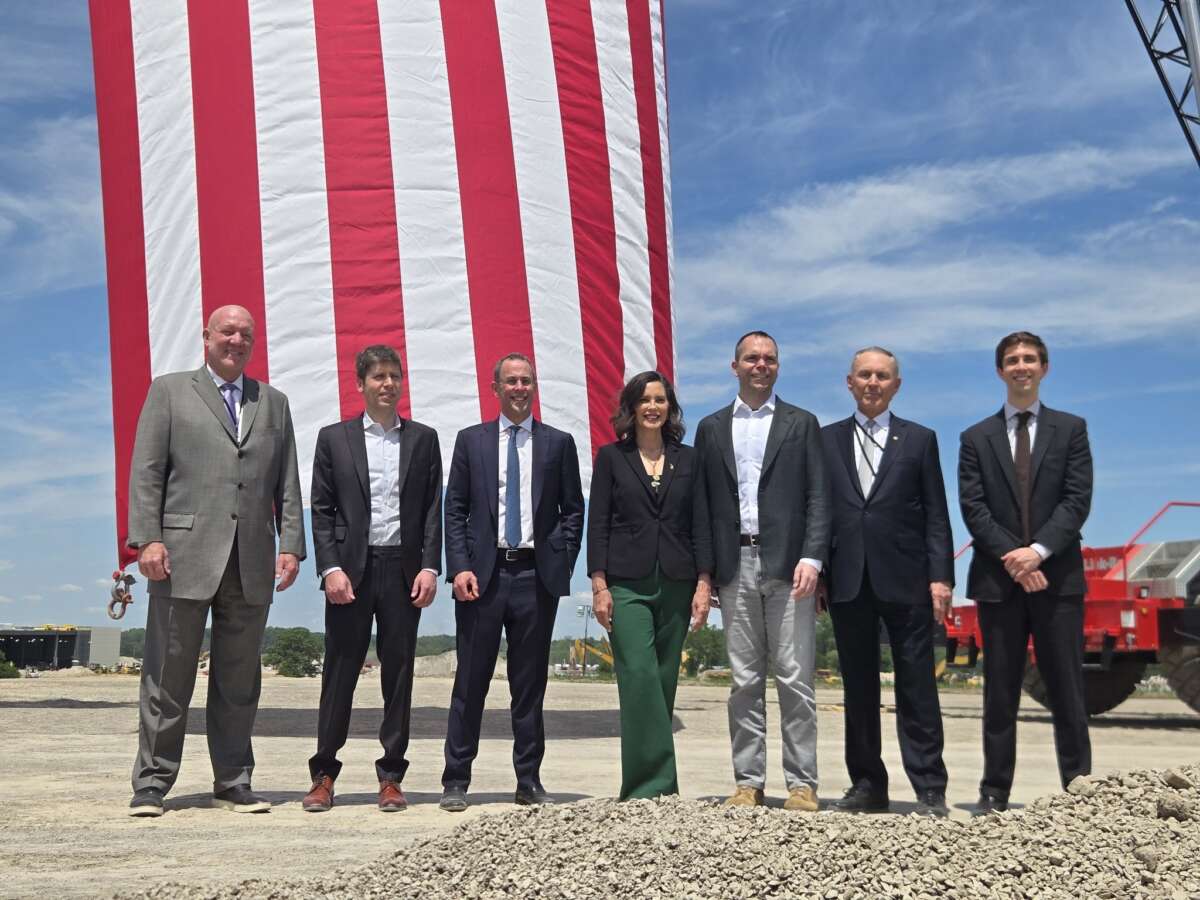
On Monday, Michigan Gov. Gretchen Whitmer joined tech CEOs and businessmen at a groundbreaking ceremony for a $16 billion data center in rural Michigan.
The data center — the first OpenAI data center in the Midwest — is already under construction, despite facing pushback from local residents. It is located in Saline Township, a rural agricultural community just 10 miles southwest of Ann Arbor, Michigan.
Among the attendees of the ceremony were Sam Altman, CEO of OpenAI; Clay Magouyrk, CEO of Oracle, a multinational tech company with a focus on AI; and Jeff Blau, CEO of Related Companies, a major privately-owned real estate development firm. OpenAI is the creator of the popular and controversial ChatGPT.
Related Digital – a data center development and investment company and a subsidiary of Related Companies – is developing the hyperscale data center for use by Oracle and OpenAI. Whitmer has called the data center “the largest economic project in Michigan history.”
The Democratic governor has faced backlash on social media for appearing at the ceremony alongside the project’s corporate backers, with critics pointing out that Oracle is a major ally to President Donald Trump.
OpenAI CEO Sam Altman gushed about the project at its site on Monday, telling the Detroit News that he hoped the data center “can be an example for the world.”
But the data center has faced resistance from community members. In September, Saline Township’s board voted to deny the rezoning of agricultural land for the project after residents gave public comments in opposition to the data center.
This was followed by a lawsuit by Related Digital, the project’s lead developer, and by local landowners who wanted the center to be built. They accused the township of “exclusionary zoning.” In October, a judge settled in their favor, allowing the project to move forward.
The data center is part of the $500 billion Stargate Project, announced by Trump at the White House last January alongside OpenAI CEO Sam Altman, Oracle’s CTO Larry Ellison, and SoftBank CEO Masayoshi Son. Its aim is to build out AI infrastructure and data centers across the U.S. The Pentagon plans to use Stargate’s infrastructure as it ramps up its use of AI for the military.
Those who oppose data centers cite strains to local resources, like water and electricity use, as well as tax breaks given to data center developers.
Ben Green, assistant professor at the University of Michigan School of Information and Public Policy, said the plan for the Michigan data center is to use 1.4 gigawatts of energy – which is “equivalent to the energy use of a million households.”
Data centers also use fuel from fossil fuel plants, increasing pollution.
In the case of the Hyperion hyperscale data center in rural Louisiana, Meta requested to withdraw 5.6 million gallons of water each day from local sources to meet the center’s cooling needs.
Green also said that the rapid pace in which data centers are being developed across the country is “fueling a massive expansion in energy and water demand,” adding that it is “putting severe strain on efforts to move the country toward renewable energy sources.”
The claim that data centers will bring jobs to local communities is a “false promise,” he said. Because the data centers are essentially warehouses of servers, they require very few workers, especially after the first couple of years.
But OpenAI CEO Sam Altman ignored this in his remarks at the ceremony on Monday, saying, “I hope this can be a real template for how we engage with future communities…. We think every community in the country should try to get one of these.”
Press freedom is under attack
As Trump cracks down on political speech, independent media is increasingly necessary.
Truthout produces reporting you won’t see in the mainstream: journalism from the frontlines of global conflict, interviews with grassroots movement leaders, high-quality legal analysis and more.
Our work is possible thanks to reader support. Help Truthout catalyze change and social justice — make a tax-deductible monthly or one-time donation today.