Part of the Series
Struggle and Solidarity: Writing Toward Palestinian Liberation
Support justice-driven, accurate and transparent news — make a quick donation to Truthout today!
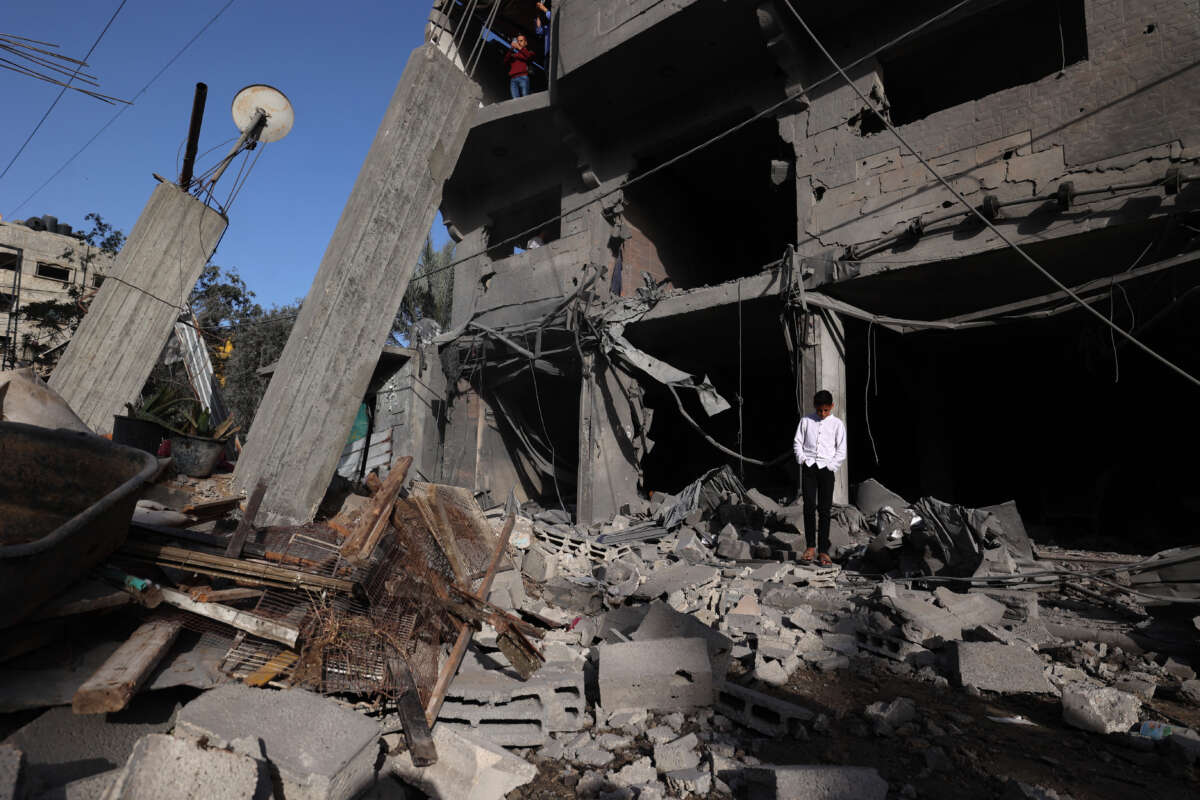
The Ain Jalout Tower complex is located in the Nuseirat refugee camp in central Gaza Strip. Considered one of the most prominent residential complexes, over the years it has served as a refuge for dozens of families. In January 2024, during the early months of Israel’s war on Gaza, these towers were subjected to heavy bombardment following waves of forced displacement of residents, who were ordered to leave as the area was deemed a “dangerous zone.” What had once been a lively community turned into rubble, leaving behind a heavy memory of loss and displacement, and the beginning of a new suffering for tower residents who found themselves without shelter.
Nearly two years later in January 2026, displaced residents from Ain Jalout Towers say the company that owned the buildings called them to discuss a project to rebuild the towers within an emergency response framework. This brought a renewed sense of hope to hundreds of families still living in displacement and instability. The discussion focused on mechanisms for the launching of reconstruction, challenges related to securing funding and building materials, and the role of local and international actors in supporting these efforts.
Reconstruction attempts in the Gaza Strip often face complex obstacles — most notably restrictions on the entry of construction materials (even after the ceasefire went into effect), weak financial resources, and international humanitarian aid that has been delayed or restricted by Israel. Despite this, emergency reconstruction projects are considered a vital step toward enabling residents to gradually regain their lives amid an extremely difficult humanitarian and economic reality.
Between Shortages of Materials and Closed Crossings
“We face a severe shortage of essential construction materials such as cement and steel, and this shortage makes rebuilding extremely difficult for the people,” saidMohammad Ziyara, the former minister for public works and housing. “Even with emergency reconstruction plans, without proper entry of materials and the necessary support, progress will be slow, and families will continue to live in very difficult conditions.”
He added that the closure or partial operation of crossings into Gaza directly obstructs reconstruction projects and delays the return of thousands of families to their homes. Despite these challenges, Ziyara confirmed that efforts continue — albeit slowly — to rebuild what the war destroyed, aiming to restore life to affected areas and alleviate residents’ suffering.
He further explained that for many years, the Ain Jalout Towers formed an integrated living space for dozens of families who settled there since their construction in the 1990s. Residents not only lived in the towers but gradually developed and maintained them, turning them into a cohesive community. Ziyara pointed out that before the recent war, there were ongoing efforts and plans to expand the Ain Jalout Towers, including the construction of a new residential tower alongside the existing ones to accommodate population growth and provide additional housing. However, these aspirations came to a complete halt with the outbreak of the war, turning the expansion project into a postponed dream, as the priority shifted to rebuilding what had already been destroyed.
“Reconstruction is not just about rebuilding towers and homes, but about restoring complete lives for families who have lost everything, and this requires the cooperation of all local and international actors,” he said.
Between Rubble and Tents: A Story of Never-Ending Loss
Ahmed Al-Hajj lived on the fourth floor of a building at Ain Jalout Towers for years with his family and owned a small shop in the ground-floor arcades at the building’s entrance. There, he spent his days serving customers in a modest space that was his only source of income.
When his building was destroyed, Al-Hajj said, “I lost everything at once — my home that sheltered me and my shop that supported my family. All we had built over the years was gone in a moment.”
He continued, “Today, I live in a tent that offers neither protection from summer heat nor winter cold. Every day is a struggle, and I have to take life day by day, because I cannot plan for tomorrow amid the lack of income and ongoing instability.”
“The children ask me when we will return to a proper home, and I have no answer. All I can give them is my promise that we will rebuild, somehow, step by step,” he said.
Al-Hajj emphasized the broader struggle: “It’s not just about our family — everyone around me has lost something. Every day I see neighbors living in tents or crowded shelters, and we all share the same fear and uncertainty.”
Between memories of the home he shared with his family and the life that once filled his shop, Al-Hajj stands before a reality weighed down by loss, trying to hold on to what remains of hope despite the heavy burden of daily suffering.
“Even in this harsh reality, we hold on to hope. We dream of the day we can rebuild our lives fully, where our families can feel safe and children can play without fear. That hope is all that keeps us moving forward,” he concluded.
Hope Conditioned on the Opening of Crossings
Muath Al-Asmar, a father of six children and a displaced resident of the Ain Jalout Towers, said his priority is restoring a minimum standard of life. “Reconstruction for my family is not about grand projects, it’s about the basics — a minimum standard of life we can call home,” he said.
Al-Asmar said that the continued closure of crossings and restrictions on construction materials make any attempt at repair nearly impossible, noting that if cement and steel were allowed in, many families would immediately begin restoring small parts of their homes, “even just a room and a bathroom,” which he considers far better than remaining in tents.
“Living in displacement imposes constant pressure, especially on the children,” he said. “They have no privacy and we struggle to secure the most basic needs. Every day is a challenge, and any improvement, even small, is urgent to regain some stability.”
Between what is proposed in plans and what is actually feasible on the ground, residents await tangible steps that begin with restoring at least the minimum level of housing — rooms that can shelter families and preserve their dignity — as a first stage toward gradually rebuilding life. Despite the slow pace of reconstruction, hope remains that these efforts will turn into a tangible reality that restores people’s stability and alleviates the prolonged suffering of displacement since the genocide began.
An important fundraising appeal: 5 Days to raise $35,000
Truthout is one of only a few platforms for justice-oriented, grassroots journalism. Today, as political censorship from the right intensifies, we have no choice but to ask for your help.
We are fundraising right now to cover our basic operating expenses. If you can support Truthout with a one-time or monthly donation, you will make a significant impact on our work. Anything you can do makes a difference — we appreciate your support.