Part of the Series
Voting Wrongs
Support justice-driven, accurate and transparent news — make a quick donation to Truthout today!
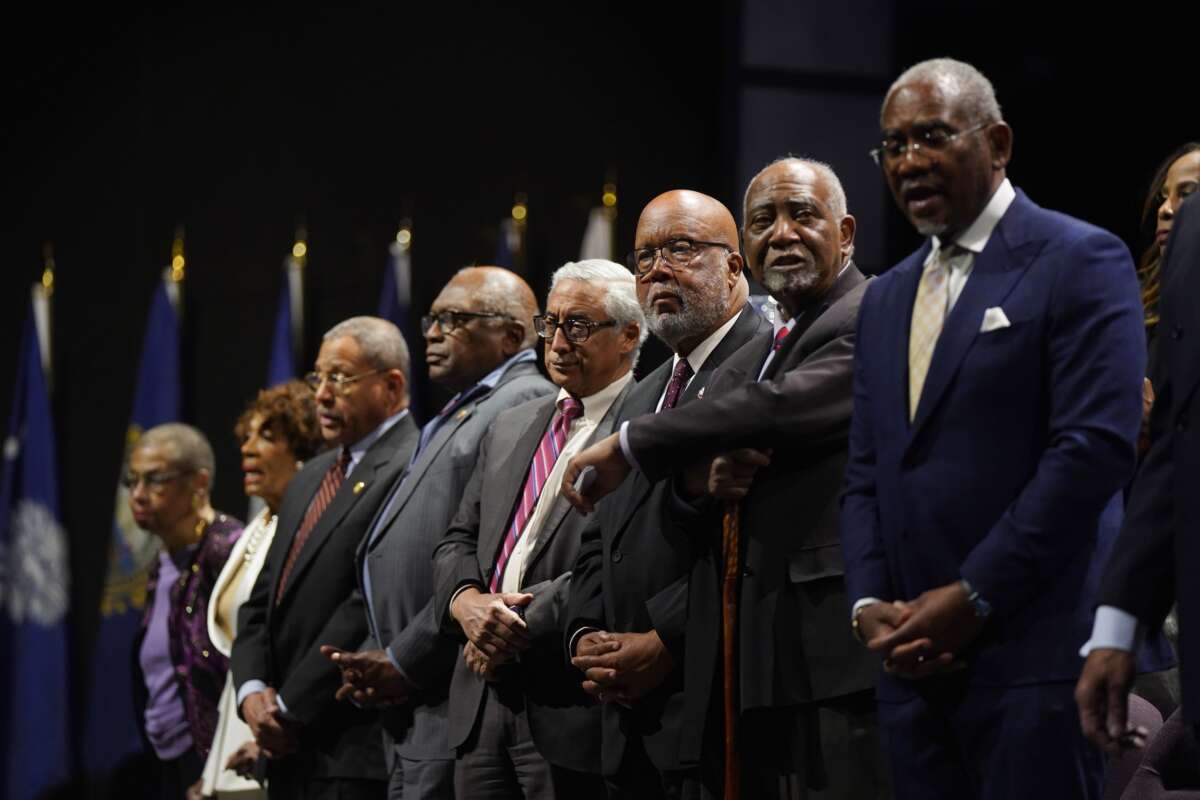
Nearly a third of the seats in Congress currently held by members of the Congressional Black Caucus could be at risk due to a recent Supreme Court ruling upending aspects of the Voting Rights Act (VRA), a new analysis has found.
In late April, the conservative-led Supreme Court, in a 6-3 decision along partisan lines, ruled against enforcement mechanisms used by some lower courts requiring states to draw Black-majority districts to comply with Section 2 of the VRA. Prior to the high court’s ruling, such mechanisms were seen as a way to ensure that states couldn’t disenfranchise Black voters.
In a dissent to the majority’s decision, Justice Elena Kagan noted that, under the new standard established by the court, “a State can, without legal consequence, systematically dilute minority citizens’ voting power.” Kagan further described the ruling as the “latest chapter in the [conservative] majority’s now-completed demolition of the Voting Rights Act.”
As a consequence of that ruling, up to 19 Democratic lawmakers within the 62-member Congressional Black Caucus in the U.S. House of Representatives could be removed from office this year or in the next few years, an analysis from ABC News concluded — not necessarily because constituents disagree with their views or want better alternatives, but because state legislatures could redistrict congressional boundaries to help Republican candidates win instead.
Several states are planning to redraw or have already redrawn their congressional maps to reflect the new standards of the Louisiana v. Callais decision in time for this year’s midterms, while others may end up waiting until 2027 or 2028 to redraw maps for the latter year’s elections.
Among the lawmakers at risk of losing their seats because of mid-census redraws are longtime stalwarts of the House like Rep. James Clyburn, a Democrat who has represented a district from South Carolina since 1993.
Clyburn responded last week to the Republican plan to draw him out of office by saying GOP lawmakers had just one goal in mind: “eliminating the state’s only Democratic House district that is occupied by a Democrat.”
“Republicans are trying to break apart South Carolina’s 6th District. Not because voters demanded it, but because Donald Trump requested it,” he added.
This past week, South Carolina Republicans sought to extend their legislative session in order to redraw maps. Democratic state senators, joined by a few Republicans, blocked that motion, effectively delaying the redistricting plan.
However, earlier this week, Gov. Henry McMaster (R) issued an executive order calling for a special legislative session, calling lawmakers back to Charleston to move the process ahead. The move has the endorsement of President Donald Trump, who on Monday had called on Republicans in the state to “BE BOLD AND COURAGEOUS” by redrawing their maps.
Barring any unexpected blockage of the special session, Clyburn, the lone Democratic member of South Carolina’s House delegation (as well as the only Black Representative), will likely see his 6th Congressional District seat gerrymandered in such a way that Republicans will end up winning it, diluting Black voting power in order to achieve that end. The redraw would result in a 7-0 Republican majority delegation, versus the 6-1 majority they currently have.
Although South Carolina is considered a deeply Republican state overall, it is not entirely Republican, as over 40 percent of residents voted for Democratic nominee Kamala Harris in the 2024 presidential election, and nearly the same percentage voted for the Democratic candidate in its most recent gubernatorial race.
As a result of its disproportionate congressional delegation favoring the GOP, the Gerrymandering Project gives South Carolina an “F” rating for how its maps are currently drawn. The state would likely retain that rating if the new maps are passed.
25 Years of Truthout: An important fundraising appeal
This September, Truthout is celebrating 25 years of publication. For over two decades, we have been a trusted source for fiercely independent journalism thanks to readers like you.
Looking to the next 25 years, we launched a special fundraising campaign. We still need to raise $16,000.
We are asking for your support at this juncture because we face greater threats than ever before in our organizational history. Trump and his MAGA allies are determined to control the information ecosystem, and movement-based organizations are subject to dangerous censorship and scrutiny.
If you can support Truthout with a one-time or monthly donation, you will make a significant impact on our work and our legacy. Anything you can do makes a difference!