Did you know that Truthout is a nonprofit and independently funded by readers like you? If you value what we do, please support our work with a donation.
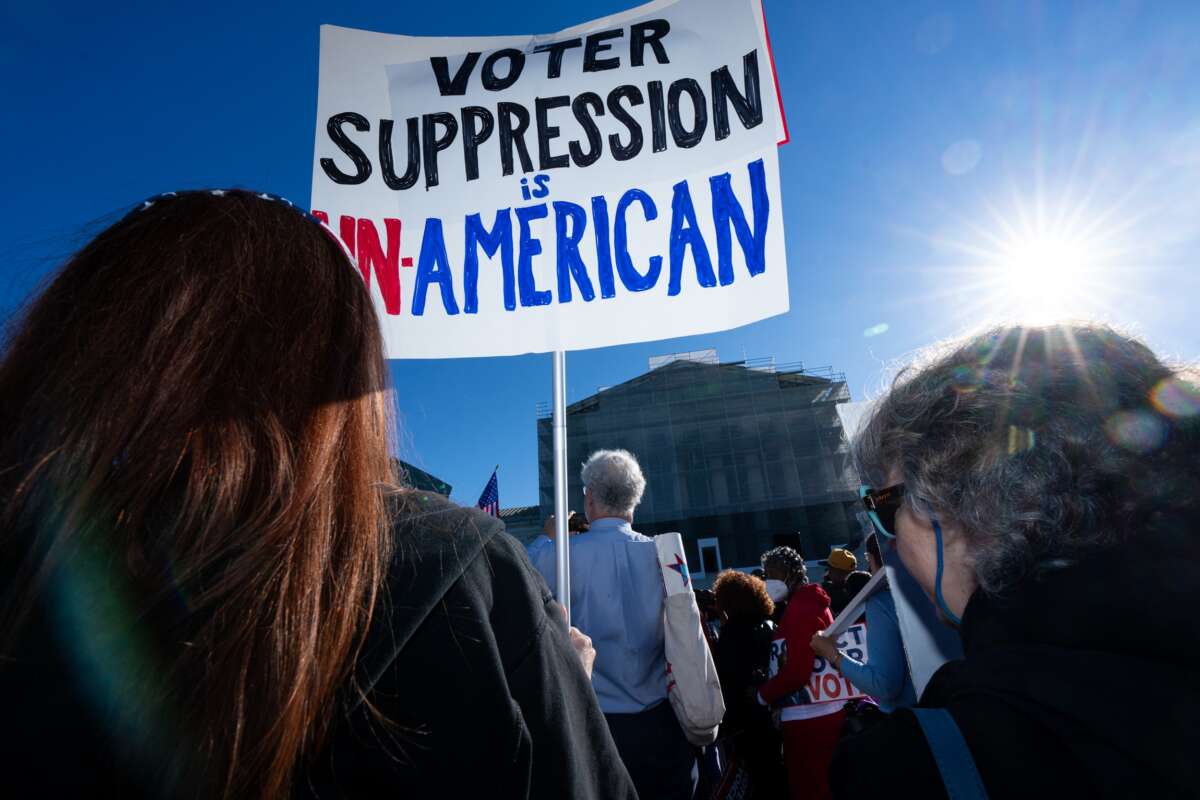
The United States Supreme Court issued an opinion on Wednesday that critics say may have finally dismantled protections for nonwhite voters codified in the Voting Rights Act of 1965.
By a 6-3 ruling along partisan lines, the conservative-led court found that Section 2 of the Voting Rights Act was being improperly used by lower courts to require states that have racially gerrymandered their congressional districts to redraw them, to ensure Black-majority districts would be a part of the eventual delegation for those states.
All three liberal-bloc justices in the case, Louisiana v. Callais, disagreed with the ruling.
Justice Samuel Alito authored the opinion of the court, writing that the Voting Rights Act “was designed to enforce the Constitution — not collide with it.” He further alleged that lower courts requiring Black-majority districts had “engage[d] in the very race-based discrimination that the Constitution forbids.”
Justice Elena Kagan penned the dissent, vehemently disagreeing with Alito’s interpretation of the law, noting that, under this new standard, “a State can, without legal consequence, systematically dilute minority citizens’ voting power.”
Describing Alito’s ruling as an “antiseptic” view of how Section 2 of the law should be applied, Kagan wrote in her dissent that the “updates” that the conservative majority proffered will “eviscerate the law, so that it will not remedy” clear examples of voter dilution based on race.
“Without a basis in Section 2’s text or the Constitution, the majority formulates new proof requirements for plaintiffs alleging vote dilution,” Kagan added.
Kagan also noted that the ruling “is part of a set” of other actions by the conservative-led Supreme Court to stifle enforcement of the law. “For over a decade, this Court has had its sights set on the Voting Rights Act,” Kagan wrote.
Despite the court just three terms prior upholding Section 2 to allow lower courts to demand redrawing racial gerrymanders, the majority ruling “does ‘revise and reformulate’ . . . and destroy” the Voting Rights Act, she said, adding:
[The majority opinion] avails itself again of the tools used before to dismantle the Act: untenable readings of statutory text, made-up and impossible-to-meet evidentiary requirements, disregard for precedent, and disdain for congressional judgment. And in that way it greenlights redistricting plans that will disable minority communities— in Louisiana and across the Nation—from electing, as majority communities can, ‘representatives of their choice.’
“I dissent, then, from this latest chapter in the majority’s now-completed demolition of the Voting Rights Act,” Kagan said.
Examining the outcome of the case, constitutional legal scholar Rick Hasen came to the same conclusions as Kagan.
“Rather than strike down part of the Voting Rights Act as an unconstitutional race-conscious law that would be said to violate the Equal Protection Clause, the opinion weakens application of the Voting Rights Act to make it a much weaker, and potentially toothless, law,” Hasen said on his website, Election Law Blog. “It is hard to overstate how much this weakens the Voting Rights Act.”
Hasen also pointed out that Alito’s opinion shifts the view of partisan gerrymandering in general, beyond just racial contemplations.
The court once “described the practice as bad and unfortunate, but out of federal courts’ reach to police,” Hasen wrote. “Now, favoring a party is seen as a venerable tradition in districting.”
Such gerrymandering is viewed disfavorably by most Americans. According to an Economist/YouGov poll published on Tuesday, only 7 percent of voters think states should be allowed to redraw their congressional districts to favor one political party over another, while a whopping 71 percent say they shouldn’t be allowed to do so.
That same poll also found that only 24 percent of Americans believe their states’ districts have been drawn fairly. Sixty-two percent of Americans also say they are dissatisfied with how democracy is working in the U.S. today, the poll found.
The decision may result in several states — particularly in the South — choosing to redraw their maps ahead of the 2026 midterms with the new Supreme Court standards in mind. Already on Wednesday, as the Supreme Court was officially rendering the ruling, lawmakers in the Florida state legislature were reviewing new maps, proposed by Gov. Ron DeSantis (R), that would produce four more Republican seats than previously anticipated within the state’s congressional delegation.
The state Senate paused a planned vote on the redistricting measure to review the Supreme Court’s ruling. DeSantis had previously indicated he wanted to redraw maps, assuming the court would rule against the protections lower courts have provided using the Voting Rights Act.
“Called this one months ago,” DeSantis said in reaction to the ruling on X. “The decision implicates a district in FL — the legal infirmities of which have been corrected in the newly-drawn (and soon to be enacted) map.”
Voting rights advocates and organizations blasted the Supreme Court for its latest decision.
“The Voting Rights Act is essentially dead, and it’s quite possible that we will, like when a similar SCOTUS gutted civil rights at the fall of Reconstruction, see a disappearance of much of the Black congressional representation,” journalist Nikole Hannah Jones said on Bluesky, adding:
There are people still living who fought — and watched their compatriots be murdered — for the passage of this act and to attempt to democratize America. To see it completed felled in the span of their OWN lifetime is just absolutely devastating.
“The Supreme Court betrayed Black voters, they betrayed America, and they betrayed our democracy,” said NAACP President Derrick Johnson. “This ruling is a major setback for our nation and threatens to erode the hard-won victories we’ve fought, bled, and died for.”
“Weakening these protections will make it harder for communities to elect leaders who will fight for strong schools, accessible health care, and real economic security, particularly at a moment when election rules are being rewritten, oversight bodies are being politicized, and partisan actors are openly pushing to entrench power at the expense of voters,” American Oversight Executive Director Chioma Chukwu said in a statement reacting to the ruling. “We stand firm against the Court’s efforts to erode the American people’s fundamental right to vote and will continue fighting to ensure every voter’s voice is heard.”
We lost 15 percent of our traffic overnight.
We now have three full months of data since Google changed its search to feature AI results. The numbers are worse than we anticipated. Overall readership that comes to Truthout through Google is down 54 percent against last year. The number of new readers who discover Truthout via Google searches is down 49 percent, and returning users from Google are down 51 percent.
We lost 15 percent of our readership overnight. This was a readership we painstakingly built over decades, and it vanished because Google chose corporate greed over a healthy democracy.
We anticipate a loss of roughly $500,000 in online revenue as a result of this massive traffic plunge in the next year alone.
The only way we can keep publishing is with strong reader support. We are asking you to start a monthly donation to Truthout today — anything you can do, whether $5 or $25, makes a difference.