Support justice-driven, accurate and transparent news — make a quick donation to Truthout today!
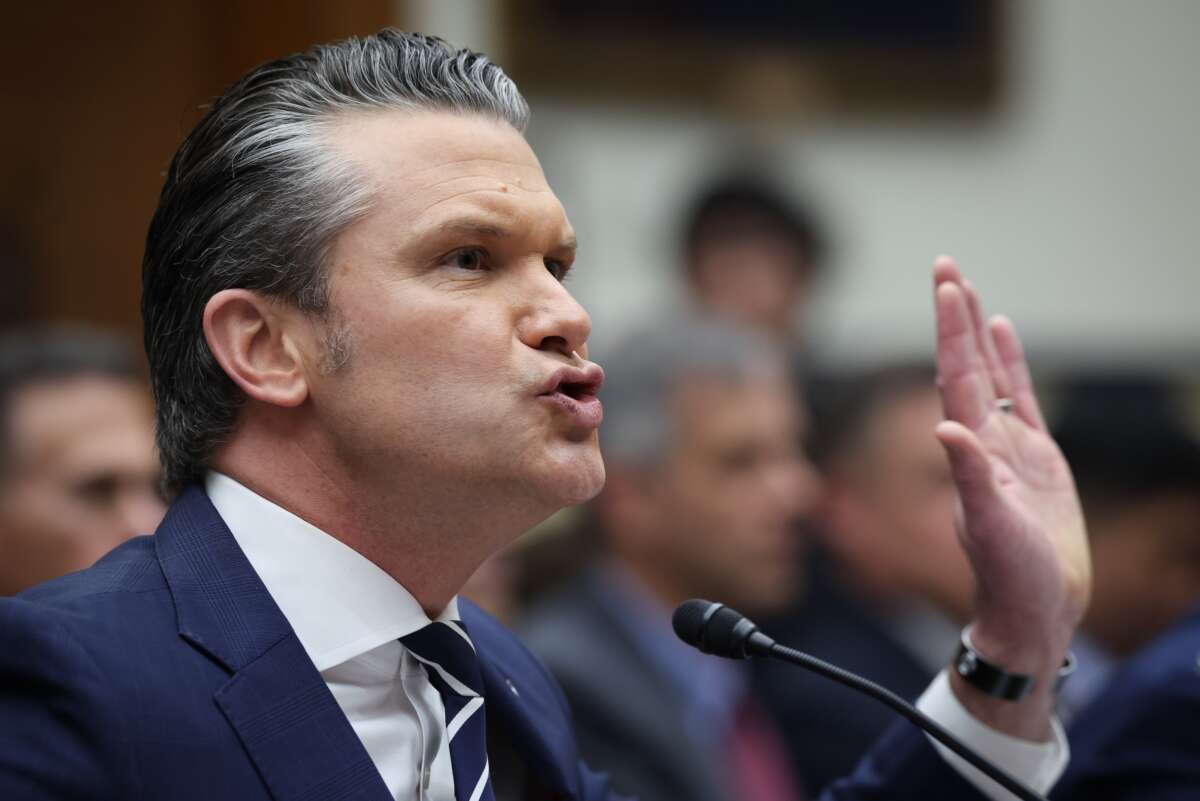
Secretary of Defense Pete Hegseth was grilled about his pledge for the military to commit war crimes by showing “no quarter” to the U.S.’s enemies in a congressional hearing on Wednesday.
Democratic Rep. Seth Moulton (Massachusetts) brought up a statement Hegseth made in a press conference on March 13, just two weeks into the U.S.-Israeli war on Iran.
“You said, ‘We will give them no quarter, no mercy.’ An order for no quarter, or no survivors, is a war crime under the Geneva Conventions. You understand, that’s murder. Do you stand by that statement?” Moulton asked.
Indeed, numerous legal experts noted at the time that such an order is a war crime and is also barred under U.S. military code, potentially exposing him to criminal liability. Hegseth has since repeated similar sentiments touting “maximum violence” in the conduct of the war.
“The Department of War fights to win. And we ensure that our warfighters have the rules of engagement necessary to be as effective militarily as possible,” he said.
Moulton shot back, pointing out that the Trump administration has tried to prosecute Democrats for sedition over a video they put out reminding soldiers of their legal obligation to disobey clearly unlawful orders.
“For insinuating that the laws that we gave them are unlawful,” Hegseth said, smirking.
The short video did not say that any of the Trump administration’s specific orders were unlawful, but the lawmakers did publish it around the start of the administration’s boat strike campaign, which legal experts, including UN human rights experts, have said are illegal. Before the first attack in that campaign, Hegseth gave the order to ensure that nobody was left alive, reports found, spurring the military to carry out a second strike to kill the survivors of the first one.
Moulton also questioned Hegseth on the purpose of the war, which Democrats have repeatedly said has not been laid out clearly by the Trump administration.
Hegesth said that the purpose of the war is to destroy Iran’s “ambitions” to obtain a nuclear weapon — something that Iranian leaders have not pursued, according to U.S. intelligence assessments. It’s unclear how a bombardment campaign and genocidal threats could destroy “ambitions.”
“Their nuclear facilities have been obliterated,” Hegseth said. When Moulton pushed back, pointing out that the administration has claimed that there was an “imminent” threat of nuclear weapons from Iran, Hegseth said, “they had not given up their nuclear ambitions, and they had a conventional shield of thousands of missiles.”
“So Operation Midnight Hammer accomplished nothing of substance, we’re in exactly the same place as we were before,” Moulton said.
During his opening statement, however, Hegseth said that the Pentagon’s “biggest adversary” now is the administration’s detractors in Congress because the U.S. already has the “best negotiator in the world” pursuing a deal with Iran. He did not specify to whom he was referring.
“The biggest challenge, the biggest adversary we face at this point are the reckless, feckless, and defeatist words of congressional Democrats and some Republicans,” he said.
In the hearing on the Pentagon’s $1.5 trillion budget request, Democrats on the House Armed Services Committee also confronted Hegseth about the costs of the war with Iran.
According to the Pentagon’s acting comptroller, the war has cost $25 billion so far. It’s unclear if this estimate is comprehensive; last month, Pentagon officials told lawmakers that the first six days alone cost over $11.3 billion, not including costs like the buildup prior to the war, which could be extensive.
“How much did it cost American taxpayers in terms of the strike to the Iranian school where kids were killed? Do you have that number in terms of the missiles we used?” asked Rep. Ro Khanna (D-California), referring to the strike on a primary school in Minab, Iran, in which 155 people were killed, including 120 children, according to Iranian media.
“As I’ve said, that unfortunate situation remains under investigation,” Hegseth responded, “but I wouldn’t tie a cost to that.”Analysts have found that the strike, on February 28, was carried out by a U.S. Tomahawk missile, which cost about $3.6 million each. The U.S. fired over 850 Tomahawk missiles in the first month of the war.
An urgent fundraising appeal: 24 Hours to raise $21,000
Truthout is one of only a few platforms for justice-oriented, grassroots journalism. Today, we face an existential threat.
Due to Google’s launch of AI search, we’ve seen a drastic plunge in our site traffic and, as a result, our revenue. We lost 15 percent of our readership overnight. This was a readership we painstakingly built over decades, and it vanished because Google chose corporate greed over a healthy democracy.
We are fundraising right now to meet our basic operating expenses. If you can support Truthout with a one-time or monthly donation, you will make a significant impact on our work. Anything you can do makes a difference — we appreciate your support.