Truthout is a vital news source and a living history of political struggle. If you think our work is valuable, support us with a donation of any size.
The world’s top megabillionaires — a list dominated by Big Tech and Wall Street barons — enjoy a gamut of luxuries that are unfathomable for most of us.
Jeff Bezos owns a half-billion-dollar superyacht. Mark Zuckerberg’s portfolio of lush properties that stretches from Palo Alto to Miami Beach is worth nearly as much. Elon Musk’s wealth roughly equals the gross domestic product of Ireland or Belgium. Larry Ellison owns virtually an entire Hawaiian island.
Meanwhile, communities across the U.S. facing the construction and operation of hyperscaled data centers — from Tucson, Arizona, to Memphis, Tennessee, from rural Louisiana to Western New York — are confronting rising electric bills, depletion of water resources, loud and constant noise, ecological degradation, and pollutants, with Black and Brown communities historically impacted by environmental racism disproportionately bearing the brunt.
These two realities — the enormous luxuries enjoyed by the world’s top megabillionaires, and the hardships imposed on communities by data centers — are bound together, with the former resting on extraction from the latter.
The very same corporate moguls who rank among the world’s wealthiest people are also among the top profiteers off the data center boom.
The very same corporate moguls who rank among the world’s wealthiest people, enjoying the heights of opulence, are also among the top owners and profiteers off the data center boom. Positioned at the apex of Wall Street and Big Tech power, these data center oligarchs are overseeing the avalanche of data centers that Americans deeply and broadly oppose. While localities across the U.S. resist the impacts of the data center boom, these oligarchs, who have enormous personal ownership stakes in their companies and firms, experience windfall profits that sustain their opulent lifestyles.
Wall Street’s Data Center Megabillionaires
Stephen Schwarzman oversees Blackstone, the world’s top private equity firm, which manages $1.3 trillion in assets. Schwarzman is worth over $40 billion.
Blackstone invests in a diverse array of sectors, from housing and health care to energy and retail. But in recent years, like other Wall Street firms, it’s been making large investments in AI and data centers.
Blackstone claims to be “the largest data center provider in the world,” with a $110 billion global data center portfolio. It owns QTS, one of the top data center colocation providers — which lease out data center space to client servers — and is steadily striking new data centers deals in the U.S. and around the world, and across the whole AI supply chain.
Schwarzman is raking in wealth from Blackstone’s operations: He took in a whopping $1.24 billion in 2025 alone.
Schwarzman has a history of deploying his vast wealth to enjoy multimillion-dollar birthday bashes — replete with live camels, trapeze artists, and celebrity performers — and gobble up expensive properties from Palm Beach to the English countryside. In Newport, Rhode Island, Schwarzman has been causing major headaches for his neighbors as he redevelops his mansion — called “Miramar” — that he purchased for $27 million in 2021.
In Palm Beach, Schwarzman has a fellow Wall Street data center billionaire as a neighbor: Henry Kravis, co-founder and longtime public face of KKR, another top global private firm overseeing $758 billion in assets. Kravis is worth over $12 billion.
Like Blackstone, KKR is splurging on the entire data center supply chain. It co-owns CyrusOne, another top data center developer, with over 50 facilities across the U.S., Europe, and Japan.
KKR is also raking in superprofits from data center cooling and energy projects to service data centers, among other data center-tied investments.
Around a decade ago, Kravis owned the seventh-most expensive home among Wall Street barons: a 26-room Park Avenue compound valued at $80 million (though he was outdone by Schwarzman, who held the top spot with a $120 million home). In 2020, Kravis made a cool $45 million by selling his 4,600-acre Colorado ranch to fellow billionaire Michael Bloomberg.
In June, Sen. Elizabeth Warren sent letters — which cited Truthout reporting — to both Blackstone and KKR expressing “concern about private equity firms’ increased involvement in the development and operation of data centers” and requesting answers to a range of questions.
Data Center Tech Oligarchs
Big tech companies that are driving the AI boom have their own archipelago of hyperscaled data centers and also purchase extensive server space from data center colocation firms.
Tech oligarchs like Amazon’s Jeff Bezos, Meta’s Mark Zuckerberg, and Oracle’s Larry Ellison — a trio worth nearly $650 billion — sit at the heights of Big Tech’s expanding data center empire.
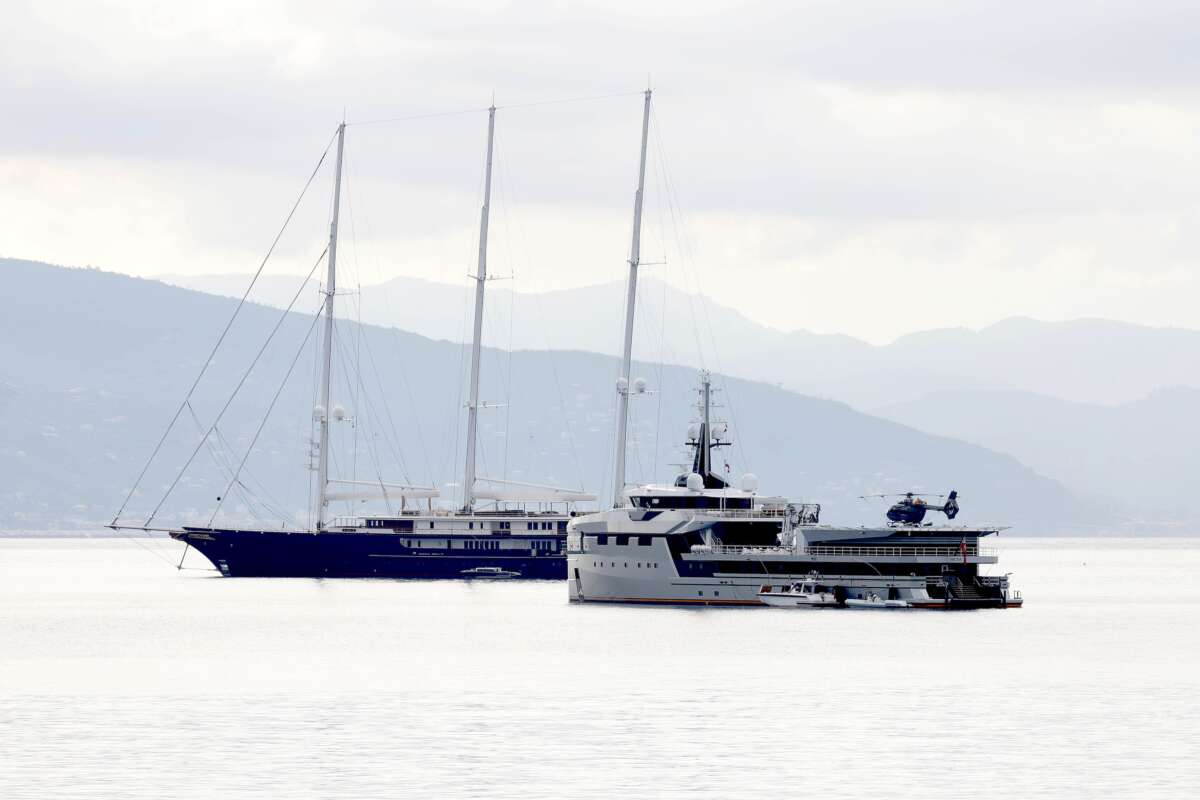
Bezos owns a 417-feet superyacht named “Koru” that’s worth $500 million. It has three jacuzzis and a swimming pool.
Amazon is consistently ranked as the world’s top data center company. According to Bloomberg, as of 2025, Amazon’s “data center operation” consisted of “more than 900 [data center] facilities in more than 50 countries.” Meta also steadily ranks among the very top data center corporations, with 28 data centers in the U.S. alone. Amazon also chairs the Data Center Coalition, a powerful data center industry group, and Meta is also a board member (as is Blackstone’s QTS and KKR’s CyrusOne).
Both Bezos and Zuckerberg enjoy luxuries that are unimaginable to the communities that house their noisy, fossil fuel-burning data centers.
Bezos owns a 417-feet superyacht named “Koru” that’s worth $500 million. It has three jacuzzis and a swimming pool, which have made it ideal for throwing parties with tycoons like Bill Gates and celebrities like Katy Perry and Kim Kardashian. The superyacht is also joined by a second 250-foot “support yacht” named “Abeona” with a helipad. (Bezos has his own fleet of helicopters and private jets.)
For his part, Zuckerberg, who also flies in his own luxurious air fleet, owns a $300 million superyacht with a 387-foot launchpad. The Meta founder recently caused a stir when the superyacht passed by Seattle the same day Meta announced it was slashing around 1,400 jobs in Washington state.
Together, Bezos and Zuckerberg own a property portfolio worth well over $1 billion. For Bezos, this includes myriad homes in Seattle; Manhattan; Washington, D.C.; and Miami, among others.
Zuckerberg, who also flies in his own luxurious air fleet, owns a $300 million superyacht with a 387-foot launchpad.
In 2020, Bezos paid a record $165 million for a Beverly Hills mansion with “expansive terraces, sprawling gardens, several guest houses, a tennis court and its own 9-hole golf course.” In 2021, he bought a $78 million Maui estate that one realtor referred to as a “trophy property.”
In 2025, as Amazon was helping to accelerate the data enter boom, Bezos splurged an estimated $50 million on his star-studded wedding to Lauren Sanchez.
For his part, Zuckerberg owns a slew of properties that includes a massive estate in Kauai, Hawaii, with two mansions with a combined 57,000 square feet, 30 bedrooms and 30 bathrooms, a tennis court and multiple swimming pools, and a 5,000-square-foot underground shelter.
Zuckerberg also owns a Lake Tahoe compound, a Miami Beach estate, and a Washington, D.C. mansion, as well as a complex of adjacent Palo Alto homes.
Island Compounds and Trillionaires
Larry Ellison, the megabillionaire founder and chairman of Oracle, the database software and cloud computing giant, is also cashing on the data center and AI boom. Ellison is among the world’s top 10 wealthiest people, with his current net worth hovering close to $180 billion.
Oracle is building an empire of water-guzzling data centers and AI partnerships. According to Data Centre Magazine, the Oracle Stargate AI Initiative — working with Sam Altman’s OpenAI in a Trump-backed deal — is the second-fastest-growing data center company.
Ellison owns properties worth around $2 billion in total. In addition to mansions and estates in Florida, California, Rhode Island, Japan, England, and elsewhere, Ellison also owns virtually all of Lānaʻi, Hawaii’s sixth-biggest island.
According to a recent Wall Street Journal report, Ellison is also a poster child for the rising phenomenon of megabillionaires’ “quest to optimize one’s land holdings by acquiring more acreage” and gobbling up entire blocks or swaths of residential land.
Like other data center billionaires, Ellison also enjoys hundreds of millions of dollars’ worth of luxuries such as a superyacht and private jets, as well as a collection of art and artifacts that include Vincent Van Gogh paintings and historic Japanese artwork. (Ellison also owned a Japanese villa reportedly worth $86 million.)
And of course, there’s Elon Musk, the first trillionaire, whose wealth has been built, in part, on data centers. Musk’s wealth is roughly equal to the GDP of the states like Pennsylvania or Ohio and nations like Switzerland — or, around 3 percent of the entire U.S. GDP.
Musk owned seven mansions worth around $100 million that he claimed to sell as he settled into a more spartan adobe. But reports indicate that he’s been staying in and buying up lavish homes in Texas.
Musk has directed his massive wealth more toward intervening in politics. He spent a whopping $291 million on federal elections in 2024, making him by far the top donor in the last election cycle, and leading to his appointment by Donald Trump as the (now former) head of the so-called Department of Government Efficiency (DOGE).
Backland Against Data Centers Growing
While the data center oligarchs benefit from massive revenues undergirded by the data center boom they’re driving, they’re also facing an enormous, expanding wave of resistance from localities across the U.S. — regularly reported on by Truthout— that crosses partisan lines and is reaching the heights of state and national politics.
Polling shows that people in the U.S. overwhelmingly oppose data centers. In mid-July, communities staged at least 142 protests across 42 states against data centers. Black and working-class organizers in cities like Memphis and across the U.S. South are driving the opposition to some of the largest and dirtiest datacenter complexes in the entire nation.
This bottom-up insurgency has moved some elected officials to propose a federal moratorium on data centers. Support for state-level moratoriums is also rising. In July, Gov. Kathy Hochul, responding to constituent pressure, made New York the first state to implement a moratorium on new data centers. (Hochul’s executive order implements a “one-year pause.”)
With opposition to the data center boom and skepticism toward the corporate-driven AI bubble only growing, we will likely see more victories like this, as people fight for communities rooted in justice and sustainability, not as sites for extraction to help oligarchs purchase yet another superyacht or mansion.
Important Message: Please Read
For 25 years, Truthout has survived by publishing impactful investigative journalism and analysis; distributing full editions 365 days a year; and building a community of readers who support us with small, hard-earned donations.
Eighty percent of our $3 million yearly budget comes from small donors alone. Of those, 8,000 readers support us with monthly donations. Back in 2018, when Facebook decided to suppress the circulation of posts made by organizations, thereby cutting readers off from seeing many articles shared by the news organizations they had intentionally decided to follow, Truthout’s total traffic declined by 40 percent, as nearly all of our traffic from that platform disappeared.
Now, Google has recently rolled out its AI search bar, providing AI summaries instead of directing readers to our site. Google Search is our single largest source of traffic; it’s the route by which nearly one third of our readers find us. Much like in 2018, a shocking 40 percent of our Google traffic has disappeared overnight.
It will not be easy for Truthout to shoulder this blow. Nor will it be easy for our peers and collaborators — news sites that depend on traffic and aren’t bankrolled by large corporations.
If you can support Truthout with a donation today, you can help us resist the AI onslaught. Please give today.