Did you know that Truthout is a nonprofit and independently funded by readers like you? If you value what we do, please support our work with a donation.
As the diarrhea-causing cyclospora parasite continues to spread through the U.S., now having sickened an estimated 11,500 Americans in at least nine states since May, it is becoming increasingly clear that the situation has been massively worsened by the actions of the “Department of Government Efficiency” (DOGE) over the past 18 months.
CNN reported last week that cuts to the Centers for Disease Control and Prevention (CDC) have created a “perfect storm” in which the outbreak could go from a minor inconvenience to a national public health crisis within a matter of weeks. DOGE cut eight of the 11 jobs at the CDC lab specializing in cyclospora. Meanwhile, the rapid dismantling of the U.S. Agency for International Development (USAID), which shared facilities and personnel with the State Department and CDC, also led to the loss of many of the experts and labs dealing with exotic diseases stateside, such as cyclospora. Take down USAID — an act that DOGE marketed as being about snuffing out supposedly bloated foreign aid programs — and there’s a guaranteed impact on the CDC and on the health of Americans stateside.
Add in additional cuts to a range of CDC offices, and the result is a disaster in the making.
Dan Jernigan, former director of the CDC’s National Center for Emerging and Zoonotic Infectious Diseases, told Truthout that the CDC’s Division of Parasitic Diseases and Malaria lost much of its funding, as did the CDC’s office for neglected tropical diseases. While those offices didn’t directly fund cyclospora research, many of their scientists had specialty knowledge of parasites such as the one that causes cyclospora — and could be called on to share that knowledge during an outbreak.
DOGE cut eight of the 11 jobs at the CDC lab specializing in cyclospora.
The Division of Parasitic Diseases and Malaria has “taken a hit because of DOGE[’s] USAID cuts and the hiring freeze [for the CDC],” notes Jernigan. “Because of that, there were fewer people to respond to the cyclospora outbreak when it was first detected.”
Taken as a whole, the result of the assault on USAID and on the CDC is that under-resourced, under-staffed labs are struggling to test all the samples that need to be tested for cyclospora to stop the spread of the parasite and to work out its origins — for while the largest outbreak has been traced to iceberg lettuce from a facility in central Mexico run by produce giant Taylor Farms, multiple cyclospora investigations are also underway for other outbreaks spread by as-yet-unidentified sources.
Jernigan, who resigned last year after the Trump administration fired the CDC director, estimates that 73 scientists at the CDC were being funded by USAID dollars before DOGE’s cuts. Today, only 38 of those scientists remain at the agency. Labs that could monitor cyclospora aren’t fully functional; many contractors have lost their government contracts; and so-called Title 42 hires — scientists hired on renewable short-term contracts — have had their appointments lapse.
Seventy-three scientists at the CDC were being funded by USAID dollars before DOGE’s cuts. Today, only 38 of those scientists remain at the agency.
The result is chaos. Put simply, the U.S. government’s top public health agencies are struggling to mount an effective response in the face of emerging biological threats. Indeed, in many instances, the government has simply abandoned the field.
Under Robert F. Kennedy Jr.’s leadership, the CDC’s FoodNet partnership with the Food and Drug Administration, U.S. Department of Agriculture, and 10 state health departments no longer mandates the tracking of cyclospora, focusing only on salmonella and E. coli outbreaks. This makes it harder both to identify an outbreak in its early stages and to track its development and push for successful interventions.
In 2025, the federal government slashed $11 billion in funds for state and local public health systems. Not surprisingly, even big states such as California are struggling mightily to plug these funding holes — a situation made worse by explicitly political efforts by the Trump administration to withhold medical and research dollars from blue states as punishment for not toeing the line on immigration and other policies.
A year ago, as I was writing on the DOGE purges for my book American Carnage, one of the fired federal workers whom I spoke with told me that he and his colleagues kept coming back to a single phrase: “Fuck around and find out.” If you cut federal government services to the bone, he explained, eventually the consequences will be extreme. We are seeing that now in the realm of public health: Since Donald Trump got back into power and unleashed DOGE on the federal workforce, the dismantling of public health infrastructure has led to the U.S.’s worst measles outbreak in decades; escalating numbers of whooping cough cases among children; the reemergence, after 60 years in which it had been eliminated, of screwworm within the country’s cattle herds; and now, a cyclospora outbreak that has sent thousands to hospital and that shows no sign of ending anytime soon.
If you cut federal government services to the bone eventually the consequences will be extreme. We are seeing that now in the realm of public health.
Overseas, as I reported for Truthout earlier this year, the CDC monitoring systems that could have detected, early on, the ongoing Ebola outbreak, were largely shuttered — leading to an uncontained outbreak that now impacts many countries in central Africa.
Polio, which since the early 1990s has been almost entirely eliminated globally, is also making a comeback, albeit still of a limited nature, in countries no longer assisted by USAID medical expertise and vaccine distribution. Many of these countries are also receiving less funding from the U.K., which historically has been a huge funder of polio vaccination campaigns but is scaling back its foreign aid commitments in the face of relentless pressure from the Trump administration to divert funds to military spending.
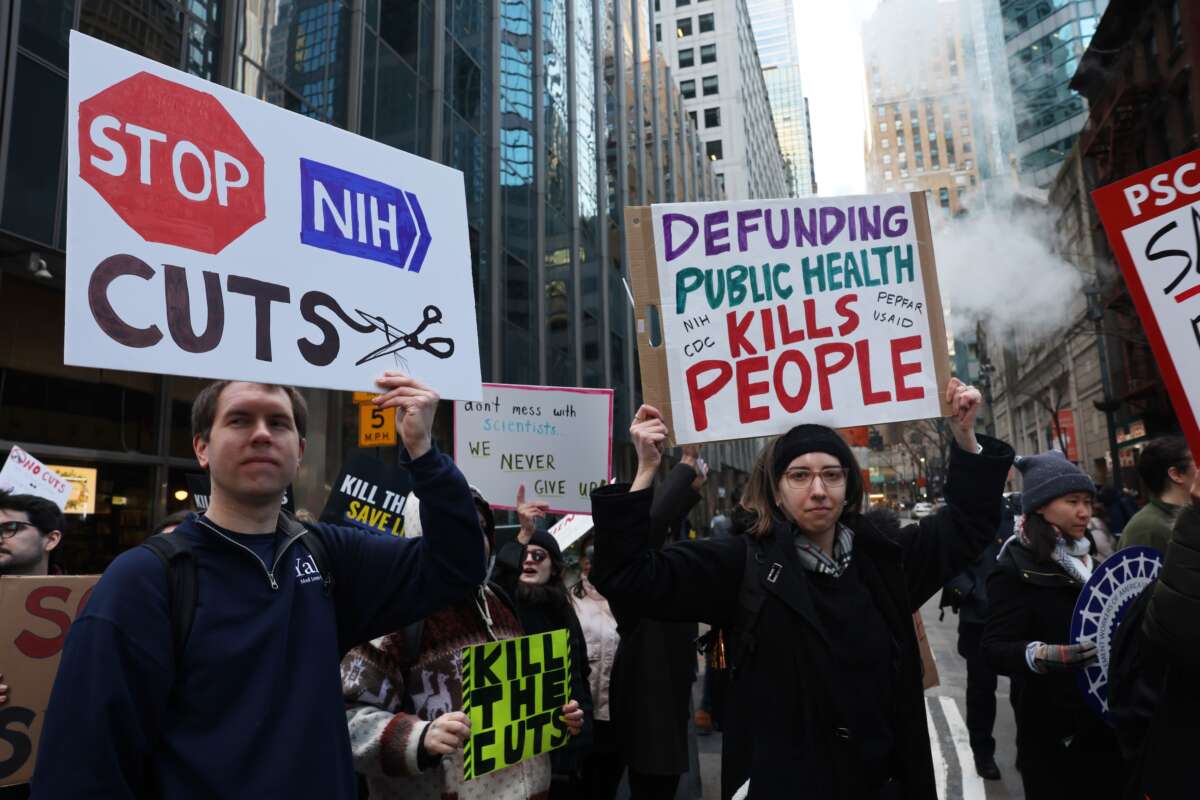
Taken as a whole, these cascading public health crises point to a system that is being bent to the breaking point. On top of that, the Trump administration’s revision of rules for federal grants and increased scrutiny of projects funded by the National Institutes of Health makes it extraordinarily hard for universities and research teams to staff their laboratories. Without a steady stream of grants, “we essentially have to turn the lights off,” Sarah Ewald, associate professor of immunology, microbiology, and cancer biology at the University of Virginia, explained to Truthout. “There’ve just been massive delays in terms of funding for basic research.” As a result, it has become harder for clinicians and researchers to work out the “frequency of disease incidences and whether they’re reaching outbreak levels.”
Making a bad situation worse, disease outbreaks are taking place in the months after the Trump administration succeeded in convincing the GOP majority in Congress not to vote to extend Affordable Care Act (ACA) credits, leading to more than 2.6 million people losing their ACA health insurance coverage. In consequence, cyclospora victims who have lost insurance now may need to fall back on visits to the emergency room for treatment.
By any measure, all of this is an extraordinarily expensive and ineffective way for the world’s richest nation to deal with a foodborne disease outbreak. Trump and RFK Jr. promised to “make America healthy again.” They are, it is now clear, falling woefully short in realizing this promise.
Important Message: Please Read
For 25 years, Truthout has survived by publishing impactful investigative journalism and analysis; distributing full editions 365 days a year; and building a community of readers who support us with small, hard-earned donations.
Eighty percent of our $3 million yearly budget comes from small donors alone. Of those, 8,000 readers support us with monthly donations. Back in 2018, when Facebook decided to suppress the circulation of posts made by organizations, thereby cutting readers off from seeing many articles shared by the news organizations they had intentionally decided to follow, Truthout’s total traffic declined by 40 percent, as nearly all of our traffic from that platform disappeared.
Now, Google has recently rolled out its AI search bar, providing AI summaries instead of directing readers to our site. Google Search is our single largest source of traffic; it’s the route by which nearly one third of our readers find us. Much like in 2018, a shocking 40 percent of our Google traffic has disappeared overnight.
It will not be easy for Truthout to shoulder this blow. Nor will it be easy for our peers and collaborators — news sites that depend on traffic and aren’t bankrolled by large corporations.
If you can support Truthout with a donation today, you can help us resist the AI onslaught. Please give today.