Honest, paywall-free news is rare. Please support our boldly independent journalism with a donation of any size.
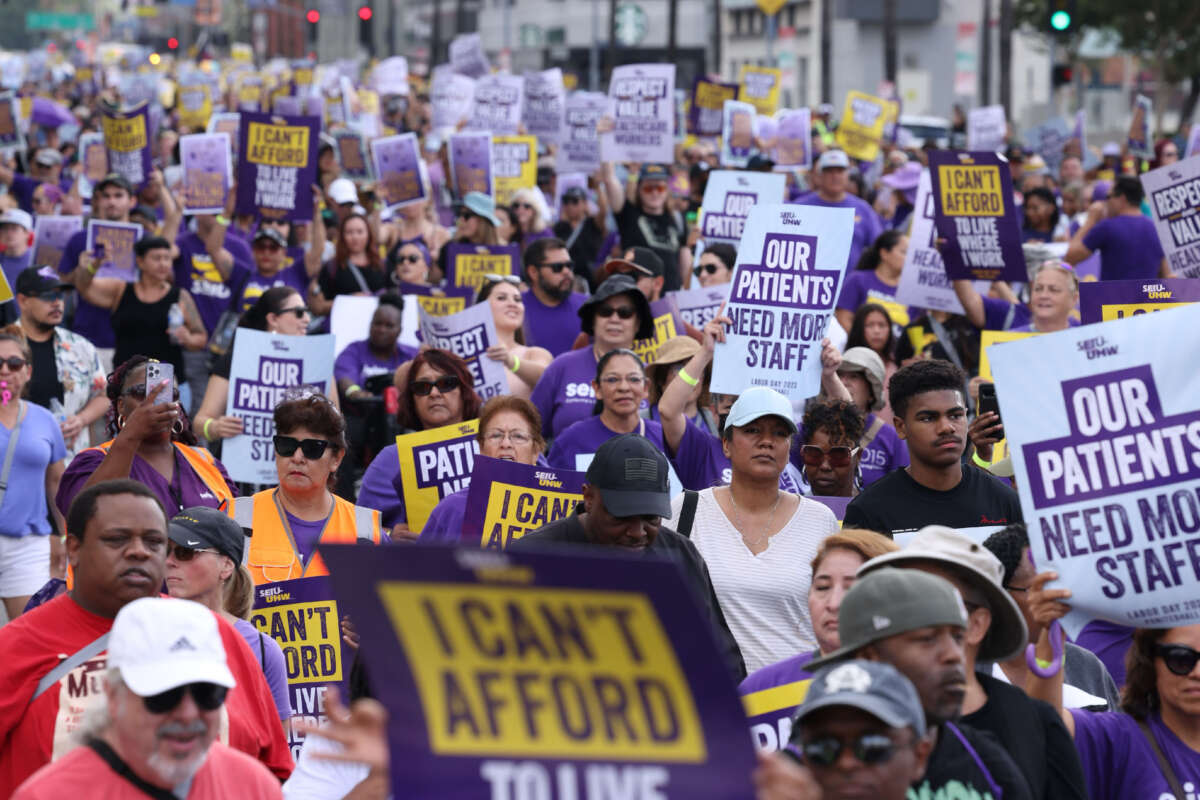
Over 75,000 health care workers for Kaiser Permanente hospitals across the country began striking on Wednesday morning, launching what the union says is the largest health care strike in U.S. history after workers’ contract expired on Saturday with no new agreement in place.
The striking workers are largely concentrated in California, though thousands of workers have also walked out in Oregon, Washington and Colorado for a planned three-day strike. Meanwhile, roughly 400 workers in Washington, D.C. and Virginia are walking out for one day. Striking employees include vocational nurses, emergency department, X-ray and radiology technicians, sonographers, pharmacists, and more.
Like workers in many other recent health care strikes, Kaiser workers are frustrated with issues of understaffing, saying that Kaiser management seems to neglect patient care in favor of profits. Employees have reported being overworked and unable to properly address all of their patients’ concerns due to high patient loads and strict time constraints.
“Kaiser executives are refusing to listen to us and are bargaining in bad faith over the solutions we need to end the Kaiser short-staffing crisis,” Jessica Cruz, a licensed vocational nurse for Kaiser Los Angeles Medical Center, said in a statement.
“I see my patients’ frustrations when I have to rush them and hurry on to my next patient. That’s not the care I want to give,” Cruz continued. “We’re burning ourselves out trying to do the jobs of two or three people, and our patients suffer when they can’t get the care they need due to Kaiser’s short-staffing.”
Unions representing the workers are also fighting for higher pay, and in August asked for a $25 per hour minimum wage with raises of 7 percent in the next two years and 6.25 percent in the following two years. Kaiser has countered minimum wages of $21 and $23 an hour, depending on location, and last month proposed a two-tier wage system. The unions argue that higher wages across the board could attract more workers and help ease worker shortage issues.
The pandemic has had a huge impact on health care staffing levels across the country, and the industry has yet to bounce back. As a result, Kaiser workers say that they’ve been operating at staffing levels far lower than before the pandemic for years; Keven Dardon, a patient access representative in Clackamas, Oregon’s Sunnyside medical center, told The Guardian that his department was cut from 60 employees to 40 during the pandemic, and patients are now having to deal with long lines and delays when checking into appointments.
“It’s really taken a toll in the hospital setting and in the medical offices that we have here,” Dardon said. “That’s what we’re fighting for. Our frontline employees are demanding Kaiser Permanente executives come to the table, we’ve proposed the things that would fix the staffing issue, we’ve made tons of proposals, but because our executives just aren’t listening to us, they are just not coming to the table to even entertain those proposals.”
The Coalition of Kaiser Permanente Unions, a group of unions representing Kaiser workers, says that Kaiser executives could fix these problems if they chose to. In the first six months of this year alone, Kaiser Permanente made $3 billion in profit, and has reported making over $21 billion in profits over the last five years. Meanwhile, 49 of its executives are paid more than $1 million in salary per year.
An urgent fundraising appeal: We have until midnight to raise $17,000
Donations are down for Truthout at a time when media is under immense pressure. Google’s AI search has driven our traffic down by 15 percent, Trump is arresting journalists, and many independent media organizations face heartbreaking cutbacks and closures.
At the same time, movement media is vital in the fight against Trump’s authoritarian reign. Our mandate to tell the truth, share strategies for resistance, and speak against fascism is ever more urgent in this deluge of political censorship and misinformation. Yet, we are struggling to meet our publishing costs when our work is so urgently needed.
We are fundraising right now for those basic operating expenses — we must raise $17,000 before midnight. If you can support Truthout with a one-time or monthly donation, you will make a significant impact on our work. Anything you can do makes a difference.