Did you know that Truthout is a nonprofit and independently funded by readers like you? If you value what we do, please support our work with a donation.
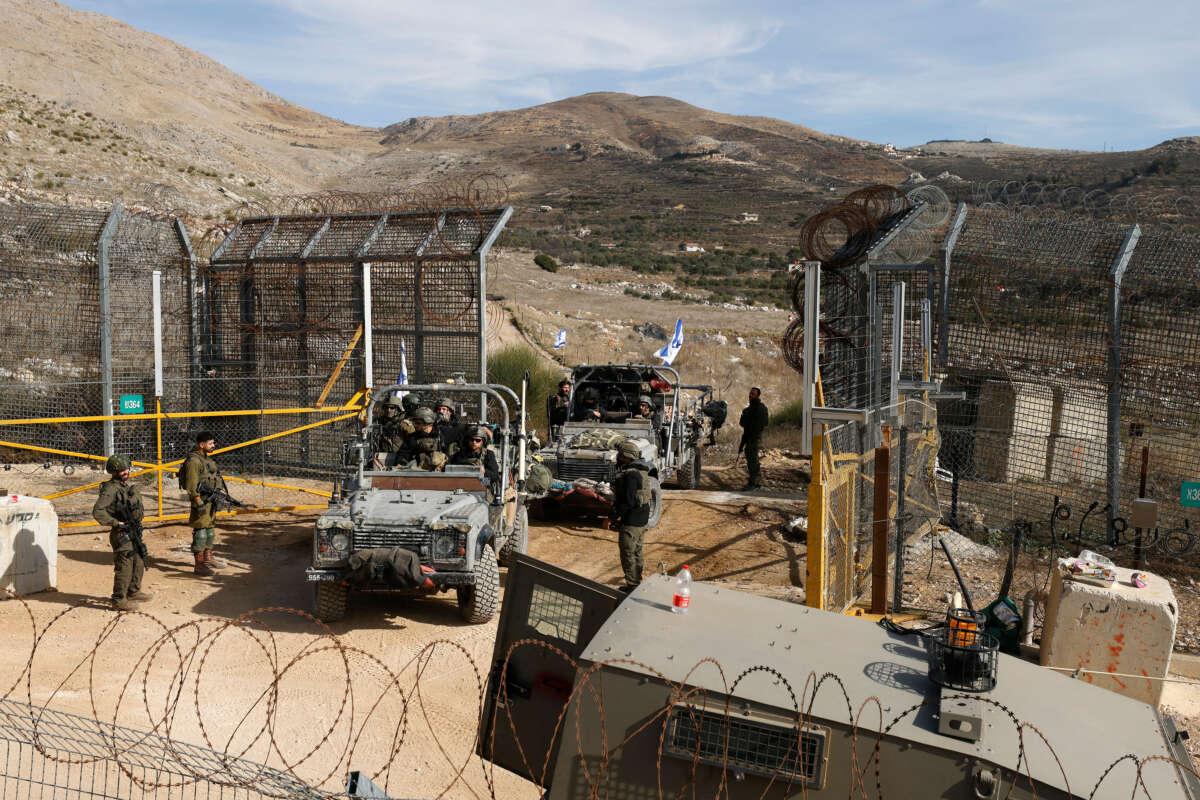
The United Nations’ special envoy to Syria said Tuesday that the Israeli military’s rapid move to seize Syrian territory following the Assad government’s collapse is a grave violation of a decades-old agreement that Prime Minister Benjamin Netanyahu claims is now dead.
“What we are seeing is a violation of the disengagement agreement from 1974, so we will obviously, with our colleagues in New York, follow this extremely closely in the hours and days ahead,” Geir Pedersen said at a media briefing in Geneva.
Hours earlier, Pedersen told Zeteo’s Mehdi Hasan that “this needs to stop,” referring to Israel’s further encroachment on the occupied and illegally annexed Golan Heights.
“This is a very serious issue,” Pedersen said, rejecting Netanyahu’s assertion that the 1974 agreement is null. “Let’s not start playing with an extremely important part of the peace structure that has been in place.”
"The message to Israel is that this needs to stop, What we are seeing in the Golan is a violation of the 1974 agreement. This is a very serious issue."
— Mehdi Hasan (@mehdirhasan) December 9, 2024
The UN's Syria Special Envoy tells me on 'Mehdi Unfiltered' that Israel's unlawful actions in Syria need to stop. pic.twitter.com/G7jSWJ8oP0
Netanyahu, who took the stand for the first time Tuesday in his long-running corruption trial, made clear in the wake of Assad’s fall that he views developments in Syria as advantageous for Israel, writing on social media that “the collapse of the Syrian regime is a direct result of the severe blows with which we have struck Hamas, Hezbollah, and Iran.”
The prime minister also thanked U.S. President-elect Donald Trump for “acceding to my request to recognize Israel’s sovereignty over the Golan Heights, in 2019,” adding that the occupied territory “will be an inseparable part of the state of Israel forever.”
The Washington Post reported late Monday that “within hours of rebels taking control of Syria’s capital, Israel moved to seize military posts in that country’s south, sending its troops across the border for the first time since the official end of the Yom Kippur War in 1974.”
“Israeli officials defended the move as limited in scope, aimed at preventing rebels or other local militias from using abandoned Syrian military equipment to target Israel or the Golan Heights, an area occupied by Israel after the 1967 Arab-Israeli war,” the Post added. “On Monday, more troops could be seen outside this Druze village adjacent to the border, preparing to cross.”
The United States, Israel’s main ally and arms supplier, also defended the Israeli military’s actions, with a State Department spokesman telling reporters Monday that “every country, I think, would be worried about a possible vacuum that could be filled by terrorist organizations on its border, especially in volatile times, as we obviously are in right now in Syria.”
Watch StateSpox justify Israel’s invasion of Syria based on hypotheticals.@shauntandon: Israel has gone across the Golan Heights, the UN said it’s a violation, does the US agree
— Assal Rad (@AssalRad) December 9, 2024
Miller: Every country would be worried about a possible vacuum that could be filled by terrorist… pic.twitter.com/AA7lNhfSt1
On Tuesday, Israel denied reports that its tanks reached a point roughly 16 miles from the Syrian capital as it continued to bomb Syrian army bases.
“Regional security sources and officers within the now fallen Syrian army described Tuesday morning’s airstrikes as the heaviest yet, hitting military installations and airbases across Syria, destroying dozens of helicopters and jets, as well as Republican Guard assets in and around Damascus,” Reuters reported. The U.S. also bombed dozens of targets in Syria in the aftermath of Assad’s fall.
The governments of Iraq, Qatar, Iran, and Saudi Arabia have each denounced the Israeli military’s seizure of Syrian land, with Qatar’s foreign ministry slamming the move as “a dangerous development and a blatant attack on Syria’s sovereignty and unity as well as a flagrant violation of international law.”
“The policy of imposing a fait accompli pursued by the Israeli occupation, including its attempts to occupy Syrian territories, will lead the region to further violence and tension,” the foreign ministry warned.
Media that fights fascism
Truthout is funded almost entirely by readers — that’s why we can speak truth to power and cut against the mainstream narrative. But independent journalists at Truthout face mounting political repression under Trump.
We rely on your support to survive McCarthyist censorship. Please make a tax-deductible one-time or monthly donation.