Truthout is a vital news source and a living history of political struggle. If you think our work is valuable, support us with a donation of any size.
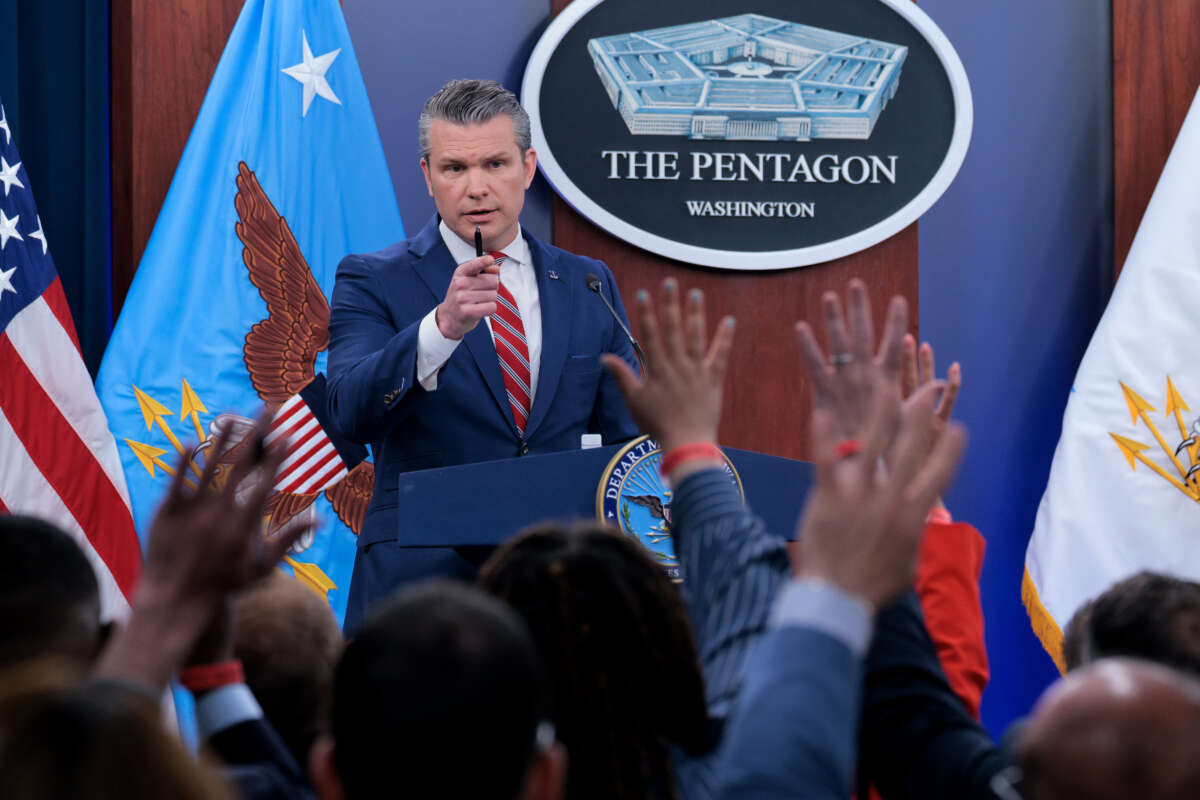
The Trump administration’s “asinine attempts to silence objective journalism just hit a new low,” said one press freedom advocate late Monday after the Pentagon announced that the US Department of Defense would mark its press office as a classified area, banning journalists from the space where they’ve previously talked openly with DOD officials.
Reporters on the military are currently largely banned from the building altogether as litigation is ongoing over the administration’s requirement that journalists have an escort to move about the Pentagon, but the new policy means that should they be able to return, they would be even more limited in their access to public affairs officers whose job it is to keep the press and public informed.
“For multiple administrations, Pentagon reporters have used the press office to meet with public affairs officers and have open conversations about what America’s armed services are doing in order to keep the public informed,” said Ben Grazda, an advocacy manager for Reporters Without Borders North America.
Calling Defense Secretary Pete Hegseth “petulant” and pointing to his unsuccessful demand that journalists sign “loyalty pledges,” Grazda added that “journalists will continue their tenacious reporting and hold the Pentagon accountable for the money, operations, and lives they impact every day.”
The Washington Post reported that Pentagon speechwriters will be moved into the public affairs office, which will be equipped with the Secret Internet Protocol Router Network, or SIPRNet, which is used to transmit classified information.
“This is the most transparent war department in history. No amount of spin from the Fake News media will change that. The Pentagon Press Office has been redesignated as a Sensitive Compartmented Information Facility due to speechwriters from the Office of the Secretary of War sharing the facility,” said Jose Valdez, the acting Defense Department press secretary, on social media on Monday, referring to Hegseth by the title he prefers.
Despite Valdez’s claims, journalists referred to the decision as “Orwellian” and noted that Hegseth is further curtailing press access to the Pentagon as the US is mediating talks to end the war the US and Israel started against Iran in February.
The policy was also announced as The New York Times reported that Hegseth had blocked the promotions of nine Navy officers who had been selected by senior Navy admirals, appearing to “violate the rules governing a promotion system that is supposed to be apolitical and merit-based.”
“Banning journalists from the press office in the Pentagon, where they worked professionally in previous administrations, is simply a sign that current DOD leadership fears accountability,” said Times reporter Trip Gabriel.
The decision to close the press office to members of the press comes eight months after hundreds of journalists walked out of the Pentagon in protest of a new policy barring them from seeking information that the Trump administration had not authorized for release.
That policy was struck down by a federal court earlier this year, but the government has appealed the ruling.
The National Press Club called the Pentagon’s newest policy “a remarkable and troubling escalation in the Defense Department’s ongoing effort to restrict independent reporting.”
“This move does not occur in isolation,” said Mark Schoeff Jr., a reporter at CQ Roll Call and president of the organization. “It follows a troubling pattern of escalating restrictions on Pentagon coverage, including efforts to limit journalists to pre-approved information, revoke credentials for routine reporting practices, and physically remove reporters from long-standing workspaces and access without an escort.”
“Calling a press workspace ‘classified’ does not make the government more transparent,” said Schoeff. “It creates yet another obstacle between journalists and the information Americans have a right to know, especially at a moment when the public needs clear, unfiltered information about the US military.”
“Independent reporting on the US military is not optional,” he added. “When journalists are pushed farther from the institutions they cover, the American people are left with less information, less transparency, and less oversight. Any effort to restrict that access should alarm everyone who values a free and informed society.”
We lost 15 percent of our traffic overnight.
We now have three full months of data since Google changed its search to feature AI results. The numbers are worse than we anticipated. Overall readership that comes to Truthout through Google is down 54 percent against last year. The number of new readers who discover Truthout via Google searches is down 49 percent, and returning users from Google are down 51 percent.
We lost 15 percent of our readership overnight. This was a readership we painstakingly built over decades, and it vanished because Google chose corporate greed over a healthy democracy.
We anticipate a loss of roughly $500,000 in online revenue as a result of this massive traffic plunge in the next year alone.
The only way we can keep publishing is with strong reader support. We are asking you to start a monthly donation to Truthout today — anything you can do, whether $5 or $25, makes a difference.