Truthout is a vital news source and a living history of political struggle. If you think our work is valuable, support us with a donation of any size.
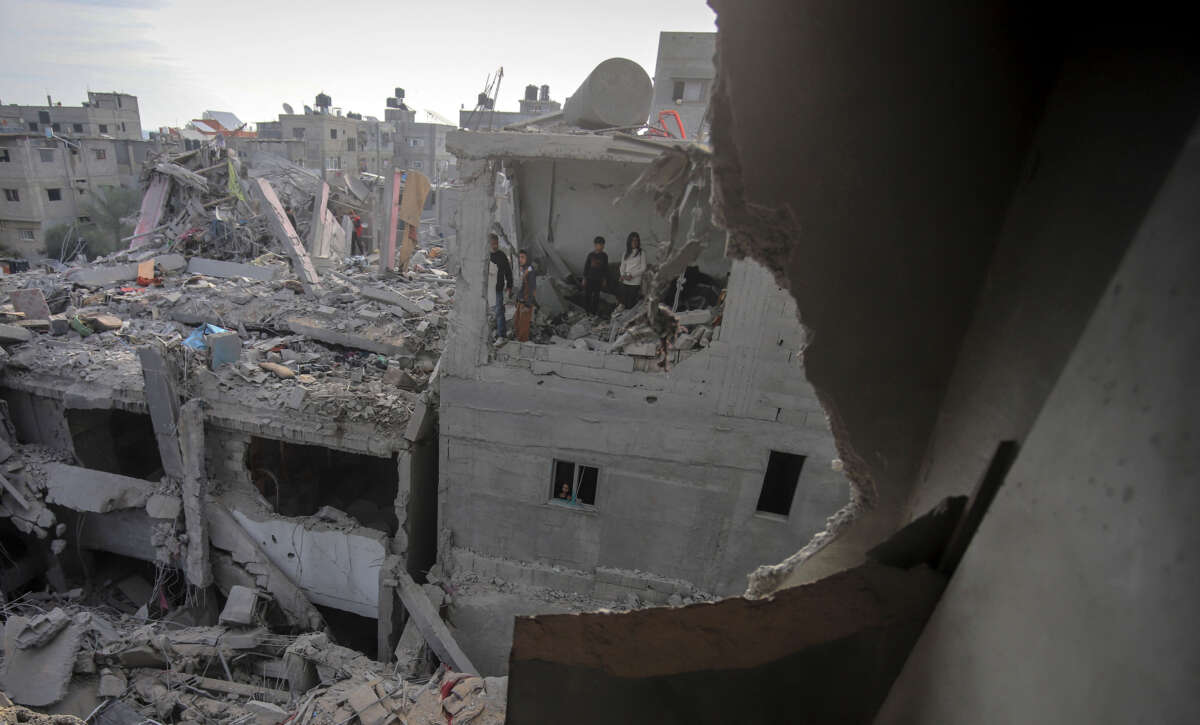
UN groups have warned that food security is “collapsing” across famine-stricken Gaza, with the entire humanitarian aid operation at the brink due to Israel’s severe aid blockade and Israeli-protected gang looting preventing what little aid that enters from reaching starving Palestinians.
The UN Relief and Works Agency for Palestine Refugees (UNRWA) has reported that Palestinians are “in a state of sheer desperation,” with so little food available that two young girls and a woman died in a crowd scrambling to get food recently.
Further, on Monday, Israel attacked a group of people lined up to buy flour in southern Gaza, killing at least 10 people.
The World Food Programme in the Middle East and North Africa has said that the entire humanitarian response in Gaza is “nearing collapse.” UNRWA announced this month that it has had to suspend the use of Gaza’s main humanitarian aid crossing point, Kerem Abu Salem, “due to a total breakdown of law and order.”
Reports have found that looting gangs in Gaza are being either passively or actively protected by Israeli forces, operating in areas that are otherwise controlled by Israel as military zones. This has led to widespread looting of and violence against aid convoys; the UN says that, in November, 90 percent of the only 109 aid trucks Israel allowed through the crossing were looted as soon as they entered the besieged territory.
The looting is exacerbating Israel’s extreme aid blockade. Last month, Israel only allowed an average of 65 trucks into Gaza per day — a fraction of the 500 to 600 trucks that humanitarian groups say is needed per day to meet the population’s basic needs.
International food authorities said last month that famine is likely already occurring or will occur in the near future in Gaza, especially in north Gaza, where Israel is carrying out a horrific ethnic cleansing campaign. Last week, UN Food and Agriculture Organization head Beth Bechdol noted that food access is at an “all-time low” across the Gaza Strip.
UNRWA has reported that the UN tried to reach Palestinians in north Gaza with aid 53 times in November; of these missions, 48 were denied by Israeli authorities, while five were approved but “severely impeded on the ground.” Only one set of food aid was able to enter, along with the only humanitarian mission that was allowed to reach Kamal Adwan Hospital in north Gaza in two months.
Without an influx of food and other crucial aid like fuel, yet more Palestinians will die from starvation, disease and other preventable causes. Gaza officials cannot account for most deaths due to starvation, but U.S. health workers back from missions to Gaza estimated in October that over 60,000 Palestinians have died from starvation, with that figure likely higher due to Israel’s eliminationist campaign in north Gaza.
Families in Gaza are also now facing a winter without proper supplies. According to the UN, humanitarian agencies have only been able to meet the needs of 23 percent of people in Gaza needing cold weather aid. This has left 945,000 people at risk of cold weather exposure, lacking simple items like tents, clothing, and heating materials.
25 Years of Truthout: An important fundraising appeal
This September, Truthout is celebrating 25 years of publication. For over two decades, we have been a trusted source for fiercely independent journalism thanks to readers like you.
As we look to the next 25 years, we have launched a special fundraising campaign. Looking to a sustainable future for our publication, we have a fundraising goal of $79,000 in the next 6 days.
We are asking for your support at this juncture because we face greater threats than ever before in our organizational history. Trump and his MAGA allies are determined to control the information ecosystem, and movement-based organizations are subject to dangerous censorship and scrutiny.
If you can support Truthout with a one-time or monthly donation, you will make a significant impact on our work and our legacy. Anything you can do makes a difference!