Part of the Series
Struggle and Solidarity: Writing Toward Palestinian Liberation
Honest, paywall-free news is rare. Please support our boldly independent journalism with a donation of any size.
Palestine solidarity activists in the U.K. are gearing up for a mass protest this Saturday against the country’s ban on Palestine Action — a direct action network that the British government has deemed “proscribed” under its anti-terrorism laws, despite the fact that the activist network engages in protest acts that do not harm people.
According to the U.K.-based activist group Defend Our Juries, at least 1,500 people have already signaled their willingness to risk arrest at the October 4 demonstration in London.
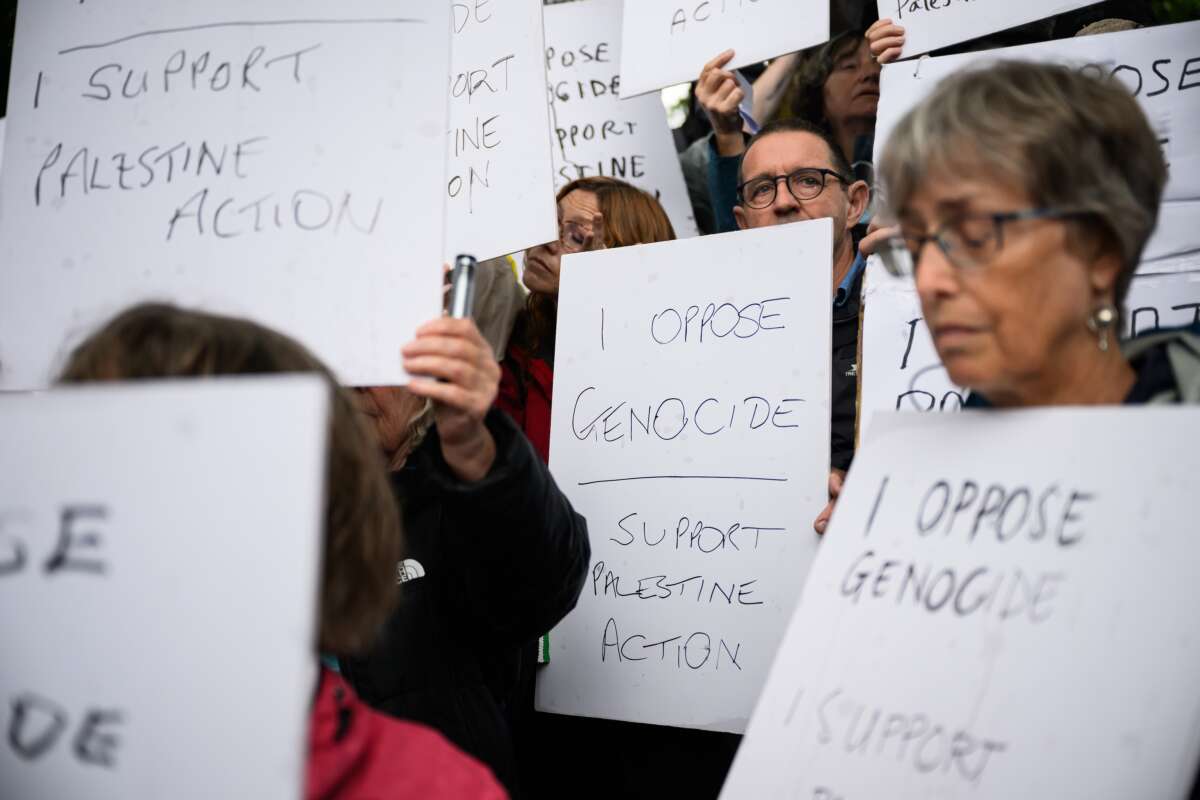
According to The Guardian, “More than 1,600 people have been arrested since the ban under the Terrorism Act came into effect on July 5, mainly for holding signs reading: ‘I oppose genocide, I support Palestine Action.’”
Most recently, on September 6, 2025, London’s Metropolitan Police arrested 890 people at a demonstration in support of the banned direct action group.
Palestine Action was founded in 2020 to prevent violations of international law by Israel. As a direct action-oriented activist network, it targets arms companies which supply the Israeli war effort. Often it sends activists into the factories, where they carry out acts of property destruction against the machines they find there. Typically, the members of the group then assemble in some public place — perhaps the roof over the works building — and let off flares, hoping to be photographed and spread awareness about the protest.
On June 20 of this year, two supporters of the group entered an air force base at Brize Norton and sprayed red paint on two aircraft. Two weeks later, the British government, which has been using anti-terror laws since 2023 to limit pro-Palestinian speech, went one stage further and proscribed Palestine Action. The effect of proscription is that anyone who belongs to Palestine Action or invites support for it or expresses an opinion supportive of it, or arranges or addresses a meeting to support Palestine Action is committing a criminal offense, carrying a maximum of 14 years’ imprisonment.
The effect of proscription is that anyone who belongs to Palestine Action or invites support for it is committing a criminal offense, carrying a maximum of 14 years’ imprisonment.
There was no fighting at the September 6 demonstration, and not one person was injured. The police had indicated that if protesters carried placards supporting Palestine Action, they would be arrested. More than 1,000 demonstrators sat on the grass, holding up handwritten signs that said: “I oppose genocide. I support Palestine Action.” Those arrested included nurses, Anglican priests, and the former editor of the doctors’ magazine, the British Medical Journal. They waited without grumbling in the hot summer sun, ageing limbs made painful by the police’s slow processing of the crowd.
One demonstrator had brought a t-shirt gently mocking the proscription: It read “Plasticine Action” and bore an image of the shape-changing comic figure from British 1980s children’s TV, Morph. He was repeatedly photographed by the police but not arrested.
Beside those displaying the main handwritten sign, there are other protesters whom the police have arrested but not yet decided whether to charge (under U.K. criminal law, the police have six months after arrest in which to make that decision. As of September 5, only 138 people had been charged out of around 700 people arrested) — including a contingent whose placards did not explicitly support Palestine Action but said only that the group should not be criminalized (one placard read “I support Palestine Action’s campaign against proscription”). The law distinguishes between supporting a proscribed group (which is illegal) and saying it should be unbanned (which is not unlawful). Nevertheless, both those holding placards that breached the law, and others whose messages sought to keep on the law’s right side were arrested. What happens to the latter remains to be seen.
Proscription: A Fool’s Errand
The governing Labour Party has sought to apply the full weight of the U.K.’s anti-terror laws against a group which the state accuses of carrying out “direct action tactics,” which it further defines as “graffiti, petty vandalism, occupation and lock-ons.”
Terrorism is meant to terrify the watching public by threatening them with violence. Yet no one associated with the proscription of Palestine Action — neither the politicians who made the decision, nor the civil servants who’ve advised them, nor the lawyers who’ve had to defend this use of the criminal law from the criticism of skeptical judges — has ever accused the activist group of being terrorists, in the sense of trying to make other people scared.
The continued proscription of Palestine Action accordingly has negative consequences for our entire political class. It makes pro-capitalist politicians look both nasty (i.e., authoritarian) and weak — they are sending out the police to make arrests and to enforce rules that everyone assumes the judges will eventually rule to have been an excessive attack on free speech.
The law also has its effect on mainstream antiwar campaigns and their supporters in trade unions, churches, etc. Groups such as the Stop the War Coalition know that proscription is an indirect attack on them, and that it raises the possibility of the government later seeking to criminalize all pro-Palestinian speech. They have an interest in seeing the ban on Palestine Action lifted. And yet they are unwilling to take even the most initial steps against proscription (such as launching a petition against it) for fear that their opposition will fall within the act’s open-ended ban on supporting a proscribed group.
Groups such as the Stop the War Coalition know that proscription is an indirect attack on them, and that it raises the possibility of the government later seeking to criminalize all pro-Palestinian speech.
The Labour Party has its origins in 19th-century social democracy; it won the last election by promising to break with the Conservative Party, to tone down the attacks on migrants and trans people, and to introduce what were supposed to be modest pro-trade union and pro-tenant reforms. We are still governed, in theory, from the political center or even the left.
In previous epochs of far right advance, working-class support for social democracy was seen as one of the main shields preventing authoritarians from winning majority support. And yet, in Britain in 2025, the widespread feeling is that Labour is no more than marking time before the inevitable victory of a hard-right government led by Donald Trump’s British ally, Nigel Farage. The latter has been ahead in the polls since April. In response, Labour politicians have taken up Reform’s talking points — on immigration, and patriotism — and supported them. No right-wing campaign has been resisted, no alternative has been put forth. As Guardian journalist Aditya Chakrabortty put it, Prime Minister Keir Starmer “is now just the warm-up act for Nigel Farage.”
The proscription of Palestine Action shows this dynamic of Labour governing from the right or even the far right, in microcosm. The process was dreamed up by Labour ministers and passed by Labour MPs. It establishes a precedent for government’s seeking to criminalize their critics in civil society. If Reform takes power after the next election, the laws will make it easier for that party to govern as authoritarians. But the wound has been self-inflicted; the people presently shredding democracy are liberals and social democrats.
Proscription is an undemocratic process — although the measure was approved by the House of Commons, parliament was incidental to it. The House of Lords was not permitted a vote, nor were members of Parliament permitted to propose amendments to the document in front of them. The reason for that stripped-down procedure is that, at its core, proscription is a measure of the executive, not parliament. It is a form of executive order, a British counterpart to the presidential orders made by Trump. The authoritarian treatment of Palestine Action is a case of senior civil servants and government ministers testing out in advance what a more repressive Britain would look like, and making themselves at ease with that future.
The authoritarian treatment of Palestine Action is a case of senior civil servants and government ministers testing out in advance what a more repressive Britain would look like.
Labour is different from Reform, its main challenger on the far right. Both parties promise to Britain a more authoritarian country, but Labour periodically agonizes about this path, is susceptible to popular pressure, and sometimes engages in acts which give the impression of disavowing its own policies. So, in September, in the same week that the government welcomed Trump to Britain, Labour announced that it would recognize a Palestinian state.
This sounded like a reformist measure, and may have been interpreted as such abroad. But, here, few people saw it any sort of concession. For, just like the U.S., the U.K. is an ally in the Israel-led international war on the civilians of Gaza. It supplies arms to the Israeli government, including components for the F35 jets. Britain is a significant gatherer of the raw intelligence that is used to enable individual and collective murder in Palestine; our politicians are co-participants not just in war but genocide. The logic of ministers’ support for that war requires them to treat ever larger number of their own citizens as criminals.
Our hope is the fact that authoritarian policing lacks popular support. Electoral rivals are showing themselves on Labour’s left. In mid-July, Labour’s previous leader, Jeremy Corbyn, announced his intention to launch an independent party, together with another Member of Parliament, Zarah Sultana. Their party will hold a founding conference in November and contest local elections next spring. There are tensions within the nascent party about who the leader will be and what politics will dominate; one place at which all the various factions are united is in opposition to the war on Gaza, and to the authoritarian measures that accompany it. (Members of Parliament voted by 385 to 26 in favour of proscribing Palestine Action; both Corbyn and Sultana were among the opponents.)
Corbyn brought Labour to the brink of election victory in 2017; even in defeat in 2019, his vote significantly outstripped that of present Labour leader Keir Starmer. In polls, Corbyn is a more popular figure on almost every metric. He and his supporters acknowledge the obstacles they will face in getting his party accepted by the media as a contender for power. Yet, no longer a member of the Labour Party, he is an outsider — and outsiders often win elections.
Holding Trump accountable for his illegal war on Iran
The devastating American and Israeli attacks have killed hundreds of Iranians, and the death toll continues to rise.
As independent media, what we do next matters a lot. It’s up to us to report the truth, demand accountability, and reckon with the consequences of U.S. militarism at this cataclysmic historical moment.
Trump may be an authoritarian, but he is not entirely invulnerable, nor are the elected officials who have given him pass after pass. We cannot let him believe for a second longer that he can get away with something this wildly illegal or recklessly dangerous without accountability.
We ask for your support as we carry out our media resistance to unchecked militarism. Please make a tax-deductible one-time or monthly donation to Truthout.