Truthout is an indispensable resource for activists, movement leaders and workers everywhere. Please make this work possible with a quick donation.
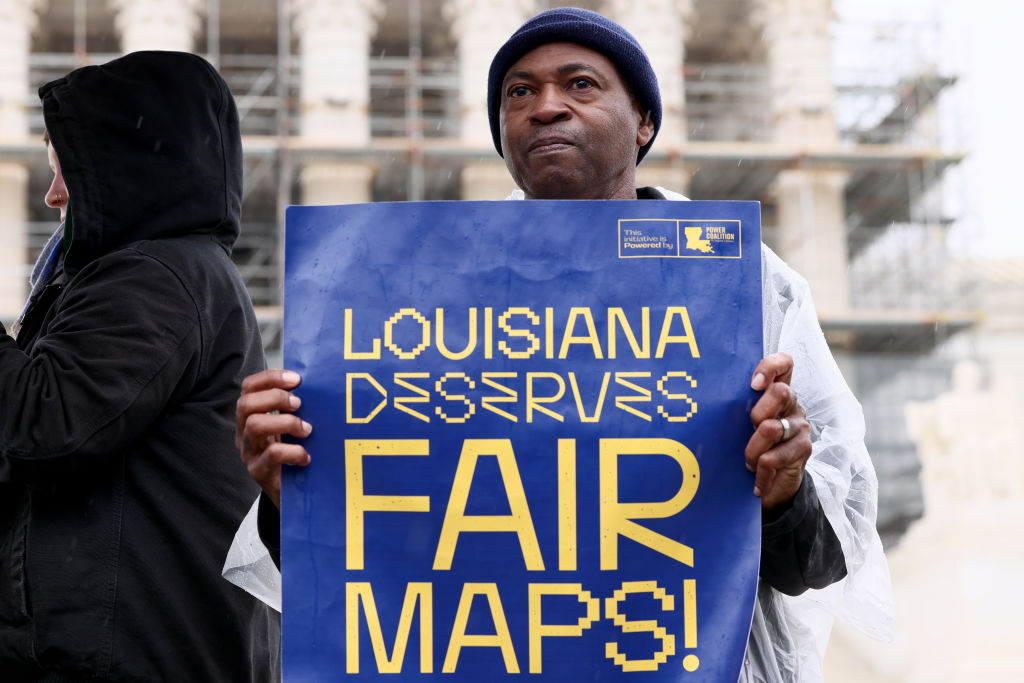
Tensions erupted Friday as Republican state lawmakers presented new election maps to eliminate one or both of Louisiana’s majority-Black congressional districts.
Hundreds of people came to the State Capitol, filling several overflow rooms, to watch the Senate and Governmental Affairs Committee, which met to consider new U.S. House district boundaries and give the public a chance to comment. Lawmakers don’t plan to start voting on the maps until at least next week.
Committee chairman Sen. Caleb Kleinpeter, R-Port Allen, called the hearing after Gov. Jeff Landry declared a state of emergency and suspended Louisiana’s upcoming U.S. House primary elections April 30, a day after the U.S. Supreme Court ruled the state’s existing congressional map was an unconstitutional racial gerrymander against white voters.
Within minutes of the meeting coming to order, Sen. Gary Carter Jr., D-New Orleans, began questioning Kleinpeter about how many absentee ballots had already been cast in the May 16 U.S. House primaries and whether the votes would be counted.
“Can you give the public certainty that those ballots will not be discarded?” Carter asked.
Kleinpeter said Louisiana Secretary of State Nancy Landry, no relation to the governor, was the appropriate official to answer his question, but she was not in attendance.
Carter continued his questioning, asking Kleinpeter if he was personally concerned about the status of his own ballot.
“Have you voted yet?” Carter asked.
“I don’t have to answer that,” Kleinpeter responded.
Surprised by the rapid-fire questions from the generally soft-spoken Carter, Kleinpeter called for a recess, which eased tensions enough for the meeting to resume after several minutes.
Kleinpeter told Carter he would make sure the secretary of state was made aware of his questions, and that she or someone from her office would attend the committee’s next meeting, which is scheduled for Wednesday.
Nancy Landry has declined to answer questions related to the U.S. Supreme Court ruling, explaining that the case, Callais v. Louisiana, is still in litigation after being returned to the federal district court where it originated. There are also ongoing legal challenges to the governor’s order to postpone the U.S. House primaries.
The rest of Friday’s hearing saw tempers flare among senators and protesters, with chants of “shut it down” heard from attendees watching from the Senate committee hall corridor and adjacent overflow rooms.
The discussion grew particularly heated when state Sen. Jay Morris, R-West Monroe, presented his congressional map that eliminates both majority-Black U.S. House districts. Morris, who is white, said his proposed boundaries don’t prevent a Black candidate from winning one of the state’s six seats.
“I didn’t draw it with the intention to draw it 6-0,” Morris said. “I left race out of it … It’s intended to comply with the Supreme Court in Callais.”
Carter began a fiery exchange with Morris about legislation the West Monroe senator sponsored this session to eliminate the Orleans Parish clerk of criminal court and eliminate several of its judgeships. Gov. Jeff Landry signed the clerk bill into law, preventing exonerated “prison lawyer” Calvin Duncan, who is now an actual attorney, from assuming office. Morris’ measure paring back the Orleans judges’ roster awaits House consideration.
“Let’s look at the totality of your work,” Carter told Morris. “Your work has eliminated the elected seat of an African American in the city of New Orleans. Your work has eliminated the political power of numerous elected officials in the city of New Orleans.”
Morris said his legislation is meant only to consolidate Orleans Parish’s dual court systems for civil and criminal cases, the only one of its kind in the state.
Carter and Morris began speaking over each other, prompting Kleinpeter to call another recess, which cut off the microphones and the Capitol’s live video feed.
“Put my microphone back on!” Carter yelled. “He’s suggesting he’s not racist. I suggest we look at his work.”
“You are out of line,” Kleinpeter said.
The sergeants-at-arms intervened, trying to calm the room as Carter and Morris both stood up to leave. As Morris walked away, he turned to the spectators seated behind him, all against his proposals, and said, “Y’all need to shut up.”
“I was frustrated when, as I was trying to answer questions from committee members, people in the audience directly behind me were continuing to comment and talk loudly enough so that it was hard for me to concentrate and answer questions,” Morris said in a statement issued after the hearing.
As Carter and Morris both left the committee room for another recess, the crowd in the hallway chanted “let him speak,” referring to Carter. Sergeants-at-arms stood guard on each side of the committee room’s two sets of double doors, refusing to let anyone enter or exit.
One protester, Mike McClanahan, the NAACP’s state conference president, managed to open the door and try to enter, but guards physically forced him back into the hall and shut the doors.
McClanahan was eventually allowed into the room once the commotion had settled down. In a later interview, he said he just wanted to see what was going on because the live feed was cut off.
“This is the people’s house,” McClanahan said. “We have the right to hear every single thing, especially while the session’s going on in our house. So I was just trying to tell them, ‘Let the people speak. Let the people speak.’ Because we need to hear. We want to hear.”
Morris did not return to the hearing and did not respond to a phone call later Friday.
In a meeting that went on for about six hours, the committee heard from several voting rights advocates.
Before the second recess, all four of Louisiana’s Black congressmen, past and present, since the Reconstruction era spoke to the committee: current U.S. Reps. Troy Carter, D-New Orleans; Cleo Fields, D-Baton Rouge; and former Congressmen William Jefferson and Cedric Richmond.
Troy Carter’s 2nd District seat would be eliminated in the version of the map Kleinpeter has said lawmakers are most likely to advance. The congressman is the uncle of state Sen. Gary Carter.
“Today, here in Louisiana we’re being tested and the whole world is watching,” Troy Carter said. “The question before us is not merely about lines on a map. The question before us is whether we will honor the principle that every citizen deserves equal protection of the law.”
Media that fights fascism
Truthout is funded almost entirely by readers — that’s why we can speak truth to power and cut against the mainstream narrative. But independent journalists at Truthout face mounting political repression under Trump.
We rely on your support to survive McCarthyist censorship. Please make a tax-deductible one-time or monthly donation.