Did you know that Truthout is a nonprofit and independently funded by readers like you? If you value what we do, please support our work with a donation.
Journalist Steven Thrasher’s second book, The Overseer Class, begins with a quote by James Baldwin from a 1967 essay in The New York Times, where Baldwin writes, “we feared black cops even more than white cops, because the black cop had to work so much harder — on your head.”
To see the continuing relevance of that quote, look to the horrific murder of Tyre Nichols in 2023 — a Black man beaten to death by five Black cops in Memphis, Tennessee. It’s this system of terror that Thrasher exposes in this new book, not just the fact that “capitalism needs Black people as executioners, not as helpers” but the system that produces an overseer class of people coming from marginalized backgrounds who do the dirty work of white supremacy and heteropatriarchy by laundering the violence with the optics of diversity.
Think of Alejandro Mayorkas, championed as the first Latino director of the Department of Homeland Security, policing the border to keep other Latinos out. Or comedian Bill Cosby, using his fame to chastise Black people for not upholding white middle-class values, while drugging and raping dozens of women. Or even Anderson Cooper, a ruling-class gay white CNN anchor, who has proudly worn various shirts that promote the Israeli and U.S. militaries as well as the New Orleans Police Department SWAT team to broadcast the “appropriate” behavior for properly assimilated gay patriots.
Thrasher’s focus in the book is not just on these individuals, but an entire class — from university administrators to celebrities to cabinet members — who climb the social ladder by stepping on the necks of the people demographically like them. The Overseer Class is wide-ranging in its analysis, from politics to media criticism to Thrasher’s own experience with overseers in academia that expands his critiques.
Steven Thrasher is a widely published journalist and scholar whose first book, The Viral Underclass, published in 2022, explores the ways in which stigma fuels pandemics from HIV to COVID-19 and beyond, and how social inequity so often determines who survives and who perishes. In The Overseer Class, Thrasher expands his analysis of the structures of power in bold new ways.
The interview that follows has been lightly edited for clarity.
Mattilda Bernstein Sycamore: In 2003, you applied to become a member of the New York City Police Department. While this was driven by economic precarity, you also hoped that as a Black gay cop you could change the system. I love that you reveal this because it shows how much people can change in a relatively short time. I wonder if you could speak to what helped you to go from thinking you could be one of the “good cops” to the abolitionist perspective of the book.
Steven Thrasher: This is the heart of the book and it took me more than 20 years to get it down in words. I am aware that people with the most passing familiarity with my writing will be surprised that I, of all people, applied to be a cop. But I didn’t really want to be a cop. I just didn’t see any other pathway to employment, food, and housing. And as I did research for this book, I found that this is not uncommon: There are a lot of Black cops, and a lot of them never wanted to be cops. It was just a job that was open.
“The right creates jobs for people it is ideologically aligned with. It creates jobs for conservatives, for racists, for fascists.”
Right now, one of the only jobs that seems to be in demand of constant recruits is to be an Immigration and Customs Enforcement (ICE) agent. I would not ever apply to be an ICE agent, and there are a lot of people who never would. But a majority of ICE agents are Latino or Chicano, and a good chunk of them are only in the job because they need a job. This is why I think abolition work needs to create the conditions for better politics. And on the left, a huge problem is that when people take principled stands, there are no jobs at all for many of us. I personally have applied to hundreds of jobs since being subjected to intimidation over Palestine, and there is nothing for me at all. Nothing. I’ll never be an ICE agent, but eventually I’ll have to do something I don’t want to do to survive. And I am very sympathetic to how the right creates jobs for people it is ideologically aligned with. It creates jobs for conservatives, for racists, for fascists. So, if the left wants fewer cops, it not only has to defund the police, it needs to fund other jobs programs.
You write about how Black cops, both in reality and representation, have been utilized not only to “redeem the legitimacy of policing as an institution, but to expand its scope.”
Over my years as a journalist, I have grown, more, not less, optimistic about the rising political consciousness of people living in the United States. Each movement — Occupy Wall Street; Black Lives Matter; LGBTQ rights; protests against the wars in Iraq, Afghanistan, Palestine, Lebanon, and Iran — has built on the last movement. And overall, I believe, Americans are increasingly opposed to spending money, resources, and personnel on war, policing, and violence-making.
And as they grow skeptical of not just “bad apple” cops but of policing as a whole, the “Black cop” pops up often to redeem the police, to say “not all cops.” And the Latino ICE agent. And the gay beat cop. Eric Adams, Axel Foley, be they fiction or real, they’re here to rein in not just policing literally, but our imagination about the scope of what’s possible.
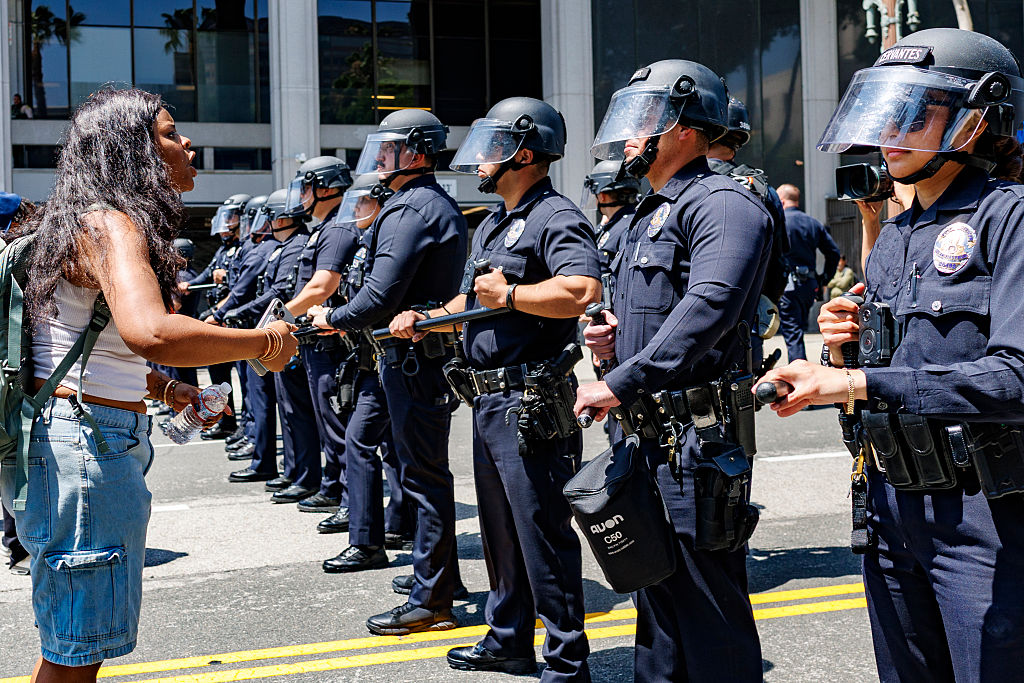
I grew up in and around Los Angeles. Los Angeles Police Department (LAPD) Chief Daryl Gates was a cartoonishly racist old white man of a cop. He ran the LAPD before and during the beating of Rodney King and the L.A. riots. He was replaced by Chief Willie Williams, a Black man. L.A. now has a Black mayor again, Mayor Karen Bass, despite the ethnic cleansing of many Black Los Angelenos, and a Korean American assistant police chief, Dominic Choi. As L.A. prepares for the Olympics and tries to further criminalize its disproportionately Black unhoused populations, it’s much easier for Bass and Choi to get away with this blatantly racist act of ethnic cleansing free of criticism than it would be for Gates to do so.
You also show how this notion of the first person from a particular demographic group to shatter the glass ceiling is often a formula for creating an overseer. How does one produce the other?
Yeah, I write about “historic firsts.” This is a trope some sociology friends and I will send each other text messages about. “The first Afro Latino to be on a U.S. quarter,” or the “first Black NASCAR driver with autism.” Some of them are laughably specific and — if you think about it — even though they are couched in the language of the group, and the tacit misnomer this “first” will be good for the group, they are really just marketing tools meant to help an individual’s career or image. And they are rarely invoked with anything negative. For instance, when former Virginia Lt. Gov. Justin Fairfax was elected, he was also called the first Black lieutenant governor, as if that were good for Black Virginians. And, weirdly, this was held up even though there had been a Black governor before, L. Douglas Wilder. But when Justin Fairfax murdered his wife, Dr. Cerina Fairfax, then killed himself, he was not called “the first Black lieutenant governor to commit murder-suicide.” I am not being flippant here. I think this reveals how “firsts” are used to create containers of race meant to benefit the careers of individuals, so that they might demand fealty from those below them in a power structure, so that they might oversee them.
On a national level, we saw this with Barack Obama: His historic presidency brought forth an understandable pride from Black Americans. Before I was a journalist, I volunteered on his first campaign. But then his policies were disastrous for many Black Americans, especially in terms of the historic wipe-out of wealth which happened in the 2008 crash; that crash didn’t happen because of Obama — it occurred right before he came in — but the recovery he managed absolved the power structure which wiped out a record’s worth of Black wealth. He also oversaw a level of immigration detention and expulsion never matched by any other president, including Donald Trump, which was disastrous for Black and Brown migrants. And being a “first” helped him oversee these crimes against the public. He was an overseer for the capitalists — and a harder one to fight against than Trump, who is a relatively easy figure to organize protest against, given his cartoonishly evil antics.
Speaking of protest, your invocation of the social, political, and communal potential of Gaza encampments is beautifully drawn through personal experience. And, as you mentioned earlier, you ended up being persecuted, and losing your job, for protecting Northwestern students. What has this whole experience taught you?
I was at UCLA and I got to meet with students and faculty who had been at their encampment. The response to theirs was among the most violent in the world. You may recall that it included fireworks being shot into the camp, and the cops shooting dozens of rounds of rubber-coated bullets, and an enormous amount of physical injury. But I was reminded that despite the danger, these places were really great educational sites. They taught young people — and not-so-young people, like me — of the power of being in community with one another. The power, and the joy, despite the danger, of learning in non-punitive ways.
In the two years since, one thing I have really learned is that the right is good at punishment, but the left sucks at helping people who are blacklisted. I have only needed one thing over the last two years: a job. I know many people like this. And there is nothing for us, at all. We are left to starve and die. For a long time, I was upset with Northwestern, but my frustration has broadened to be much more frustrated with a left that will make no place — like, literally no place at all — to help the students, staff, and faculty who have been blacklisted.
You point out that K-12 public schools have actually fought back against Trump administration attacks while some of the wealthiest educational institutions in the world have immediately done his bidding.
As I talk to you, I am outside of L.A. in Oxnard, my hometown. The school districts here refused to back down on anything — on DEI [diversity, equity, and inclusion], or fighting ICE, on LGBTQ issues. They have consistently won. Many if not most people and organizations have won when they fought back. I reject that this is a matter of school districts relying on local taxes versus universities funded by the feds — Oxnard, L.A., New York, and other school districts get a lot of federal Title I money. But they fought back. Because they believe in DEI, LGBTQ rights, and fighting ICE.
“The school districts here refused to back down on anything — on DEI, or fighting ICE, on LGBTQ issues. They have consistently won. Many if not most people and organizations have won when they fought back.”
The universities that gave in to Trump also did what they believe — they agree with Trump. They think there are too many nonwhite people working and studying in universities. They do not like immigrants. They do not like LGBTQ people, especially trans people. They do not like women. They think universities should be sites of hoarding resources for straight, white, cis American business interests. They want to be able to research how to make bombs, and they want to seek “donations” from warmongers who can shape the university as a research and development lab for their bombs.
Throughout the book you come back to three people who could have become overseers, but chose a different path — James Baldwin, Toni Morrison, and Martin Luther King Jr. How did they resist, and what makes them important models for us today?
They all directly rejected imperialism and domination, and encouraged us to share whatever bounty we are blessed to achieve with others, and not to hoard it ourselves. But King’s preaching on “the drum major instinct” is the most important, I think — it helps us not to seek to be the first, the loudest, the most on display, which is socialized into us, particularly by how we are supposed to promote ourselves on social media.
Press freedom is under attack
As Trump cracks down on political speech, independent media is increasingly necessary.
Truthout produces reporting you won’t see in the mainstream: journalism from the frontlines of global conflict, interviews with grassroots movement leaders, high-quality legal analysis and more.
Our work is possible thanks to reader support. Help Truthout catalyze change and social justice — make a tax-deductible monthly or one-time donation today.