Truthout is a vital news source and a living history of political struggle. If you think our work is valuable, support us with a donation of any size.
A federal judge on Thursday blocked key pillars of President Donald Trump’s efforts to overhaul the 2026 elections, declaring unconstitutional his attempts to create centralized lists of adult citizens and giving the U.S. Postal Service unprecedented authority over who can vote by mail.
The 37-page ruling by U.S. District Judge Indira Talwani concluded that the president did not have the constitutional authority to regulate state elections as he tried to do in a March executive order.
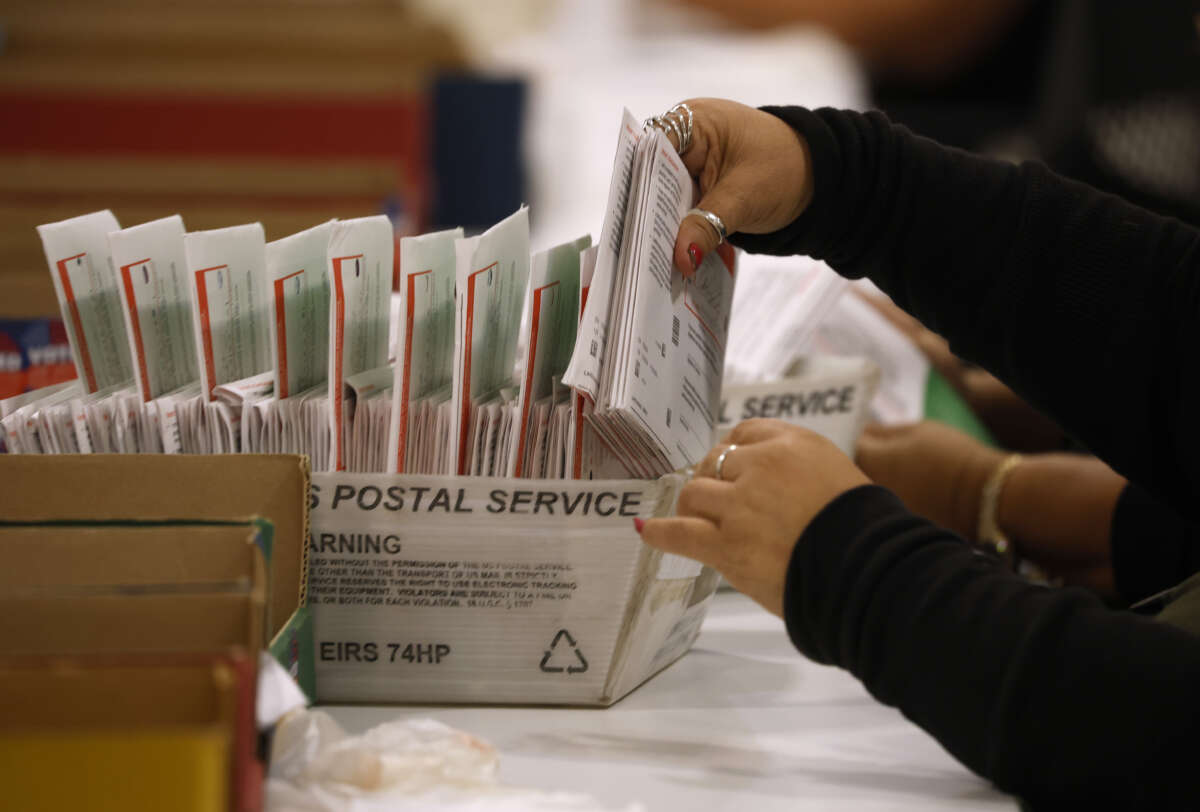
The executive order directed the U.S. Department of Homeland Security and Social Security Administration to create a nationwide list of verified U.S. citizens over 18, and thus presumably eligible to vote in federal elections. It also called on the U.S. Postal Service to create a system to handle and accept mail-in ballots only from voters on preapproved lists.
Talwani’s decision came one day after the head of the Postal Service said the agency would refuse to deliver mail-in ballots to voters that were not on lists approved by the federal government, making explicit what the agency’s proposed new rules had previously implied.
In her ruling, Talwani said that the federal government could not use the postal system to regulate who gets ballots.
“No law enacted by Congress delegates authority to control mail-in voting to USPS,” Talwani wrote.
Talwani issued an injunction specifically preventing the federal government from enforcing those provisions of the order against the 24 jurisdictions (23 states and the District of Columbia) whose attorneys general and governors brought the lawsuit. The list includes most Democratic-led and swing states, including Arizona, California, Michigan, Nevada, New York, North Carolina, Pennsylvania, and Wisconsin.
However, the injunction applies only to this year’s elections. Talwani granted the Trump administration’s motion to dismiss the plaintiffs’ legal challenges to the executive order as not yet ripe when it comes to future elections.
The White House implied that it would appeal the ruling. In a statement, Abigail Jackson, a spokeswoman, said the administration is “confident that we will ultimately prevail.” The U.S. Postal Service didn’t immediately respond to a request for comment.
Some Democratic secretaries of state who brought the case hailed the ruling as a major victory for voters.
“Trump will not be able to use the Postal Service to control which voters receive a mail ballot, and cannot use the DOJ to intimidate election officials into following his unlawful order,” said Colorado Secretary of State Jena Griswold. “The Constitution is clear: States run elections, not Trump. This is a major victory for American democracy.”
The ruling is the latest in a series of judicial rebukes to Trump’s efforts to impose federal control over American elections, something that the Constitution leaves to Congress and the states.
The executive order is the second election-related one issued by Trump. The first one, issued in March 2025, sought to require prospective voters to prove their citizenship when registering to vote in federal elections and impose restrictions on states accepting mail-in ballots after Election Day. Federal courts have so far blocked major portions of the first executive order, including the effort to require documented proof of citizenship when registering to vote.
During the hearing in the case over the second order, in early June, Talwani expressed concerns about the executive order.
“What’s the harm if I say no one can use this list for the November election?” Talwani asked.
The Trump administration has cast the president’s efforts as an attempt to compel federal agencies to enforce existing laws barring noncitizens from voting in elections.
Trump has consistently targeted America’s electoral system and, without evidence, accused Democrats across the nation of “rigging” elections.
The president has repeatedly claimed that he was cheated out of the presidency in 2020 when he lost to Democrat Joe Biden, even though federal judges, state elections officials, and independent investigations have repeatedly debunked those allegations.
Before Thursday’s ruling, the Trump administration had been forging ahead with implementing the executive order.
A different federal judge declined in late May to block major parts of the executive order, arguing that the issue was premature because the U.S. Postal Service had yet to take any steps to set up the new system. The following day, the Postal Service unveiled its proposed rules, which would give the agency the power to block delivery of mail-in ballots to Americans across the nation unless they were on a verified list of voters.
And in early June, the Trump administration said that it was taking steps to create a new nationwide mechanism aimed at verifying voter citizenship, per the executive order.
Votebeat is a nonprofit news organization covering local election integrity and voting access. Sign up for their newsletters here.
Fundraiser Deadline: Missed
Truthout is one of only a few platforms for justice-oriented, grassroots journalism. Today, as political censorship from the right intensifies, we have no choice but to ask for your help.
We missed our fundraising deadline, but there’s still time to help us meet our basic operating expenses before the end of the month. If you can support Truthout with a one-time or monthly donation, you will make a significant impact on our work. Anything you can do makes a difference — we appreciate your support.