Did you know that Truthout is a nonprofit and independently funded by readers like you? If you value what we do, please support our work with a donation.
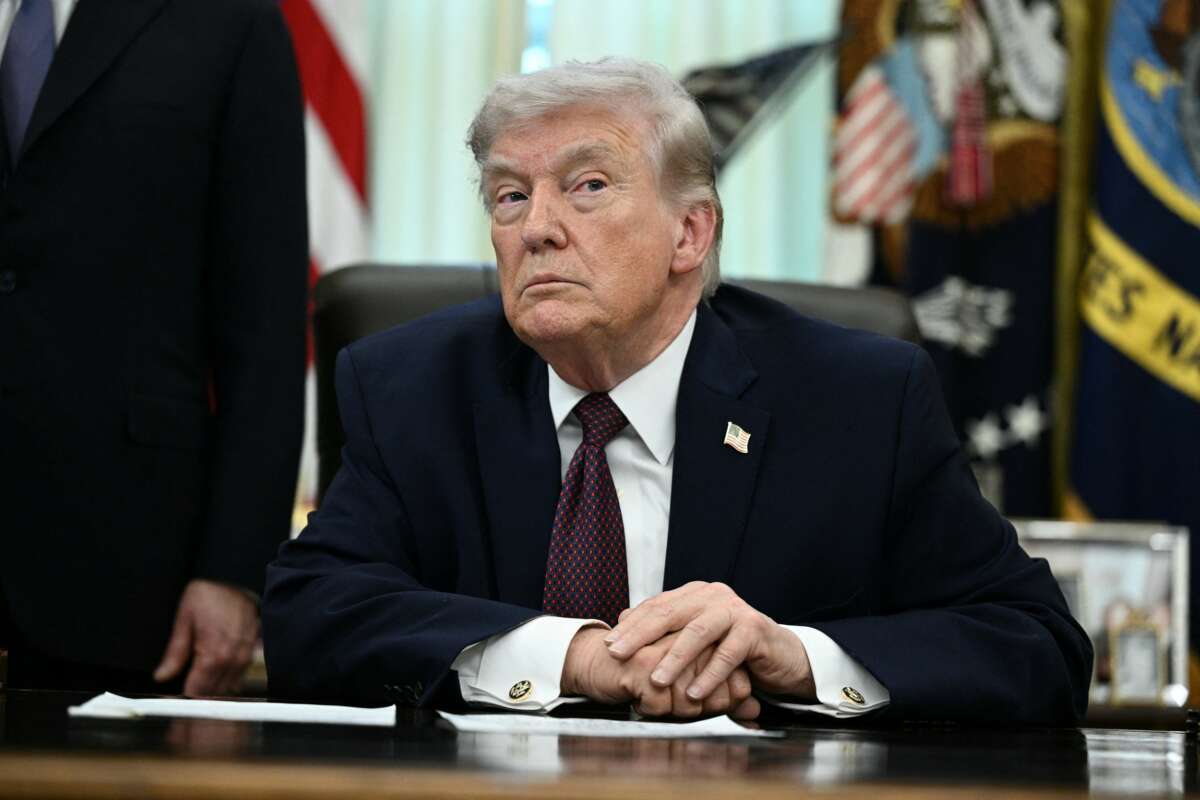
President Donald Trump is expressing optimism for the two-week ceasefire deal that has been reached between the U.S. and Iran. However, on many aspects of the supposed deal — including management of the Strait of Hormuz — the president appears to still be at odds with Iran, despite implying the country’s leaders are open to his ideas about the waterway.
Trump announced the tentative ceasefire on Tuesday night, writing on Truth Social it was dependent on the strait, through which one-fifth of the world’s oil travels, being reopened.
“Subject to the Islamic Republic of Iran agreeing to the COMPLETE, IMMEDIATE, and SAFE OPENING of the Strait of Hormuz, I agree to suspend the bombing and attack of Iran for a period of two weeks,” Trump said.
The decision to suspend planned attacks on civilian sites was made due to a 10-point plan offered by Iran, Trump added, calling the proposal “a workable basis on which to negotiate.”
In subsequent posts, Trump suggested that the two countries would agree to manage the Strait of Hormuz together.
“The United States of America will be helping with the traffic buildup in the Strait of Hormuz,” Trump wrote in a post around midnight Eastern Time, adding that there will be “big money” to be made.
“We’ll be loading up with supplies of all kinds, and just ‘hangin’ around’ in order to make sure that everything goes well,” Trump also wrote.
Trump reiterated those plans in comments to ABC News’s Jonathan Karl on Wednesday.
“We’re thinking of doing it as a joint venture,” Trump said, referring to the strait. “It’s a way of securing it — also securing it from lots of other people. It’s a beautiful thing.”
However, Iran has not yet agreed to any of those plans. Indeed, its 10-point proposal that Trump has referenced calls for the opposite to occur, for Iran to manage the strait, not mentioning U.S. involvement at all. The plan offered by Iran also calls for the complete removal of the U.S. military from the entire Middle East.
“When US President Donald Trump ordered Iran to reopen the Strait of Hormuz, he didn’t demand that it relinquish that position. Instead, he amplified a letter from Iran’s foreign minister affirming Tehran’s authority over the waterway,” CNN’s Middle East editor Abbas Al Lawati pointed out.
Any agreement between the two countries on the Strait of Hormuz is, of course, dependent on the continuance of a ceasefire over the next two weeks or longer, if agreed upon, in order to allow negotiations to occur. The National Iranian American Council (NIAC) expressed cautious optimism about a ceasefire pact, but noted that it would require Trump to be less aggressive.
“President Trump has gone from threatening civilizational annihilation in the morning to announcing a very tenuous ceasefire in the evening,” NIAC wrote in a statement on Tuesday. “There are many questions to answer, including how sustainable it can be.”
“We encourage all parties to seize this opportunity to pursue a workable deal and an end to the war that has been devastating for the people of Iran, U.S. and regional security and the global economy. Everything can get far worse if this opportunity for peace lapses,” NIAC added.
As of Wednesday, it was unclear whether the strait had been reopened or not. Some ships reported being able to sail through, but the strait appears to remain in “blocked” status as ships try to determine if they can make a safe passage.
There are “no clear signs yet of large-scale positioning or queuing that would indicate ships are preparing to move through in significant numbers,” and “most operators appear to be holding back,” said Dimitris Ampatzidis, a senior analyst for the maritime shipping industry, speaking to The New York Times.
Iran also announced on Wednesday that it would resume restricting shipments in the strait due to Israel’s continued attacks on Lebanon. The ending of such attacks was also a part of its 10-point proposal. Trump has said Israel’s attacks on Lebanon were not part of the ceasefire deal.
Attacks in Iran also appeared to continue on Wednesday, including on some oil facilities. Pakistan’s Prime Minister Shehbaz Sharif, whose country helped broker the ceasefire agreement, decried the ongoing skirmishes.
“Violations of ceasefire have been reported at few places across the conflict zone which undermine the spirit of peace process,” Sharif wrote on X. “I earnestly and sincerely urge all parties to exercise restraint and respect the ceasefire for two weeks, as agreed upon, so that diplomacy can take a lead role towards peaceful settlement of the conflict.”
An urgent fundraising appeal: 4 Days to raise $30,000
Thank you for reading Truthout today. We have a brief message before you go —
Unfortunately, donations are down for Truthout at a time when media is under immense pressure. Trump is arresting journalists, Big Tech is censoring independent news, and economic conditions for media have been worsening for years.
Simultaneously, movement media is vital in the fight against Trump’s authoritarian reign. Our mandate to tell the truth, share strategies for resistance, and speak against fascism is ever more urgent in this deluge of political censorship. Yet, we are struggling to meet our publishing costs when our work is so urgently needed.
If you can support Truthout with a one-time or monthly donation, you will make a significant impact on our work. Please give today during our fundraiser (4 days left).