Truthout is a vital news source and a living history of political struggle. If you think our work is valuable, support us with a donation of any size.
Unlike the invasion of Iraq, which received the support of a sizable minority of congressional Democrats, Donald Trump’s war on Iran has received near-universal criticism. Still, the party has focused primarily on process-style critiques — such as the legality of declaring the war under the Constitution and the war’s economic impact — rather than the humanitarian consequences and flagrant violations of international law.
That should not come as a surprise to anyone familiar with the U.S. bipartisan consensus on Iran: For over 20 years, a number of prominent Democratic leaders — and in some cases, large majorities of congressional Democrats overall — have helped pave the groundwork for Trump’s war by issuing exaggerated and alarmist statements about Iran’s supposed danger to the region, threatening the use of military force, and undermining diplomatic initiatives, sometimes even criticizing Republicans from the right.
In 2024, the Democratic Party platform criticized “Trump’s fecklessness and weakness in the face of Iranian aggression during his presidency” by not responding militarily to attacks by Iran and groups in Iraq and elsewhere that share Iran’s strategic objectives. The platform cited four separate incidents that took place under his first administration, failing to acknowledge that each was a direct result of Trump’s aggressive policies against Iran, including the assassination of Qassim Suleimani, a top Iranian general.
By contrast, the party’s platform praised President Joe Biden for having “authorized precision airstrikes on key Iranian-linked targets,” which it claimed would “deter further aggression by Iran.” It praised “America’s ironclad commitment to the security of Israel and our unrivaled ability to leverage growing regional integration among U.S. partners to counter Iranian aggression.” Though eager to stress military means to counter Iran, the platform failed to directly call for a return to the Iran nuclear deal under the Obama administration, which considerably reduced regional tensions — a deal that Biden campaigned on reinstating but failed to do.
The month after the release of the party platform, Democratic nominee Kamala Harris attacked Trump in a presidential debate, declaring that her administration “will always give Israel the ability to defend itself, in particular as it relates to Iran and any threat that Iran and its proxies pose to Israel.”
In an interview with CBS, when she was asked who she considered to be the greatest enemy of the United States, Harris said it was “obvious” that Iran — not nuclear-armed states such as Russia, China, or North Korea — was the “greatest adversary.” She explicitly said that she would not rule out going to war against that country.
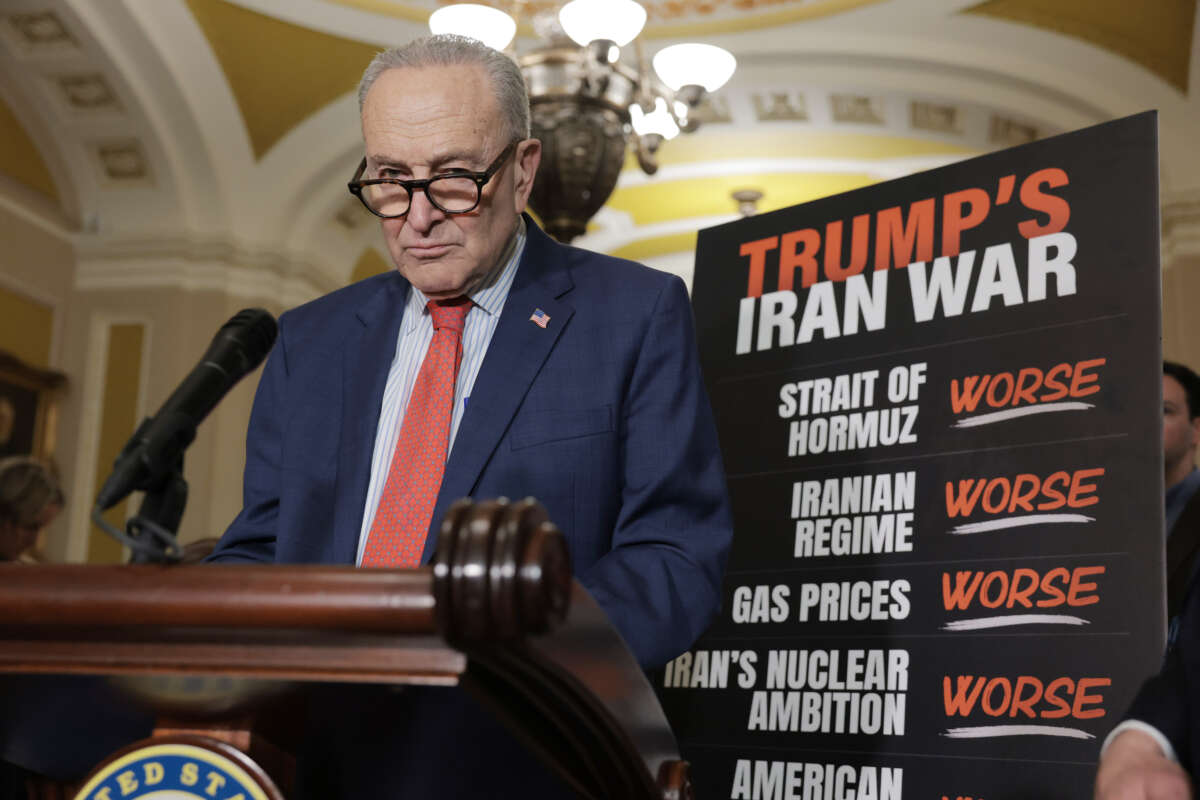
This framing from the right continued into Trump’s presidency, even as the president began pushing more toward sustained military conflict. During Israel’s unprovoked bombing of Iran in June 2025, Senate Democratic leader Chuck Schumer insisted that “Israel has a right to defend itself,” despite the fact that Israel had started the war. Just over a week before, he criticized Trump for even engaging in negotiations with Iran — negotiations that provided cover for the U.S.’s own bombing of multiple Iranian nuclear sites. Just prior to the U.S. bombing of Iranian nuclear sites during Israel’s war, Schumer posted a video to social media accusing Trump of “folding on Iran” by attempting to negotiate a deal, bemoaning about how “Trump always chickens out” regarding the use of military force.
Similarly, House Democratic leader Hakeem Jeffries refused to criticize the Israeli attack or call for a return to the Iran nuclear deal. Although Iran has no capability of striking anywhere outside of the Middle East, Jeffries claimed “the Iranian regime poses a grave threat to the entire free world.”
Such hyperbole is not new. As far back as 20 years ago, Democratic leaders like then-Sen. Evan Bayh were claiming that Iran “may be only months away from having the capacity to build a nuclear bomb” and insisting military options should be considered. Similarly, then-Sen. Hillary Clinton argued during the Bush years that his administration was not taking the threat of a nuclear Iran seriously enough, criticizing it for allowing European nations to take the lead in pursuing a diplomatic solution, and insisting that the administration should make it clear that military options were being actively considered. These proclamations came even as the U.S. was struggling to maintain control of Iraq at the height of its occupation.
During the 2008 Democratic primaries, Clinton accused Barack Obama of being “naive” and “irresponsible” for wanting to diplomatically engage with Iran and other nations that U.S. policy has often antagonized. Despite these accusations, Obama selected her as his secretary of state, through which, according to a story in Time magazine, Obama administration officials noted she was “skeptical of diplomacy with Iran, and firmly opposed to talk of a ‘containment’ policy that would be an alternative to military action should negotiations with Tehran fail.”
Clinton was far from the only Democrat pushing back against the Obama administration’s diplomatic efforts. In 2011, in an effort to sabotage any potential diplomatic contact with Iran, an overwhelming majority of House Democrats voted for a Republican bill declaring “No person employed with the United States Government may contact in an official or unofficial capacity any person that … is an agent, instrumentality, or official of, is affiliated with, or is serving as a representative of the Government of Iran.” Administration pressure and constitutional questions prevented the bill from passing the Senate, but it underscored that over 90 percent of House Democrats were intent on undermining Obama’s efforts for a non-military resolution to the conflict with Iran.
The following year, a similarly large majority of House Democrats voted for a resolution urging the president to oppose any policy toward Iran “that would rely on containment as an option in response to the Iranian nuclear threat.” While Obama had already stated a willingness to consider taking military action against Iran if the regime procured nuclear weapons, this resolution significantly lowered the bar for war by declaring it unacceptable for Iran simply to have “nuclear weapons capability” — not necessarily any actual weapons or an active nuclear weapons program.
In 2013, after Clinton was replaced by the more liberal John Kerry as secretary of state and Iranians elected the reformist President Hassan Rouhani, yet another overwhelming majority of House Democrats joined Republicans in voting, over the objections of the White House, to impose punitive new sanctions on Iran. It was widely interpreted as a bipartisan rejection of the new Iranian president’s offer to enhance nuclear transparency and pursue “peace and reconciliation” with the West.
Additionally, in an apparent effort to poison the atmosphere on the eve of Rouhani’s inauguration, over two dozen Democratic senators signed a letter to President Obama demanding a “toughening of sanctions” and “a convincing threat of the use of force.”
In May of that year, every Democratic senator joined their Republican colleagues in supporting a resolution which “urges that, if the Government of Israel is compelled to take military action in self-defense, the United States Government should stand with Israel and provide diplomatic, military, and economic support to the Government of Israel.” The wording is significant in that it put Senate Democrats on record that the United States should support an Israeli war on Iran not only if Israel was attacked, but even if Israel attacked first. By giving Benjamin Netanyahu the authority to determine what might “compel” Israel to act in “self-defense,” this near-unanimous decision helped pave the way for Israel to make such claims in its U.S.-backed war in June 2025 and the joint U.S.-Israeli war this year.
Fortunately, by 2015, the Obama administration — along with Great Britain, France, Germany, Russia, and China, and with the backing of the European Union and the United Nations — was able to negotiate an agreement whereby, in return for sanctions relief, Iran drastically curtailed its nuclear program to the degree that it was physically impossible to build a nuclear weapon, while also agreeing to strict monitoring to ensure compliance. It took perhaps the most intense lobbying efforts of the Obama presidency to get congressional Democrats on board. In the end, only two Democratic senators, Robert Menendez and Chuck Schumer, opposed the agreement, but their colleagues nevertheless elected them to senior positions — Menendez as chair of the Foreign Relations Committee and Schumer as their Senate leader.
The 2016 Democratic platform endorsed the nuclear deal — but declared that, if Iran violated the agreement, rather than allow for the automatic reimposition of strict international sanctions to pressure Iran to come back into compliance as the deal outlined, a Democratic president “will not hesitate to take military action.” Since it would take Iranians at least a few years to rebuild their dramatically circumscribed nuclear program to the point where they could develop even a single nuclear weapon, there would be plenty of time, as well as serious punitive economic mechanisms, to push Iran to resume its compliance. Immediately launching a war, as the platform called for, would therefore not only be a direct violation of the United Nations Charter, it would be completely unnecessary.
This is only a partial list of ways in which Democrats have pushed for a military confrontation with Iran over the past couple of decades. Even today, the fact that Democratic leaders still support unconditional military aid to Israel and Netanyahu, Trump’s partner in the illegal attacks on Iran, raises questions about their sincerity in opposing the war.
It is highly unlikely the United States would have launched a full-scale war under a Democratic administration as it has under Trump. However hawkish many in the Democratic leadership have proven to be, they would have been far more likely to listen to allied governments, as well as the broad consensus of strategic analysts, intelligence officials, and military leaders that make up the foreign policy elite, many of whom have long warned of the serious consequences of going to war.
At the same time, it is important to recognize how Democrats share responsibility with Republicans for creating the climate that made such a war possible.
Press freedom is under attack
As Trump cracks down on political speech, independent media is increasingly necessary.
Truthout produces reporting you won’t see in the mainstream: journalism from the frontlines of global conflict, interviews with grassroots movement leaders, high-quality legal analysis and more.
Our work is possible thanks to reader support. Help Truthout catalyze change and social justice — make a tax-deductible monthly or one-time donation today.