Support justice-driven, accurate and transparent news — make a quick donation to Truthout today!
Over the past month of the U.S.-Israeli war against Iran, Donald’s Trump mission has creeped from vowing that he’s “not putting troops anywhere” to backing himself into an escalation that makes the chance of ground invasion far more likely. As many as 17,000 American troops could be gathering in preparation for an operation to land on, and potentially even seize, any number of Iranian islands in the embattled Persian Gulf and the Strait of Hormuz.
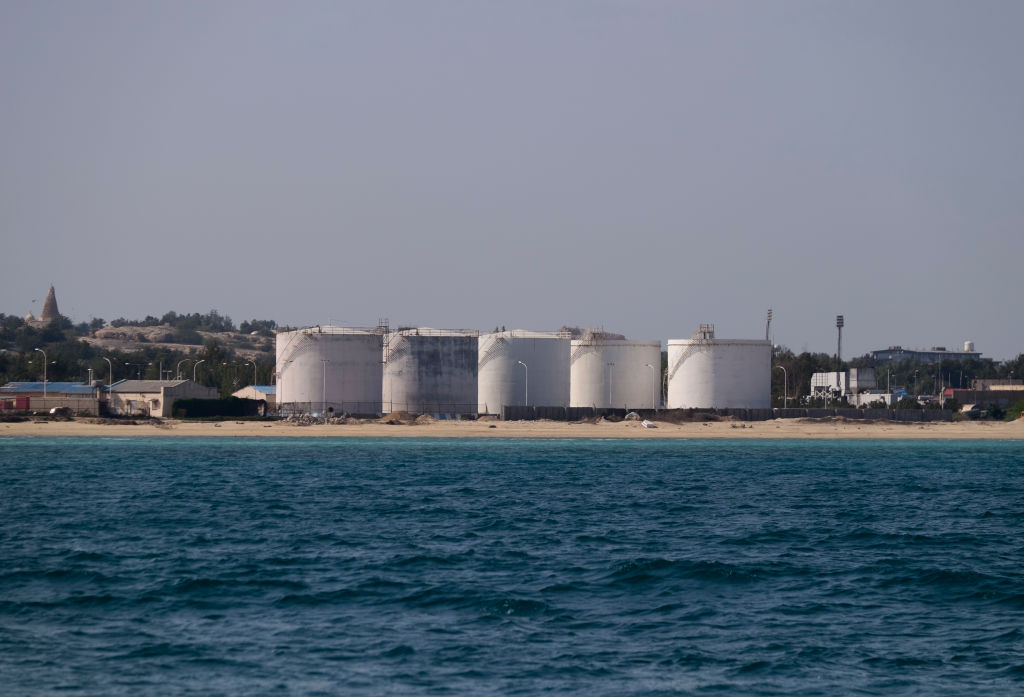
Kharg Island, deep in the Gulf and near the coasts of Kuwait and Iraq, is the isle the Trump administration has most clearly placed in its crosshairs. Media reports have suggested the administration is also considering other special operations, such as a complex raid to seize enriched uranium from Isfahan. But taking Kharg is now being touted by some of the same hawks who pushed for the initial U.S. military action in Iran as a new central goal of the war, an opportunity to acquire significant leverage that the United States can and must take. “We did Iwo Jima,” Sen. Lindsey Graham said to Fox News on March 22, “We can do this.”
Other islands closer to the strait, like Larak, an island off Iran’s southern coast, have been more critical to Iran’s ongoing blockade of oil tankers. But 80 to 90 percent of Iran’s own crude oil exports — which have increased since the war began — run through Kharg, making the island’s oil terminal deeply important to the functioning of Iran’s economy, in wartime or otherwise. Over the past few weeks, the American government, ever-obsessed with seizing the oil of other nations as recompense, has attempted to make Kharg into its plaything. On March 13, the U.S. conducted airstrikes on the island and sent a volley of rockets, allegedly fired from Emirati territory, with CENTCOM claiming to have hit “90+ military sites” that destroyed “naval mine storage facilities” and “missile storage bunkers,” among other purported targets.
After the strikes, Trump immediately bragged that Iran now had “NO ability to defend anything we want to attack” and later said that “we may hit it a few more times just for fun.” While he made a point of claiming to spare the oil infrastructure on the island, wary of price shocks caused by Israeli attacks on oil refineries near Tehran days earlier, Trump otherwise spoke of the island as if it had been “totally demolished.” The White House social media accounts posted his message announcing the attacks with the headline: “Kharg Island Obliterated.”
This “obliteration” would have come as news to the more than 8,000 permanent residents of the island, to say nothing of the thousands more who have come to Kharg to work in the oil industry — residents and workers who have been removed from the American government’s discussion of a potential invasion, as well as American media’s reporting about the impacts of such an invasion.
Locals on the island told BBC Persian that the targets the U.S. bombed hit deep inside the city of Kharg, where most of the population resides, that “the island doesn’t really have a military base,” and that following the bombing of Kharg Airport, which runs domestic flights to cities on the Iranian mainland, there was now no way to evacuate.
The White House’s cavalier attitude towards an invasion of Iranian territory has been notable, with Trump mentioning on March 29 that “maybe we take Kharg Island, maybe we don’t” because his “favorite thing is to take the oil in Iran.” But Western media coverage has arguably done just as much to create the impression that Kharg is solely a strategic asset to be conquered, with the welfare of its native inhabitants a footnote, if mentioned at all.
Mainstream outlets like Reuters and The Washington Post have backgrounded the civilian population in favor of dry, military-focused analysis, with the Post blithely printing the words of an analyst from the pro-Israel Washington Institute that it would be “safer” for U.S. forces to simply surround the island with mines and hold it hostage. Coverage on CBS and Fox News has perpetuated outright falsehoods about the island’s population; CBS brought on an analyst from the conservative Hudson Institute to say that Kharg could easily be isolated because it had “no civilian population center” and “really is just oil infrastructure,” while Fox’s Jesse Watters featured Medal of Honor recipient David Bellavia, who told viewers that “civilians are not allowed to even go to Kharg Island.”
Outlets that have mentioned Kharg’s civilian population have often done so in passing, sometimes referring to the island’s inhabitants as a mere additional risk that U.S. paratroopers and marines will have to account for. In a Bloomberg editorial, James Stavridis, former NATO Supreme Allied Commander, writes about the thousands on the island as problems to be solved, people “who would need to be contained in their homes or evacuated; the Iranians may have planted sophisticated booby traps.”
The narrative from war hawks pushing for an invasion has suggested such an operation could be of a limited nature, more along the lines of a raid and less like the long-term occupation of Iraq, a “quagmire” that the Trump administration has insisted the war with Iran is nothing like. But while Fox Business may bring on a former Navy SEAL to talk about how oil seized from Kharg Island could be passed “back to the Iranian people once they take over this regime,” there is little indication that Trump would want to quickly exit Kharg. The president said outright on Sunday that invading it would “mean we had to be there for a while.” There’s even less indication that the Trump administration cares about giving power to the Iranian people or preserving their livelihoods or national economy.
An invasion of Kharg would place thousands of Iranians — perhaps hundreds of thousands if the U.S. military also chose to invade other islands like Larak, Kish, Abu Musa, Hormuz, or Qeshm — under direct military occupation in a form for an indefinite period with no immediate plans for exit or planned transition, a military operation with few parallels in the War on Terror era.
As U.S. threats continue to build, Iran has reportedly brought further military reinforcements to Kharg over the past several days. Life on the island continues. Iran’s Speaker of Parliament Mohammad Bagher Ghalibaf has warned of “continuous and relentless attacks” on “vital infrastructure” in the region should a U.S. ground invasion commence. Esmail Hosseini, spokesman for the parliament’s Energy Commission, was more blunt on a parliamentary visit to the island, saying that Kharg will become “the graveyard of the aggressors.” One resident of the island told a reporter from Mehr News, “The enemy thinks it can break the resistance on Kharg Island with a few attacks, but they are blind, and we will not leave the field for them.” The White House, at least for now, does not appear to be heeding these warnings.
The American narrative of having supposedly learned lessons after endless years of war in Iraq and Afghanistan is finally being challenged by brutal reality. A desire to wage war without endangering American lives, while exacting unlimited damage and chaos against any state that has the means to fight back, means the question of what to do with civilians has become virtually unmentionable. A war can ostensibly be waged for the freedom of the Iranian people in the abstract, this narrative goes, but even their mere existence is not allowed to be a factor in the actual operations of a military, one that now openly prides itself on ignoring “stupid rules of engagement” and maximizing “lethality.” The people of Kharg, and of Iran more broadly, are deemphasized, ignored, erased from discussion, until they suddenly become an immediate and shocking problem, a problem the U.S. simply didn’t anticipate, a problem to now be dealt with by a government that bragged about obliterating the land upon which they exist.
Media that fights fascism
Truthout is funded almost entirely by readers — that’s why we can speak truth to power and cut against the mainstream narrative. But independent journalists at Truthout face mounting political repression under Trump.
We rely on your support to survive McCarthyist censorship. Please make a tax-deductible one-time or monthly donation.