Did you know that Truthout is a nonprofit and independently funded by readers like you? If you value what we do, please support our work with a donation.
Israel’s creeping annexation of an ancient West Bank village and its archaeological site stands to upend the lives of its Palestinian inhabitants and dispossess them of their lands. Israeli settlers and the Israeli army have stepped up efforts to make life “unbearable” for Palestinians, according to the town’s residents, in order to compel them to leave. Many of them face expulsion, as their homes fall within the area slated for seizure.
Villagers, activists, and politicians from Sebastia, northwest of Nablus, have for years warned the international community of Israel’s plans to erase them and the 5,000 years of Palestinian history contained within the town’s archaeological ruins. Their warnings have fallen on deaf ears.
On November 12, the Israeli government issued an order outlining plans to “expropriate” 450 acres of land from ancient Sebastia and the village’s entire archaeological park, which includes homes and businesses.
Israel’s seizure of the lands of Sebastia and the nearby village of Burqa will form part of a plan to create a “national park” for Israeli settlers on one of the most significant Palestinian historical sites in the West Bank out of 6,000 others.
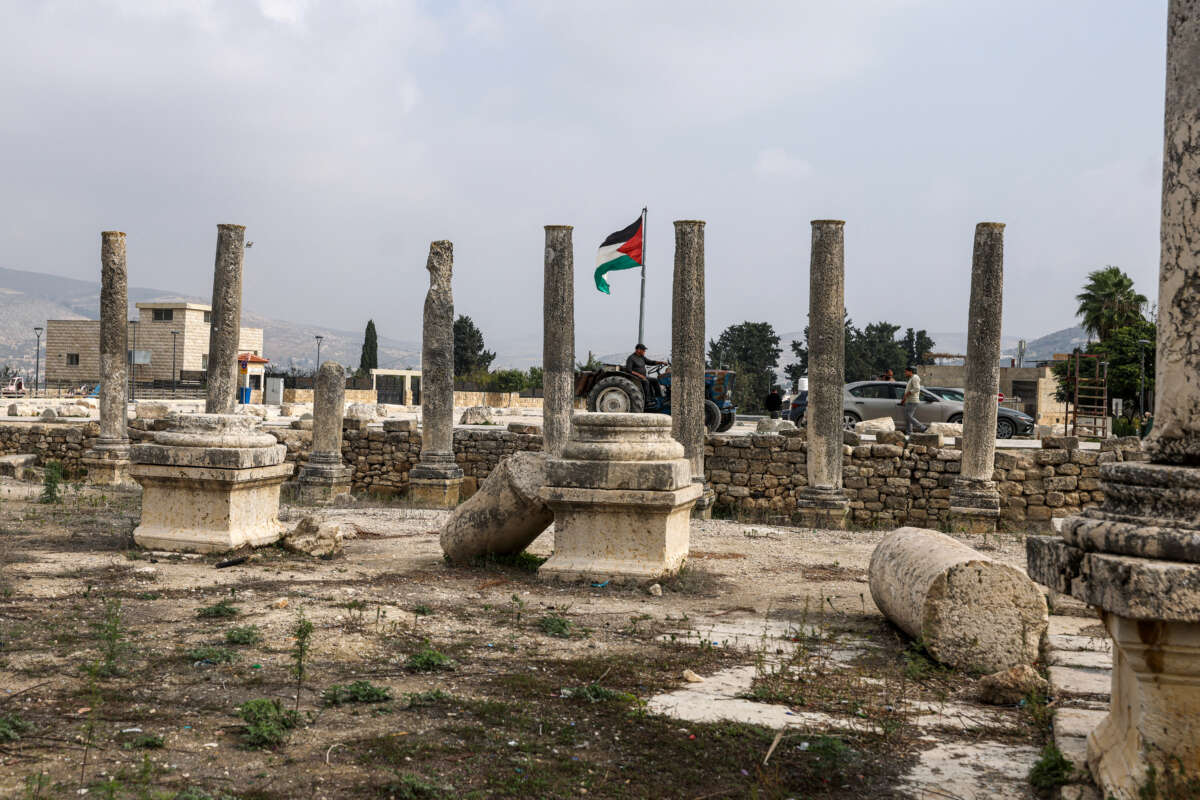
The village’s archaeological park, which is being considered for UNESCO World Heritage status, contains relics and artefacts spanning the Bronze Age (before 3,000 BC) to the Ottoman Period. Palestinian residents of Sebastia say that the ruins bear witness to Palestine’s centuries of interactions with conquering empires, while revealing Palestine’s impact on those empires in return.
The archaeological park itself falls under full Israeli military control as part of Area C. But most of the village is part of Area B, which falls under joint Israeli-Palestinian jurisdiction, according to the demarcations of the 1993 Oslo Accords.
What is most notable about the latest seizure order is that it encroaches upon land and properties in Area B and stands to change residents’ lives forever, particularly if soldiers are permanently stationed inside the village or archaeological park and if settler visits become more regular.
In May 2023, in a precursor to the national park plans, the Israeli government approved a 30 million shekel (more than $8 million) scheme to restore Sebastia’s archaeological park and establish a tourism center, new access roads, and an expanded military presence. The Israeli Civil Administration has also submitted orders for new roads to connect the surrounding settlements.
Dispossessing the Owners
Nihad Abadi, a 65-year-old farmer and father of six in Sebastia, owns a farm and hundreds of precious olive trees that have been passed down through generations. As Israel’s long-threatened “annexation” of the northern West Bank village moves a step closer, Abadi and his family face losing all of it.
“If they want to kill us in our own home, let them come and do it,” Abadi told Mondoweiss from the besieged Palestinian village. “I won’t just leave my house. I built it with my own hands, stone by stone.”
“If I lose this place, there’s nowhere else for my family to go,” Abadi added. “Fear is always here now in Sebastia, but you have to live with it. You can’t let it take over.”
Maps included in Israel’s order show the seized area covers hundreds of private plots containing 5,700 olive trees, the lifeblood of Sebastia’s economy, according to the municipality.
Abadi spoke to Mondoweiss from his increasingly dilapidated family home, which he has been unable to renovate or improve due to restrictions from Israeli authorities. It falls just within the boundaries of the land Israel plans to seize, an area equivalent to about 275 football pitches.
What is left of Abadi’s land, which once generated him a small fortune by Sebastia’s standards, is loomed over by the illegal Israeli settlement of Shavei Shomron.
Abadi tells Mondoweiss that his father remains in his late grandfather’s home, marooned on the other side of the highway from his son and nestled beneath the imposing militarized perimeter of the settlement.
As for himself, he is now unable to farm the 3,000-square-metre plot he owns and the 75 acres of land he was leasing. Abadi blames settler attacks, rising costs, and the presence of the Israeli military for his turn in fortunes. He estimates he has lost more than 300,000 shekels (over $90,000) in the past three years.
“They didn’t put any effort into this land,” Abadi says. “We and our ancestors worked it. We poured our sweat into this land. I’m more connected to it than anyone else. I was born and raised on it.”
“Israel confiscated much of my family’s lands, annexing it to the settlement,” Abadi explains. “But even so, we didn’t leave.”
Many of Abadi’s neighbors on the northwestern outskirts of the village are also facing displacement, but are too afraid to discuss their situation for fear of Israeli reprisal.
Sebastia residents had been afforded just 14 days to object to the plans through the Israeli legal system. Like hundreds of other villagers, Abadi rushed to submit documents to local authorities that prove his ownership of his home and land, in an attempt to block the seizures.
Lifelong Sebastia resident and activist Ahmad Kayed, 60, said the village was in a “state of emergency,” with residents more afraid than ever of displacement and intensifying military violence.
Local officials, including Sebastia Mayor Muhammad Azim, have condemned the international community for ignoring their continual pleas for support. Mayor Azim conceded the future for the village is “dark and bleak” and previously warned “rivers of blood” would run through the streets if Israel’s plans become a reality.
Israel’s unprecedented land seizure comes as forced displacement in rural areas and refugee camps runs rampant and settler violence reaches record levels.
A Village Under Siege
Israeli anti-settlement heritage organization, Emek Shaveh, said Sebastia would become the fifth historical site in the West Bank to be expropriated since 1967. Moreover, the seizure would be the largest of any archaeologically significant area in the state’s history.
Celebrating the move, Israeli Minister of Heritage Amichai Eliyahu, himself an illegal settler, said that “the flag of an invented people will be removed from Sebastia, and the flag of the Jewish people will be raised in its place.”
Local municipality figures, the Palestinian Minister for Tourism and Antiquities, Hani al-Hayek, and representatives from Emek Shaveh have met in Sebastia several times over the last month to work on a public information campaign and a last-ditch bid for UNESCO World Heritage recognition and international support.
At the first meeting on November 22, it was confirmed that the order will also entail the takeover of two cultural heritage gift shops, a factory, and 550 agricultural plots. Since 2020, the village has lost about 700 olive trees and 750 apricot trees due to settler damage and Israeli land seizures.
Sebastia is now surrounded by checkpoints, the illegal Israeli settlements of Shavei Shomron and Homesh, as well as dozens of unofficial settler encampments obstructing access to vast swathes of Palestinian land.
Kayed says the village has been under siege since Israeli Prime Minister Netanyahu’s far-right ultranationalist coalition rose to power in 2022. About 40 families have left Sebastia after military invasions became incessant.
“It is like an earthquake or a bomb has hit us,” he told Mondoweiss after the Israeli order was submitted. “We have never been so worried for the future of our village. And we feel alone. No one has listened to us.”
He says that the Israeli army intends to make life “unbearable” for residents until they either leave Sebastia or are forced out.
Settler politicians and ultranationalist ministers visited and announced their intentions to create “Samaria National Park” in May this year. Excavations at the site began soon after, despite being condemned as “illegal” by the Palestinian Ministry of Tourism and Antiquities and a host of civil society bodies.
Figures on the Israeli far right refer to Sebastia as Samaria, or Shomron in Hebrew, and claim it was the capital of the Biblical Kingdom of Israel nearly three millennia ago.
But most historians believe the Northern Kingdom lasted for under 200 years, while Palestinian culture has interacted with ruling empires from the Bronze Age through to the Ottoman period.
Heritage Minister Eliyahu stated on social media that “Sebastia, the capital of the ancient Kingdom of Israel, has been neglected.”
The Minister accused the PA of paving over Israeli history and “dumping waste” on Jewish relics, adding that Jews will no longer be “expelled” from their “historic homeland.” Eliyahu’s office told the media in May that there is no evidence of any Palestinian history in the village’s archaeological park.
Yet the Ottoman architecture, Hellenistic Western wall, the ruins of a Byzantine basilica, a Roman forum and amphitheater, and the remains of the Temple of Augustus tell a different story, Sebastia Archaeological Museum curator, Walaa Ghazzal, says. The Crusader-era Church of Saint John, rebuilt into a mosque, is believed to be the site of the tomb of John the Baptist, known in the Quran as Prophet Yahya, and has been a pilgrimage site for centuries.
Sebastia is one of 63 sites in the West Bank that have been designated by Prime Minister Benjamin Netanyahu as an “Israeli heritage site.” For years, the Israeli military has surveilled the site and forcibly blocked the Palestinian Authority and the municipality from carrying out any excavations, cleaning, and restoration work.
Ghazzal accuses Israel of perpetrating a “crime against history,” calling for support from historians, universities, and academics around the world “before it is too late.”
“The confiscation order is the coming of a nightmare we had long feared,” she said. “Our village has witnessed the rise and fall of many civilizations, but this does not give anyone the right to claim ownership, except for the rightful landowners who have lived on this land for generations.”
“What is happening is the illegal theft of knowledge and heritage,” she added. “Each of the civilizations that have passed through the village left its mark, which collectively forms the historical fabric of Palestine. Let us act now, not just to protect a village, but to defend a living archaeological site whose people still have access to it, enjoy its presence, and live alongside it.”
Ghazzal says that less than 10 percent of the archaeological park had been properly excavated, and the people of Sebastia have been denied the chance to unearth more of their collective heritage.
The Israeli government also issued an order last July to build a military outpost at the scenic summit of Sebastia’s archaeological park. Construction has not yet begun.
In addition, the government has outlined plans to build a “defense station” at the historic Massoudieh Station, part of the Ottoman Hejaz Railway, less than two miles away from the village. Yossi Dagan, chairman of the Shomron Regional Council that governs 35 illegal West Bank settlements, visited the site with other settlers and construction vehicles in late November to celebrate the beginning of renovation works. This week, a metal gate has been constructed by the military at the entrance to the station.
Sebastia’s ‘Second Nakba’
Since October 7, 2023, Israeli military violence in the village has intensified. There have been at least 25 gunshot injuries in the village, many involving children, while over 15 village residents have been arrested, seven of whom are still detained.
Ahmad Jazar, 14, was shot dead by Israeli soldiers in June last year, and Fawzi Makhalfeh, 19, was killed a year before. Teenager Nawar Sholi and 27-year-old Ayman Sha’er were both disabled after being shot in the thigh by soldiers’ exploding bullets.
Israel’s repression has become so severe that even peaceful protests have become too dangerous, Mayor Azim told Mondoweiss, expressing fears over losing many more village residents.
“We are fully aware of the military’s brutality and violence, and how it kills anyone who stands in its way,” he said. “However, there is no doubt about the deep sense of pride and the strong will of the people of Sebastia to protect and preserve their cultural and historical heritage and to defend their property.”
Traders told Mondoweiss they fear displacement and have lost over three-quarters of their business as tourism plummeted since October 7. Many owners have already moved their restaurants and stores to other locations in the village to avoid reprisals from the military.
An average of 150,000 international tourists, Christian pilgrims, and Palestinians from across the West Bank would visit Sebastia annually before October 7. Now there are fewer than 500 guests per month, the municipality says.
While speaking with Mondoweiss, Kayed says he doesn’t want to imagine life without the views from the hillsides of the archaeological park, the most beautiful place to admire the sunset in Palestine.
Kayed reminisces about planting olive trees with his late mother while taking phone calls from international journalists and national ambassadors. Some of the trees his family and other villagers had nurtured had been uprooted by recent Israeli excavations or burned by settlers.
“These trees are part of our life, part of our soul,” he said. ”But we cannot even reach our land now. We cannot feed ourselves.”
Now, Kayed believes that the village faces a “second Nakba.” He gestures towards a particularly charred and decaying tree, with Sebastia’s dramatic Roman-era western wall behind it, whose stones were defaced by Israeli settler graffiti depicting Stars of David.
“Ours is the story of these trees,” he observed. “They want us to die as these trees have.”
He then points to a tree stump sprouting fresh shoots. “But we will learn from them, and we will grow again.”
A terrifying moment. We appeal for your support.
In the last weeks, we have witnessed an authoritarian assault on communities in Minnesota and across the nation.
The need for truthful, grassroots reporting is urgent at this cataclysmic historical moment. Yet, Trump-aligned billionaires and other allies have taken over many legacy media outlets — the culmination of a decades-long campaign to place control of the narrative into the hands of the political right.
We refuse to let Trump’s blatant propaganda machine go unchecked. Untethered to corporate ownership or advertisers, Truthout remains fearless in our reporting and our determination to use journalism as a tool for justice.
But we need your help just to fund our basic expenses. Over 80 percent of Truthout’s funding comes from small individual donations from our community of readers, and over a third of our total budget is supported by recurring monthly donors.
Truthout’s fundraiser ended last night, and we fell just short of our goal. But your support still matters immensely. Whether you can make a small monthly donation or a larger one-time gift, Truthout only works with your help.