Truthout is a vital news source and a living history of political struggle. If you think our work is valuable, support us with a donation of any size.
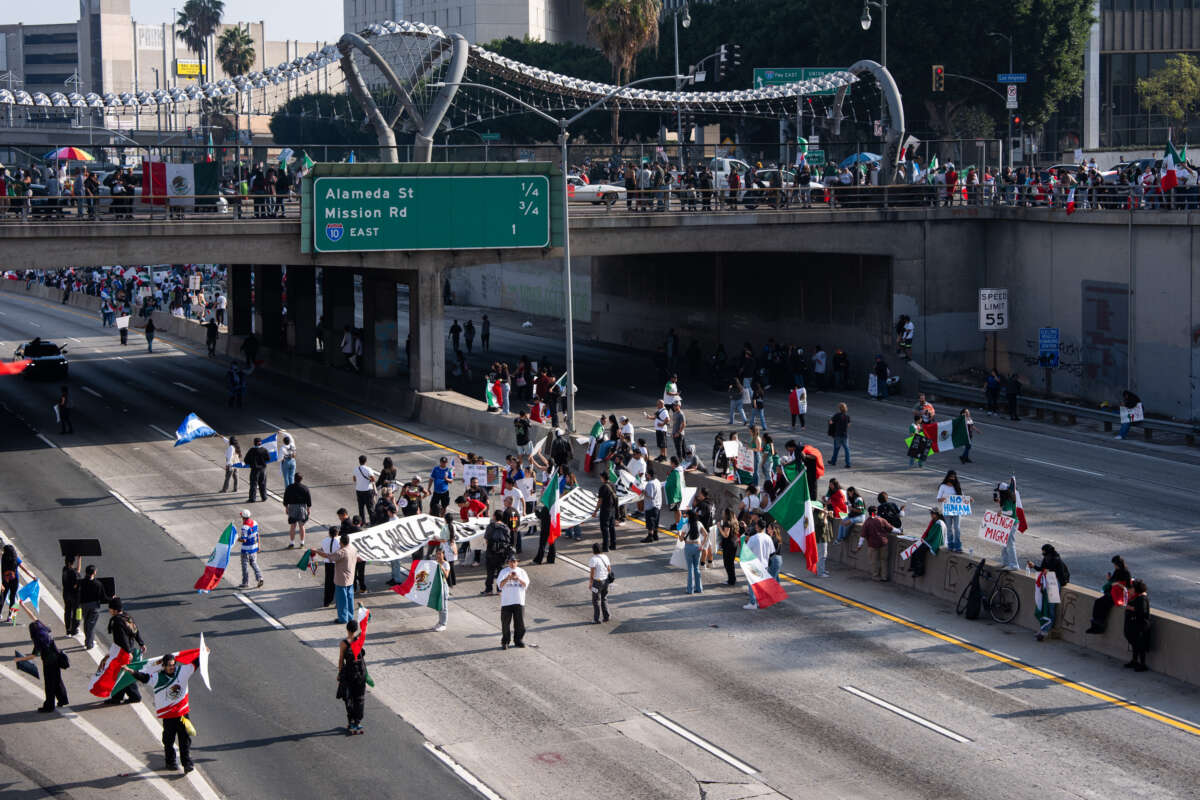
From people taking over campus lawns in solidarity with Gaza, to freeway blockades protesting police and immigration enforcement brutality in 2025, to the 2011 Arab Spring and Occupy Wall Street protests: the activist takeover of space is an important technique for social change and justice. While many folks refer to these takeovers as “occupations,” others (including myself) refer to them as “counteroccupations” to emphasize that many of the locations where they take place are already occupied by oppressive governments or institutions.
Regardless of the label we use to describe them, this method of activism is quite popular and movements around the world use this tactic in many ways. Some groups temporarily take over a space simply to get attention for a certain issue. It can essentially be a tool of protest designed to make other people and governments hear their demands. People may put themselves in a place where they “aren’t supposed to be” to get media attention for their issue. They may block a freeway to bring attention to the issues of police violence and racialized urban inequalities, or they may climb a polluting factory to hang a protest banner in an off-limits space to embarrass a polluting company. In these ways, activists may take over spaces not with the intent of staying around and controlling them, but as Bart Cammaerts puts it, just to create “extreme speech acts — a crying out for visibility” designed to strengthen existing demands.
On the other hand, some protesters take over a space with the aim of physically disrupting a particular event: like blocking a meeting where people are making decisions that increase inequality, exclusion, or environmental damage. Examples of this would be the massive anti-globalization protests in Seattle, Genoa, Cancún and other sites where the World Trade Organization and other international financial institutions met in the late 1990s and early 2000s. There are also actions that use counteroccupation tactics in order to block a specific construction project, destructive activity, or the circulation of a dangerous commodity. The struggles against the Dakota Access Pipeline in South Dakota, the Maunakea telescope project in Hawai‘i, forest clearcutting projects in the American West, the Coastal GasLink pipeline in the Wet’suwet’en Nation, as well as the protests in the Nevada desert against nuclear weapons testing in the 1980s and 1990s, have all made use of these kinds of counteroccupation and blockade tactics.
These tactics up the ante from protests that simply make demands in that they are not just trying to be visible and get the public’s attention. They are physically blocking the state’s (or a corporation’s) ability to act in a place. Some movements may then use these blockading tactics in order to gain leverage for the demands they are making of existing governing institutions. However, some movements — and this is crucial — are not using the tactic to ‘ask’ for anything or improve their bargaining position for a demand. Instead, they are using the tactic with the aim of supplanting the existing institutions of governance.
From Counteroccupation to Replacing the State
One fall morning in 2014 I had the opportunity to watch something that changed forever how I viewed political action and strategies for social change. I was visiting the island of Okinawa to study U.S. plans to construct a new military base, but I was also there to learn more about activist tactics from the people who were organizing against it. On the beach that morning a group of protesters in kayaks set out to sea in order to make a rather daring claim: that a section of the nearby bay should not be a military base, but instead be a place governed by local citizens according to the ethics of environmental protection, community health, and peaceful international relations. What made their claim so daring was who they were up against and the way they made this claim. These kayakers heading off into the waters offshore of Henoko Village were taking on the combined power of the Japanese government and the U.S. military. These two powerful entities had decided — against overwhelming public opposition — that the waters off of Henoko should be filled in with sediment and turned into a new U.S. Marine Corps Air Station. The kayakers, however, had other ideas.
People in Okinawa have had a difficult time effectively influencing government policies through elections and protests. Okinawa’s history, though, is unique in that this group of islands (which lay between Taiwan and the main islands of Japan) were once the independent Ryukyu Kingdom, but they are now the site of a “double colonization” where local desires and self-determination have been thwarted by both the Japanese and U.S. governments. Okinawa was annexed by Imperial Japan in 1879 and since the end of World War II the main island has been used as a site for a large collection of U.S. military bases which cause numerous social and environmental problems for the 1.3 million residents. People have tried to influence the governments in Tokyo and Washington D.C. to reduce the burden of the bases, but negotiations in the 1990s only went so far as to promise closing one problematic base in central Okinawa (Futenma Marine Corps Air Station) if another one is built to replace it in the Henoko area of northern Okinawa. Island residents have elected anti-base governors one after another, but these governors have not been able to stop the plans of the U.S. military or the Japanese central government. In February of 2019 Okinawans went to the polls and over 72 percent voted against the construction of the new base. Both the U.S. and Japanese governments, however, claimed they did not have to heed the results. Even as the COVID-19 epidemic raged in the spring of 2020, the Japanese Supreme Court ruled the construction of the base could continue. In early 2025 that same court denied the last active lawsuit from the local prefectural government which aimed to halt the project. All told, thousands of people in Okinawa have engaged in protests that fill streets (and even whole stadiums) over the past few decades. Still, the construction moves forward. Faced with this situation, people in Okinawa have had to come up with other tactics to try and govern their island according to the will of the people that call it home.

It is not just in Okinawa, of course, where activists have been using this tactic. Over the past several decades, demonstrators around the world have been performing counteroccupations that attempt to replace the state. While many of these kinds of protests erupt in places (like Okinawa) with long histories of colonial repression, people living in other places are also now seeing that the systems of governance that rule over them are sliding evermore toward being dictatorial and unresponsive. Folks in these situations can learn a lot from the experiences of communities where people have long had few illusions that the ruling powers are trying to help.
That fall morning back in 2014, I hopped in a small boat piloted by activists who were supporting and documenting the kayakers. As we sped out of the fishing port and into the small swells of the Pacific, we caught up to kayakers arrayed on the edge of a floating barrier that marked the restricted area of the bay. On the other side of the barrier were Japanese Coast Guard boats warning the protesting kayakers not to enter the cordoned waters. Eventually, one kayaker traversed the floating barrier. As he did this, the Coast Guard boats descended upon him. This however left gaps in the Coast Guard’s line which other kayakers exploited. The bulk of kayakers then entered the waters that were officially the jurisdiction of the U.S. military. The outnumbered Coast Guard boats then retreated further back towards the shore and monitored the situation while the kayakers paddled triumphantly through the exclusion zone in the bay.
At first, I thought about this as a tactic of protest — a way for activists to use civil disobedience to bring attention to an issue, to voice disagreement with a government policy, and demand a change. Through observations and conversations with activists, however, I realized that something much different was happening. I had personally participated in and witnessed occupation-style protests in a number of places in the past, but that morning in Okinawa I saw that something more was going on here. These activists were not merely protesting against something and asking for different policies. They were directly taking over the space, challenging both the U.S. and Japanese governments’ right to govern the bay, and making the claim that the place should be managed according to local life-affirming ethics. In short, the kayakers were attempting to block the governing power of unrepresentative institutions while also replacing it with citizen-led management. The activists offshore from Henoko Village decided to halt the unwanted destruction of their bay by physically putting themselves in that place and attempting to change how it is governed. By doing so, they were undermining the legitimacy of claims by both the distant U.S. and Japanese central governments to control what happens in this place. In the local view, the Japanese and U.S. governments were undemocratically and unfairly imposing a massive project that was sure to have enormous negative political, economic, social, and environmental impacts. The solution to this was to try to wrest control of the space and govern it according to different ethics — whether the official state powers wanted them to or not. I refer to this as ‘replacing the state’.
From Resisting Authority to Creating Authority
Replacing the state involves having an alternative vision for a place, but it is also about claiming to have the authority and developing the ability to make the vision real in that space, regardless of what state or corporate actors want to do there. The importance of this cannot be understated. When activists move beyond reform, resilience, and resistance (the three Rs of ineffective activism) and start being able to dictate what will occur in a place and develop the logistical capabilities to make it happen, then activists cross a line into a whole new realm of strategy. Activists can stretch beyond electoral campaigns, government petitions, demands, and counteroccupations that just resist a project or policy. Instead, they can become creative agents building an alternative system of governing in a place.
To put it simply, more and more of us are recognizing that our current governments, electoral processes, and non-confrontational methods of protest are not enough to really make the world better. It is therefore critical to consider other strategies and tactics. The more people are excluded from effective participation in traditional politics, economic opportunity, maintaining the health of their communities, and environmental decision-making, the more it makes sense to pursue tactics like creating counteroccupations which aim to replace the state.
Press freedom is under attack
As Trump cracks down on political speech, independent media is increasingly necessary.
Truthout produces reporting you won’t see in the mainstream: journalism from the frontlines of global conflict, interviews with grassroots movement leaders, high-quality legal analysis and more.
Our work is possible thanks to reader support. Help Truthout catalyze change and social justice — make a tax-deductible monthly or one-time donation today.