Truthout is a vital news source and a living history of political struggle. If you think our work is valuable, support us with a donation of any size.
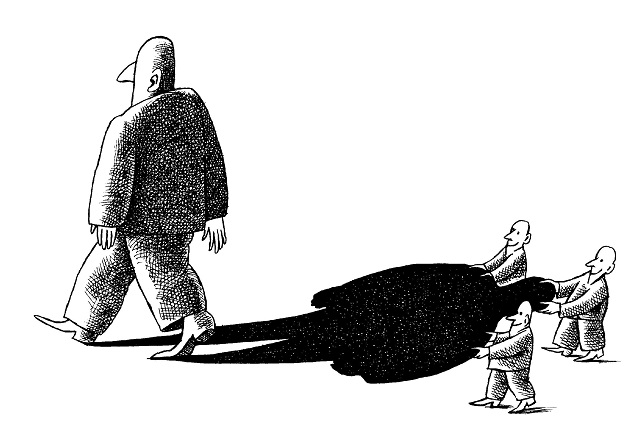
Here comes another billionaire who thinks that anyone who talks about income inequality is a Nazi; this time it’s Ken Langone, the co-founder of Home Depot. I don’t have anything useful to say about this, other than observing that there must be a lot of these guys.
I mean, there aren’t that many billionaires. Our sightings of multiple examples of the genus that not only believes that progressives are just like Hitler but will say so in public must indicate that a substantial proportion of our billionaires share this belief, but they’re more private about it.
Luckily, great wealth doesn’t bring great political influence in modern America – does it?
Jonathan Cohn’s recent article on Mr. Langone in The New Republic brought to mind an earlier rant by the same guy on Bloomberg TV, in which he denounced yours truly and my “highfalutin thoughts and ideas.” And I think that this rant (and others like it) gives a partial clue to the mystery of the continuing popularity of the Wall Street “macro canon,” despite its total failure in practice.
What, after all, was Mr. Langone raging against?
Well, me, of course. But not, presumably, against “highfalutin” ideas in general: Mr. Langone can’t really be a stupid man, and I’m sure that when it comes to, say, information systems for inventory management, he’s quite willing to accept the idea that some things are technical and require some knowledge.
No, what I think he’s really raging against are two things. First is the idea that understanding economics, as opposed to other issues, might involve some kind of special expertise. This is an all-too-common problem among the wealthy, and maybe especially among self-made men: they think that their personal financial success means that they understand the economic system, and they bristle at the notion that macroeconomics may be more than the sum of individual business strategies.
The other source of his rage – and this, I think, gets at the roots of the right-wing canon – is his fury at the notion that sometimes scarcity doesn’t rule. For many people on the right, it has to be true – just has to be true – that prosperity is limited by the willingness of productive people (that is, people like them) to produce.
The idea that sometimes the problem is instead a lack of demand, that the failure is a system malfunction rather than a lack of sufficient effort, is anathema. Among other things, it suggests that sometimes people succeed or fail for reasons that have nothing to do with their personal talents and virtues or lack thereof, a suggestion that men like Mr. Langone – who believe that their personal success was entirely earned – find deeply offensive.
And so when anyone says that this is a depressed economy in which deficits don’t crowd out private spending, and in which printing money doesn’t mean inflation that expropriates their hard-earned wealth, they don’t listen to the argument, let alone pay attention to the evidence.
They take it as a personal affront, and start yelling about highfalutin nonsense.
Important Message: Please Read
For 25 years, Truthout has survived by publishing impactful investigative journalism and analysis; distributing full editions 365 days a year; and building a community of readers who support us with small, hard-earned donations.
Eighty percent of our $3 million yearly budget comes from small donors alone. Of those, 8,000 readers support us with monthly donations. Back in 2018, when Facebook decided to suppress the circulation of posts made by organizations, thereby cutting readers off from seeing many articles shared by the news organizations they had intentionally decided to follow, Truthout’s total traffic declined by 40 percent, as nearly all of our traffic from that platform disappeared.
Now, Google has recently rolled out its AI search bar, providing AI summaries instead of directing readers to our site. Google Search is our single largest source of traffic; it’s the route by which nearly one third of our readers find us. Much like in 2018, a shocking 40 percent of our Google traffic has disappeared overnight.
It will not be easy for Truthout to shoulder this blow. Nor will it be easy for our peers and collaborators — news sites that depend on traffic and aren’t bankrolled by large corporations.
If you can support Truthout with a donation today, you can help us resist the AI onslaught. Please give today.