Did you know that Truthout is a nonprofit and independently funded by readers like you? If you value what we do, please support our work with a donation.
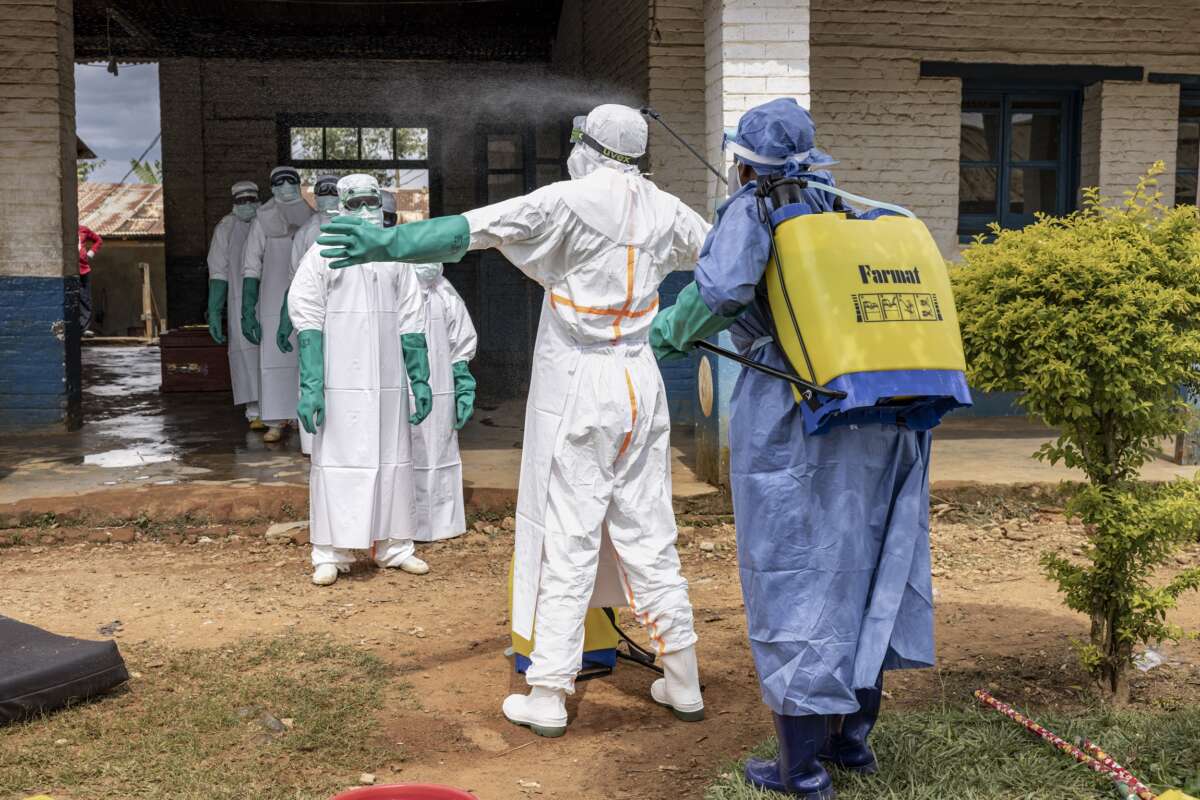
Trump administration cuts to grants disbursed by the United States Agency for International Development (USAID) likely resulted in a delayed response to the current Ebola outbreak in parts of central Africa, former federal health officials have said.
As of Monday, at least 220 people are suspected to have died from Ebola in the Democratic Republic of the Congo (DRC) and Uganda. More than 500 cases of Ebola have been detected in Congo alone.
Though the virus was officially uncovered just last week, it’s believed that it had been spreading undetected for at least several weeks prior.
The Trump White House dismantled USAID last year, with the State Department absorbing its remaining necessary programs. The cuts affected billions of dollars in grant money for thousands of programs and nonprofit organizations around the world.
If left intact, some of that funding could have resulted in faster detection times for the current outbreak, former federal officials within USAID, the Centers for Disease Control and Prevention (CDC), and the National Institutes of Health (NIH) told NBC News,
“What we’ve lost is speed, which is the most important thing in an outbreak like this,” said Nicholas Enrich, former acting assistant administrator for global health at USAID.
People who were once employed in programs funded by the U.S. have had to find new jobs, former CDC medical officer Daniel Bausch pointed out.
“Now they’re driving a taxi in Kinshasa or selling fruit somewhere. So this cadre of reasonably trained people that you can employ just isn’t around,” Bausch explained.
Heather Reoch Kerr, country director for the International Rescue Committee (IRC) in the DRC, also said the lack of funding is disrupting the response to the Ebola outbreak.
“Many facilities in affected areas are operating without basic protective supplies” because of cuts to USAID, Reoch Kerr said.
World Health Organization (WHO) Director-General Tedros Adhanom Ghebreyesus recently addressed the outbreak, saying that health officials within the organization are prepared to tackle the situation head-on. However, “we are facing an extremely serious and difficult outbreak,” Tedros added. “It will get worse before it gets better.”
The cuts to USAID, as well as the Trump administration’s decision to exit WHO (a choice that was finalized earlier this year), will undoubtedly disrupt global health responses, like what’s being seen in central Africa right now, health experts predicted.
The cuts have “disrupted the ability for contact tracing to happen, for those preventive activities to be mounted very well,” Abraham Leno, director of government relations for the humanitarian organization Alight, told The Hill.
Other experts predicted this outcome several months ago.
“Because of these two decisions and the long-lasting consequences, lives will be lost,” said Lindsey Locks, an assistant professor of Global Health at Boston University, in an op-ed last year.
Beyond disease outbreaks, the Trump administration’s decisions will “reverse decades of progress in reducing malnutrition and hunger worldwide,” Locks said.
The administration’s moves to dismantle international health infrastructure will “weaken the shared governance architecture for outbreak preparedness and response,” Chatham House fellow Ebere Okereke wrote in January.
“The WHO’s authority has been diminished,” Okereke added, noting, “Disease surveillance depends on trust.”
Important Message: Please Read
For 25 years, Truthout has survived by publishing impactful investigative journalism and analysis; distributing full editions 365 days a year; and building a community of readers who support us with small, hard-earned donations.
Eighty percent of our $3 million yearly budget comes from small donors alone. Of those, 8,000 readers support us with monthly donations. Back in 2018, when Facebook decided to suppress the circulation of posts made by organizations, thereby cutting readers off from seeing many articles shared by the news organizations they had intentionally decided to follow, Truthout’s total traffic declined by 40 percent, as nearly all of our traffic from that platform disappeared.
Now, Google has recently rolled out its AI search bar, providing AI summaries instead of directing readers to our site. Google Search is our single largest source of traffic; it’s the route by which nearly one third of our readers find us. Much like in 2018, a shocking 40 percent of our Google traffic has disappeared overnight.
It will not be easy for Truthout to shoulder this blow. Nor will it be easy for our peers and collaborators — news sites that depend on traffic and aren’t bankrolled by large corporations.
If you can support Truthout with a donation today, you can help us resist the AI onslaught. Please give today.