Honest, paywall-free news is rare. Please support our boldly independent journalism with a donation of any size.
Migrant children incarcerated at a now-closed facility next to an Air Force Reserve base outside of Miami were exposed to toxic chemicals such as arsenic and lead, which are linked with developmental harm and cancer, according to more than 20,000 pages of records released as part of federal litigation over the site.
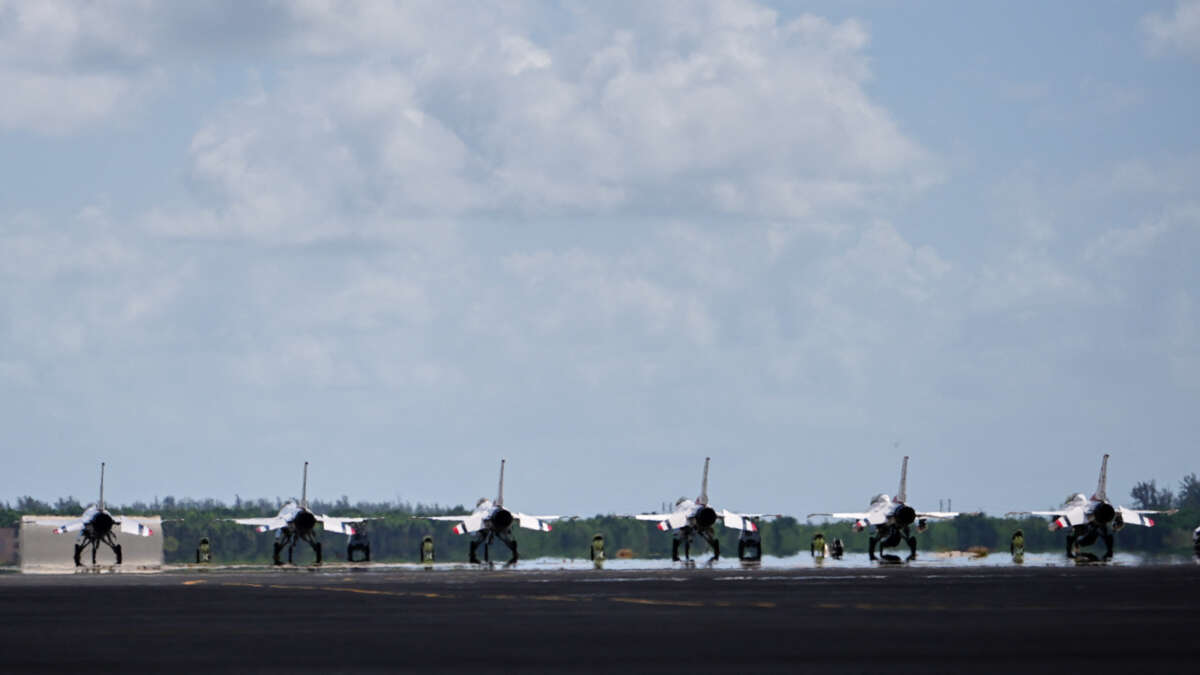
The Homestead migrant detention center for unaccompanied children, which closed in 2019, was situated adjacent to Homestead Air Reserve Base, a Superfund site, according to the social justice and environmental groups that sued in 2021 to make the documents public. The children, who were as young as six years old, also were subjected to the constant noise of F-16C fighter jets taking off and landing at the base, as well as sexual abuse, the groups said.
The litigation concluded last week after the federal government agreed to pay the groups’ legal fees. Earthjustice filed the lawsuit on behalf of the American Friends Service Committee in the U.S. District Court for the District of Columbia, naming as defendants the Air Force, the Department of Homeland Security and Immigration and Customs Enforcement. The Air Force declined to comment on the litigation. The Department of Homeland Security referred inquiries to the Department of Health and Human Services, which also declined to comment.
The situation fits a nationwide pattern of migrants incarcerated in harmful environments, said Guadalupe de la Cruz, Florida program director at the American Friends Service Committee. Some 60 miles northwest of the site, thousands of undocumented migrants were held in tents at the facility known as Alligator Alcatraz, which opened last year during hurricane season in a remote region of the Everglades. That facility closed this past June.
“It really does mark a victory of how much pressure organizations can be putting on the government for accountability,” said de la Cruz, of the Homestead site. “It really shows the repeated pattern, that the government has created facilities in areas that are not adequate to provide safe conditions for children or people to be in, and it’s become a common practice for the government to use contaminated land to set up detention facilities.”
The Obama administration opened the Homestead facility for children in 2016 as an “emergency influx shelter.” The Trump administration closed it briefly in 2017 but reopened it the next year, and its population swelled to more than 3,700 before the site closed amid public pressure, the groups said. The records the groups obtained showed some of the children detained at the facility were not unaccompanied minors but were taken from their parents at the U.S.-Mexico border. Despite the known history of contamination there, the documents revealed there was no evaluation for environmental hazards or remediation of the affected areas.
The site was near 16 sources of contamination, a concern in a coastal area vulnerable to intensifying hurricanes as the global climate warms. Hurricane Andrew destroyed much of the base in 1992, and a lack of a hurricane plan was another reason the detention facility closed. The contaminants are linked with developmental harm in children and can cause cancer and damage to the kidneys, liver and immune system. The fighter jet noise was at levels associated with cognitive injury and developmental harm. At one point the facility was the largest juvenile detention center in the country, the groups said.
“We need to be vigilant. We need to make sure, for kids but also for anybody, that the potential risks for health are being taken into account,” said Tania Galloni, managing attorney for the Florida regional office at Earthjustice. “We don’t think that happened here, and we don’t ever want to see that happen again.”
Important Message: Please Read
For 25 years, Truthout has survived by publishing impactful investigative journalism and analysis; distributing full editions 365 days a year; and building a community of readers who support us with small, hard-earned donations.
Eighty percent of our $3 million yearly budget comes from small donors alone. Of those, 8,000 readers support us with monthly donations. Back in 2018, when Facebook decided to suppress the circulation of posts made by organizations, thereby cutting readers off from seeing many articles shared by the news organizations they had intentionally decided to follow, Truthout’s total traffic declined by 40 percent, as nearly all of our traffic from that platform disappeared.
Now, Google has recently rolled out its AI search bar, providing AI summaries instead of directing readers to our site. Google Search is our single largest source of traffic; it’s the route by which nearly one third of our readers find us. Much like in 2018, a shocking 40 percent of our Google traffic has disappeared overnight.
It will not be easy for Truthout to shoulder this blow. Nor will it be easy for our peers and collaborators — news sites that depend on traffic and aren’t bankrolled by large corporations.
If you can support Truthout with a donation today, you can help us resist the AI onslaught. Please give today.