Did you know that Truthout is a nonprofit and independently funded by readers like you? If you value what we do, please support our work with a donation.
If Democrats are Charlie Brown — and they could be — Texas is the political football yanked away at the end of every game. Promising candidacies continue to endure painful yet predictable losses, which clock in close enough to hold on hope for next time.
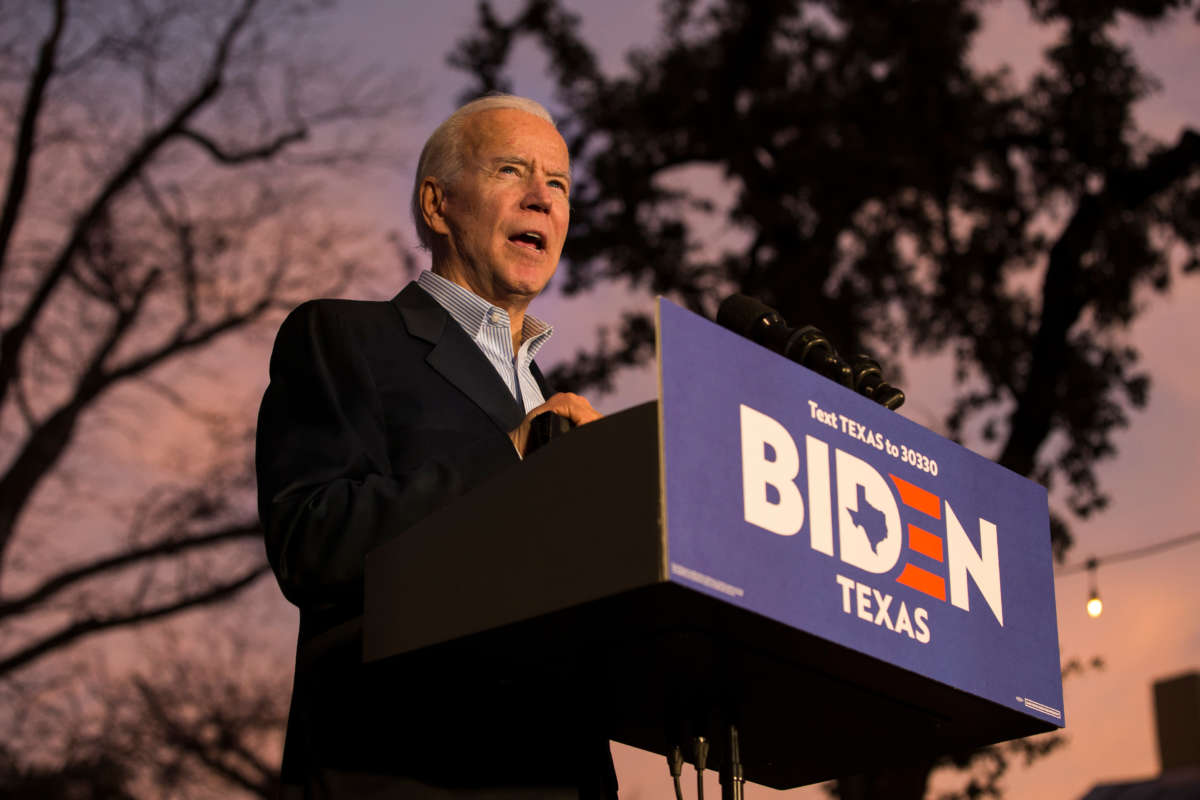
The polls are teeing them up again in 2020. A new CBS News/YouGov survey finds President Donald Trump up one point over former Vice President Joe Biden among Texas voters at 46% to 45%. That’s well within the margin of error.
And that poll is not an outlier. An average of the eight Texas public polls since May shows Biden and Trump in a statistical tie, with Biden up by 0.3 points. A Real Clear Politics average of five recent polls also rules the race a tie, and FiveThirtyEight’s weighted average puts Trump up by only 0.1 points.
A few factors are driving the numbers, including the heavily-criticized response of Republican leadership to the coronavirus pandemic as cases surge across the state. Houston has turned into the country’s most intense hotspot. In a recent Dallas Morning News/UT Tyler poll, only 38% of Texans approved of Trump’s performance.
Though Texas has been over-hyped as a swing state, Democrats have posted numbers unmatched in a generation. This is sparked by accelerating shifts across a number of key political demographics, such as increases in Hispanic voters. Perhaps less well documented is an injection of college-educated white voters in the state’s most populous cities: Austin, Dallas, Houston and San Antonio.
Texas, however, is a massive state, and flipping it would likely require an immense well of resources and time, which may be better placed elsewhere. Besides, the state is not an electoral tipping-point: The race can be won on other more manageable battlegrounds.
Though the Biden campaign has engaged voters across the state, holding virtual roundtables, community meetings and calls, it has so far shown a reluctance to mess with Texas. In a statement to Salon, the campaign suggested it would let voters make the call for themselves, pointing to Trump’s botched response to the pandemic.
“Texans won’t forget Trump’s inability to lead our country during this pandemic, and this fall they will have the opportunity to make a change and send Joe Biden to the White House,” the campaign said.
Trump Campaign Deputy National Press Secretary Samantha Zager dismissed any speculation out of hand.
“Democrats like to pretend Texas is on the table, but they know that’s a joke — just ask Governor Wendy Davis, Senator Beto O’Rourke and President Hillary Clinton,” she told Salon in an email, in an attempt to comedically mock the defeats of three recent high-profile candidates.
Zager has a point: Pundits who predicted upsets got three wake-up calls in a row. But election experts do not point to past results. They point to current data, and they point to trends.
In that sense, Zager’s black-and-white claims belie the troubling reality facing the Trump campaign: The margin of victory shrank considerably between each of those races.
First, Davis’ 2014 gubernatorial bid drew national attention — and national dollars — after her forceful 13-hour filibuster against a 2013 anti-abortion bill. Davis ultimately lost her race to Republican Greg Abbott by 20 points.
Clinton’s candidacy, or perhaps Trump’s vulnerabilities in the heavily-Hispanic state, built up more buzz in 2016. However, Clinton never got within three points, coming closest in early August on the heels of Trump’s disparaging remarks about a Muslim Gold Star family. When she lost the state by nine points, she became the first Democratic president to come within single digits since the 1990s. It was one of the 10 tightest wins that year for Trump.
The gap narrowed again in 2018 with the Senate candidacy of former Rep. Beto O’Rourke, a spirited, resolute young politician whose image seemed to capture something central about the generational changes across the state. He sprung to the national stage only a few months before the election, pulling tens of millions of dollars in donations from around the country. Though he ran a tight race, O’Rourke came up three points short of Republican opponent Ted Cruz.
What’s more: This year’s Senate race may be competitive, too. In the CBS/YouGov poll, Sen. John Cornyn was up six points (against Royce West) or eight points (against MJ Hegar) against his possible Democratic challengers. Recent state polling shows that about one-third of Texas voters are still undecided, even about their 18-year incumbent.
Also, the Cook Political Report anticipates that as many as six Republican-held House seats may realistically flip in November. In other words, at least certain races in Texas are very much in play for Democrats.
Today, Larry Sabato’s Crystal Ball project at the University of Virginia lists Texas as “leans Republican.” But the group says that is not a lock.
“We still think Trump is favored in Texas,” Kyle Kondik, the site’s managing editor, told Salon. “But the numbers are what they are.”
“The state is becoming more competitive, and the Democratic growth is being driven to no small degree by the migration of white voters with four-year college degrees into the Democratic Party — or at least into the anti-Trump column,” he continued. “We see this kind of trend in highly-educated places across the country, and that includes a lot of suburban congressional districts in Texas.”
“At this point, I think our best guess would be that the presidential race would look a lot like the Senate race in 2018 — close, but with a Republican edge,” Kondik added. “However, even that would be close for comfort for Republicans, who cannot put together a plausible Electoral College majority without Texas.”
Sabato’s Crystal Ball currently has four states in the “toss-up” category: Arizona, Florida, North Carolina and Wisconsin. Nonetheless, Texas polls have been consistently closer than all four.
Asked whether this trend could nudge Texas into the toss-up column, Kondik said: “If it still looks like this come Labor Day, quite possibly.”
Important Message: Please Read
For 25 years, Truthout has survived by publishing impactful investigative journalism and analysis; distributing full editions 365 days a year; and building a community of readers who support us with small, hard-earned donations.
Eighty percent of our $3 million yearly budget comes from small donors alone. Of those, 8,000 readers support us with monthly donations. Back in 2018, when Facebook decided to suppress the circulation of posts made by organizations, thereby cutting readers off from seeing many articles shared by the news organizations they had intentionally decided to follow, Truthout’s total traffic declined by 40 percent, as nearly all of our traffic from that platform disappeared.
Now, Google has recently rolled out its AI search bar, providing AI summaries instead of directing readers to our site. Google Search is our single largest source of traffic; it’s the route by which nearly one third of our readers find us. Much like in 2018, a shocking 40 percent of our Google traffic has disappeared overnight.
It will not be easy for Truthout to shoulder this blow. Nor will it be easy for our peers and collaborators — news sites that depend on traffic and aren’t bankrolled by large corporations.
If you can support Truthout with a donation today, you can help us resist the AI onslaught. Please give today.