Honest, paywall-free news is rare. Please support our boldly independent journalism with a donation of any size.
As Floridians raced to prepare for and escape the path of Hurricane Milton, an analysis published Monday showed that high sea-surface temperatures fueling the monstrous storm’s rapid intensification were made between 400 and 800 times more likely by the climate crisis.
The research organization Climate Central noted that Milton, which is expected to make landfall in the populous Tampa Bay metropolitan area on Wednesday night, is a “historically powerful” storm that has “undergone extreme rapid intensification over sea surface temperatures warmed by climate change.”
Sea-surface temperatures in the area where Milton has developed “are at or above record-breaking highs,” Climate Central observed, conditions that have allowed the storm to quickly become what the U.S. National Hurricane Center (NHC) described as an “extremely serious threat to Florida,” a state still reeling from the destructive Hurricane Helene.
“Climate change clearly warmed the Gulf waters that fueled Milton’s development, likely supercharging its rapid intensification and making this hurricane much more dangerous,” said Daniel Gilford, a meteorologist at Climate Central. “Fossil fuel pollution is amplifying this threat.”
As New York Times climate reporters Raymond Zhong and Mira Rojanasakul explained Monday, “For a year and a half now, the upper layer of the world’s oceans has been at or near its hottest temperatures on record.”
“The seas absorb most of the extra heat that carbon dioxide and other greenhouse gases trap near Earth’s surface,” the pair wrote. “So the same human-caused forces that have been bringing abnormal heat to towns, cities, and landscapes are helping to warm the oceans.”
Milton exploded from a tropical storm to a Category 5 hurricane in just over 24 hours — intensification that scientists Jeff Masters and Bob Henson called “a spectacular and ominous feat.” The storm has since weakened slightly to a Category 4 as it moves across the Gulf of Mexico, but it is still expected to be devastating.
“It is very likely that Milton will be a highly destructive hurricane costing over $10 billion for Florida — and Milton could end up placing among the costliest U.S. hurricanes on record, depending on the eventual details of landfall,” they wrote Monday. “The risk is also high that Milton will be very deadly if people in low-lying areas do not heed evacuation orders and flee the hurricane.”
Conditions causing Milton were made 400-800x more likely by climate change. This is a climate emergency https://t.co/QKv15CjVwI
— Saul (@saaaauuull) October 8, 2024
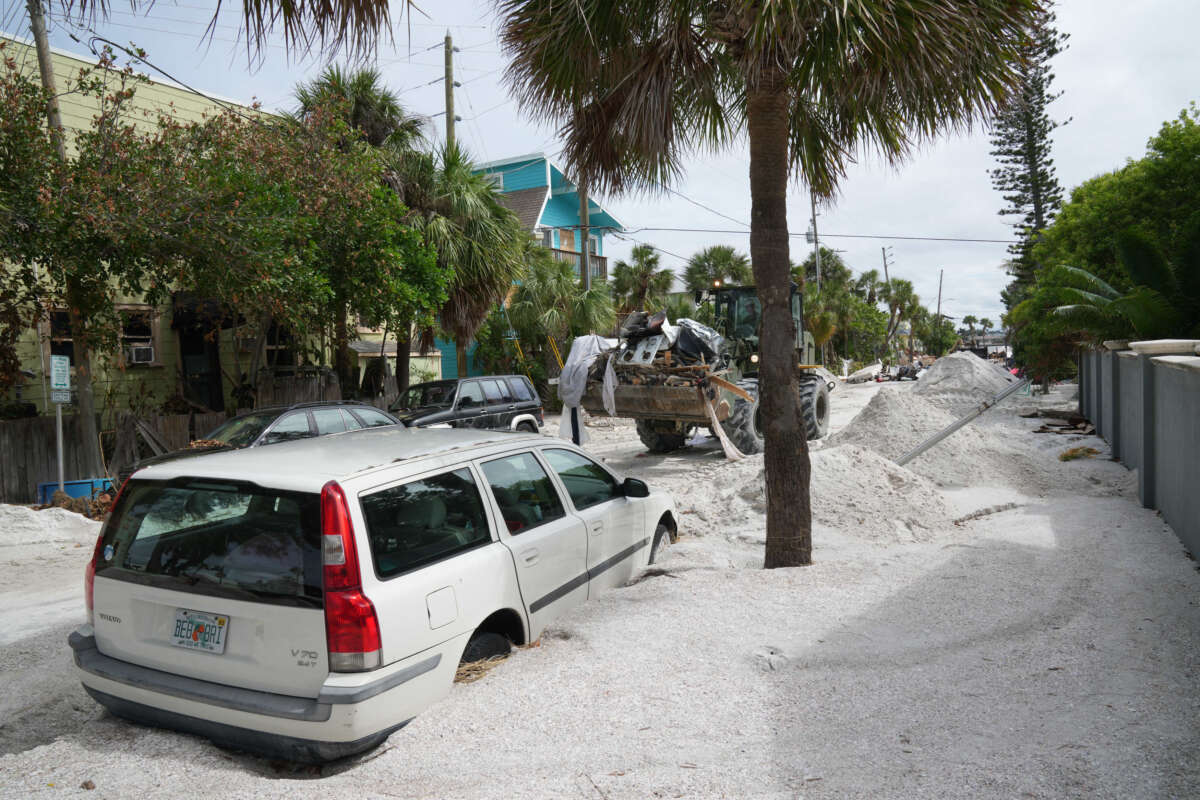
Many Florida counties are under voluntary or mandatory evacuation orders as Milton barrels toward the state just days after Helene ripped through the region, wreaking deadly havoc across six states.
“Some of the same communities ravaged by Helene are now facing this new threat. Millions of Floridians may be asked to evacuate,” the American Red Cross said in a statement. “Helene and Milton are both examples of how extreme weather is becoming more frequent and intense. In this case, meteorologists say Helene’s intense and far-reaching rainfall — which extended hundreds of miles from the coast — can be attributed to the climate crisis. And Milton is already the third-fastest rapidly intensifying storm on record in the Atlantic, according to more than 40 years of data from the National Hurricane Center.”
The Associated Press noted late Monday that “as evacuation orders were issued, forecasters warned of a possible 8- to 12-foot (2.4- to 3.6-meter) storm surge in Tampa Bay.”
“That’s the highest ever predicted for the region and nearly double the levels reached two weeks ago during Helene,” AP reported, citing a spokesperson with the NHC.
Important Message: Please Read
For 25 years, Truthout has survived by publishing impactful investigative journalism and analysis; distributing full editions 365 days a year; and building a community of readers who support us with small, hard-earned donations.
Eighty percent of our $3 million yearly budget comes from small donors alone. Of those, 8,000 readers support us with monthly donations. Back in 2018, when Facebook decided to suppress the circulation of posts made by organizations, thereby cutting readers off from seeing many articles shared by the news organizations they had intentionally decided to follow, Truthout’s total traffic declined by 40 percent, as nearly all of our traffic from that platform disappeared.
Now, Google has recently rolled out its AI search bar, providing AI summaries instead of directing readers to our site. Google Search is our single largest source of traffic; it’s the route by which nearly one third of our readers find us. Much like in 2018, a shocking 40 percent of our Google traffic has disappeared overnight.
It will not be easy for Truthout to shoulder this blow. Nor will it be easy for our peers and collaborators — news sites that depend on traffic and aren’t bankrolled by large corporations.
If you can support Truthout with a donation today, you can help us resist the AI onslaught. Please give today.