Truthout is an indispensable resource for activists, movement leaders and workers everywhere. Please make this work possible with a quick donation.
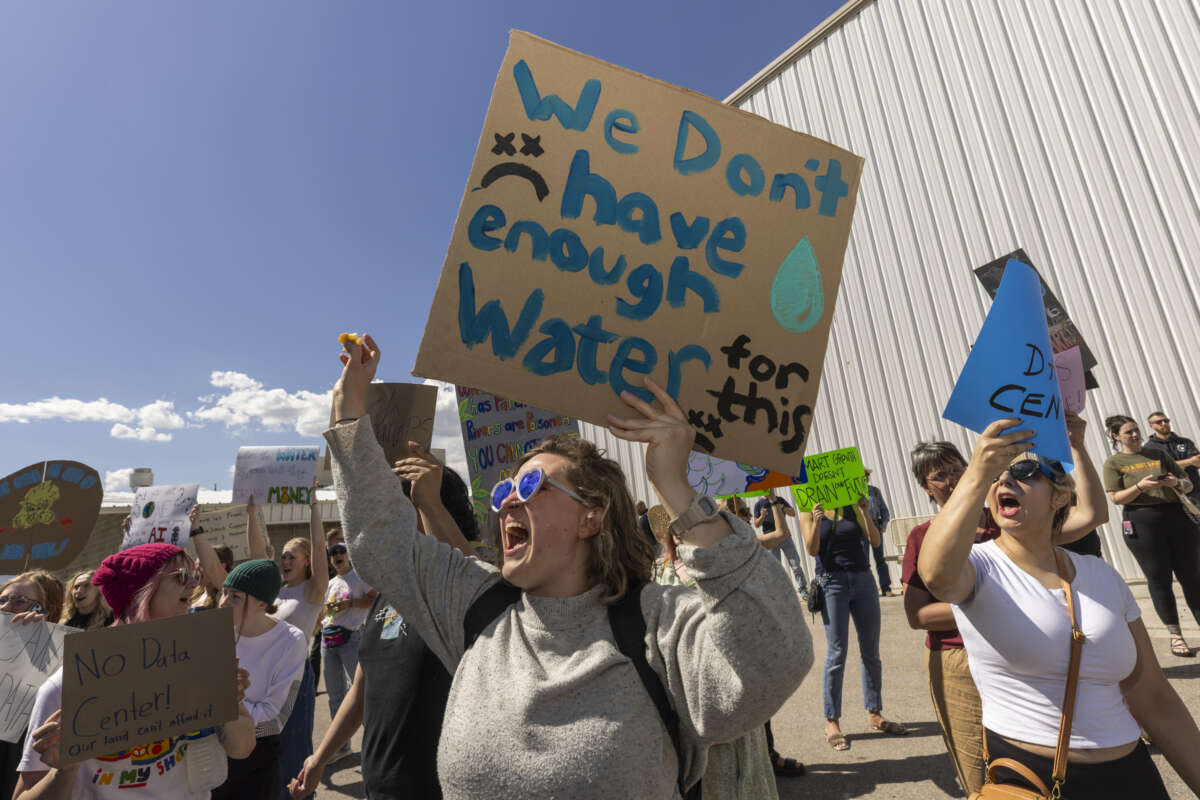
An increasing number of states are pursuing legislation aimed at preventing local municipalities from regulating data centers and artificial intelligence (AI), legal advocates warn, all but ensuring their construction. This “preemption legislation” truncates efforts led by residents to counter the rapid expansion of facilities that have been widely criticized for everything from noise pollution to the secretive process by which many contracts for development are approved.
In the past two years, at least nine states have considered 12 different bills aimed at curbing local control of data centers and artificial intelligence, according to the Local Solutions Support Center, a national network of organizations that tracks the overuse of preemption.
“The companies that are behind AI are going to state legislatures proactively and saying, ‘We want to make sure that there are no governments that are regulating AI … we want you to enact this,’” said Leslie Zellers, a lawyer with the Local Solutions Support Center. “It’s a coordinated effort by special interests to try to stop any local regulation of AI.”
Members of Local Solutions Support Center say that the bills introduced in New Hampshire, Ohio, South Carolina, and Virginia, which seek to codify a “right to compute,” are facsimiles of the same model legislation written by the conservative lobbying group American Legislative Exchange Council. Going off that model allows the legislation to appear in many state houses seemingly all at once, and it’s dangerous, Zellers said, because once preemption is made law, it’s nearly impossible to undo.
The U.S. is constructing data centers faster than anywhere else in the world and is home to the largest number of hyperscale data centers. A single hyperscale facility can consume as much energy as 2 million U.S. households. While data centers have been used since the 1940s to store computer processing information off-site, the AI boom is driving the construction of new hyperscale facilities.
Explicit support from the Trump Administration coupled with active and ongoing deregulation of the Environmental Protection Agency has paved the way for data center construction, often in places where land is cheap and relatively undeveloped.
The national fight over data centers has shined a light on the ways poor, rural, and disenfranchised communities can pay the price for the economic development of industries shielded from their own externalities. Numerous reports detail the impact of data centers on drinking water quality and availability, fossil fuel use, and attendant air pollution.
In response to the buildout, Sen. Bernie Sanders (D-VT), introduced legislation calling for a moratorium on data centers, Maine’s legislature approved a ban on new data center construction (which the governor later vetoed), and residents in cities such as Monterey Park, California, pushed local councilmembers to consider a total ban on the energy-gobbling enterprises.
At the same time, several states are considering ways to roll out the red carpet for development by preempting local municipalities from following in the footsteps of Monterey Park.
But these preemption laws do more than prevent local governments from protecting their residents, Zellers said. “[It] disregards the will of the people living in those communities to decide what kind of industry or businesses they want to allow there.”
Communities should have a say in what goes on within the boundaries of their city, especially given that they’re the ones who might have to contend with pollution that results from operation, Zellers said.
“There’s no way that the state legislature can know enough about every community to say you must require this, because they’re not the ones bearing the brunt of the impact,” she told Prism.
West Virginia, seeking to compete with the development in nearby states like Virginia, approved a law in its most recent legislative session that preempts local governments’ abilities to regulate data centers, citing the data center race with China and a need for economic development.
Paula Kaufman, an educator and a life-long West Virginian, told Prism that the model of propping up data centers as a form of economic development is short sighted. The pattern was seen with timber, then coal, followed by fields of oil and gas wells, but Kaufman bemoaned the idea that the state has to sell itself in order to be valuable.
“Here, [there’s] an inverse relationship between the wealth of a space and the wealth of the people — super rich in resources and then super poor people,” Kaufman said. It’s the “boom and bust” cycle, similar to what the state experienced in the heyday of coal, she added. “Politicians can say, ‘oh, it’s going to bring jobs,’ but it doesn’t account for the bust cycle. It doesn’t provide a long-term plan for sustained financial security.”
Despite little longitudinal evidence supporting the claim, proponents of data centers tout the economic activity that results from their construction and operation, as do the West Virginia and South Carolina bills. However, it increasingly appears that data centers are some of the least efficient job stimulants and economic drivers. Washington, D.C.-based advocacy group Food and Water Watch found that as of 2024, as few as 23,000 people nationally worked in data centers, accounting for 0.01% of all jobs across the country.
“These companies come in, talk to local elected officials who have varying degrees of sophistication about industries, [and] they manipulate public opinion,” said Mitch Jones, managing director of Policy and Litigation at Food and Water Watch. “They promise jobs, income, funding, and in exchange, they get huge tax cuts, access to water, electricity, land, so on and so forth.”
He added, “Every extractive industry that comes into a community makes these promises, it’s just that data centers are doing it from a position of economic power that most industries don’t have.”
State-level preemption laws put data centers in a highly favorable position. With little federal regulation and no manner of local accountability, companies can push a product onto local communities and leave when the going gets tough. The lack of federal oversight is even more of a reason why preemption laws are dangerous to everything from resource use to civic engagement, advocates say.
“If what this industry claims about itself is true, it’s going to have such a profound effect on our lives that we deserve a say in that matter,” Jones said. “We are a democracy; as such, we deserve democratic decision making when it comes to an industry which claims it’s going to disrupt so much of how we are living.”
Prism is an independent and nonprofit newsroom led by journalists of color. We report from the ground up and at the intersections of injustice.
An important fundraising appeal: 48 Hours to raise $22,000
Thank you for reading Truthout today. We have a brief message before you go.
Unfortunately, donations are down for Truthout at a time when media faces immense pressure. Yet, grassroots media is vital in the fight against Trump’s authoritarian reign. Our mandate to tell the truth, share strategies for resistance, and speak against fascism grows more urgent each day. We must appeal for your support.
If you can support Truthout with a one-time or monthly donation, you will make a significant impact on our work. Please donate during our fundraiser.