Support justice-driven, accurate and transparent news — make a quick donation to Truthout today!
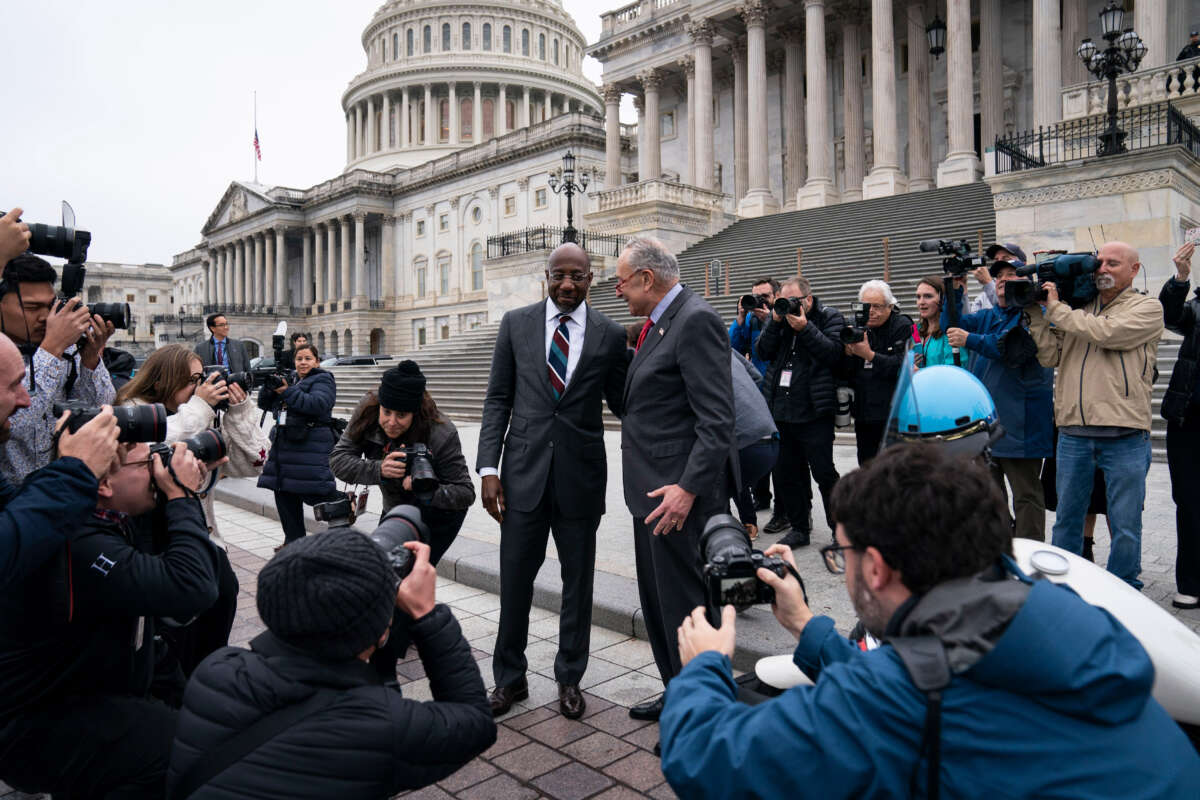
Democratic Sen. Raphael Warnock’s win over former NFL player Herschel Walker in Georgia’s runoff election earlier this week means that Democrats will see their numbers in the Senate increase from 50 seats to 51 when the 118th Congressional session begins in January.
The new power dynamic could make it possible for congressional investigations into the January 6, 2021, attack on the U.S. Capitol building to continue.
Democrats were set to control the Senate whether or not Warnock won, as the chamber’s 50-50 split left tie-breaking votes to Vice President Kamala Harris. (The vice president’s vote may still be needed in certain circumstances if right-wing Democratic senators vote against their party on future legislation.)
However, Democrats gain more legislative power through the extra seat because having 51 votes instead of 50 ends a power-sharing agreement that was established between them and Republicans. That agreement was necessary to conduct everyday business in the Senate on matters that Harris couldn’t vote on as a member of the executive branch.
As a result of that agreement, established in 2021 by Democratic leader Sen. Chuck Schumer (New York) and Republican leader Sen. Mitch McConnell (Kentucky), an equal number of Democrats and Republicans were placed on committees, and Democrats’ subpoena power was greatly curtailed. Going forward, however, Democrats will have a majority on all committees and won’t have to abide by those rules on subpoenas.
The end of the power-sharing agreement also means that any temporary or select committee that Democrats choose to set up will have a Democratic majority. This means that Schumer and Democrats could establish a select committee to investigate the January 6 attack on the Capitol and use their unrestrained subpoena powers to aid in their inquiry.
“Move the January 6 committee to the Senate,” lawyer and frequent GOP critic Tristan Snell said on Twitter. “With Warnock winning, Dems will control all committees — making a Senate J6 committee possible.”
The January 6 committee in the House is set to dissolve next month when Republicans take control of that chamber. According to committee chair Rep. Bennie Thompson (D-Mississippi), the panel plans to issue its final report on December 21.
House Republican leader Kevin McCarthy (R-California), the next presumptive Speaker of the House, has vowed to investigate the January 6 committee’s work, claiming that the committee has withheld evidence from the American people. (Members of the committee, meanwhile, have promised to release all of their findings in the final report). McCarthy’s investigation into the inquiry will likely be tainted by GOP lawmakers who are determined to undermine the January 6 committee’s findings.
A competing committee in the Senate, however, could respond to false narratives from the GOP with evidence of its own.
A Senate January 6 committee would also allow lawmakers to pursue answers to questions that remain unresolved by the current committee’s work, University of Albany Law School professor Ray Brescia told Truthout.
The imminent dismantling of the House select committee investigating the January 6 attack “does not mean Congress’s work must or should end,” Brescia said. “The new, one-seat majority Democrats enjoy in the Senate means that the investigation can continue if, as is likely, there are questions left unresolved from the House Committee’s work.”
Many of the issues that the committee has yet to resolve are still unknown to the public, “but, no doubt, in the rush to finish its work before the Democratic majority [in the House] is lost in January, there are likely to be many unanswered questions, trails left unpursued, and witnesses that still have some explaining to do,” Brescia said. “A Senate committee could take the baton from the House and pursue those questions.”
Important Message: Please Read
For 25 years, Truthout has survived by publishing impactful investigative journalism and analysis; distributing full editions 365 days a year; and building a community of readers who support us with small, hard-earned donations.
Eighty percent of our $3 million yearly budget comes from small donors alone. Of those, 8,000 readers support us with monthly donations. Back in 2018, when Facebook decided to suppress the circulation of posts made by organizations, thereby cutting readers off from seeing many articles shared by the news organizations they had intentionally decided to follow, Truthout’s total traffic declined by 40 percent, as nearly all of our traffic from that platform disappeared.
Now, Google has recently rolled out its AI search bar, providing AI summaries instead of directing readers to our site. Google Search is our single largest source of traffic; it’s the route by which nearly one third of our readers find us. Much like in 2018, a shocking 40 percent of our Google traffic has disappeared overnight.
It will not be easy for Truthout to shoulder this blow. Nor will it be easy for our peers and collaborators — news sites that depend on traffic and aren’t bankrolled by large corporations.
If you can support Truthout with a donation today, you can help us resist the AI onslaught. Please give today.