Truthout is a vital news source and a living history of political struggle. If you think our work is valuable, support us with a donation of any size.
Nicholas Crafts, an economics professor at the University of Warwick, wrote a really interesting article on the Vox blog recently about Britain’s economic policy in the 1930s. The gist is that monetary policy drove recovery through the expectations channel; the Bank of England managed to credibly promise to be irresponsible — that is, to generate inflation.
But how did it do that? Mr. Crafts argues that this was possible for two reasons: the bank was not independent, but just an arm of the Treasury, and the Treasury had a known need to generate some inflation to bring down high debt levels.
This is very closely related to the economist Gauti Eggertsson’s analysis of Japanese policy over the same period: there, too, the lack of central bank independence combined with a fiscal imperative made it possible to change monetary expectations in an unorthodox way, which was exactly what was needed (although they should have skipped the invading Manchuria part).
All of this reinforces the important point that — as I put it early in this crisis — we’ve entered a looking-glass world in which virtue is vice and prudence is folly, and in which doing the responsible thing is a recipe for economic failure.
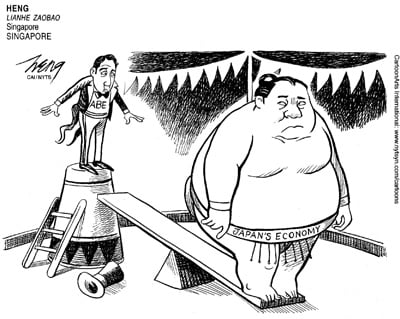
And it also bodes surprisingly well for Abenomics, which might work in part precisely because of what everyone imagines to be Japan’s biggest problem: its huge public debt.
Which Textbook Is That?
Ryan Avent at The Economist, like me, was favorably impressed by Mr. Crafts’s article on British policy in the 1930s. I was, however, slightly puzzled, in a tooting-my-own-horn fashion, by the reference — which I missed in Mr. Crafts’s article, but was repeated and emphasized by Mr. Avent in an article he wrote on May 13 — to the “textbook approach” of raising inflation expectations to escape a liquidity trap.
Um, which textbook is that, exactly? As far as I know, among basic textbooks only Krugman and Wells even talk about the liquidity trap; certainly Robin Wells and I were the only ones talking about it before 2008. And the whole discussion of inflation expectations and monetary policy in a liquidity trap as a sort of inverted version of the usual credibility problem — in fact, the whole revival of the liquidity trap as a modern concern — dates from a paper I published in 1998: “It’s Baaack: Japan’s Slump and the Return of the Liquidity Trap.”
This isn’t purely self-promotion (although obviously that’s part of it). I do think that one reason I’ve done pretty well in tracking this ongoing slump is that I’ve been thinking about liquidity trap issues for a very long time — years before almost anyone else.
25 Years of Truthout: An important fundraising appeal
This September, Truthout is celebrating 25 years of publication. For over two decades, we have been a trusted source for fiercely independent journalism thanks to readers like you.
As we look to the next 25 years, we have launched a special fundraising campaign. At this moment, we have a goal to raise $31,000 in the next 24 hours.
We are asking for your support at this juncture because we face greater threats than ever before in our organizational history. Trump and his MAGA allies are determined to control the information ecosystem, and movement-based organizations are subject to dangerous censorship and scrutiny.
If you can support Truthout with a one-time or monthly donation, you will make a significant impact on our work and our legacy. Anything you can do makes a difference!