Honest, paywall-free news is rare. Please support our boldly independent journalism with a donation of any size.
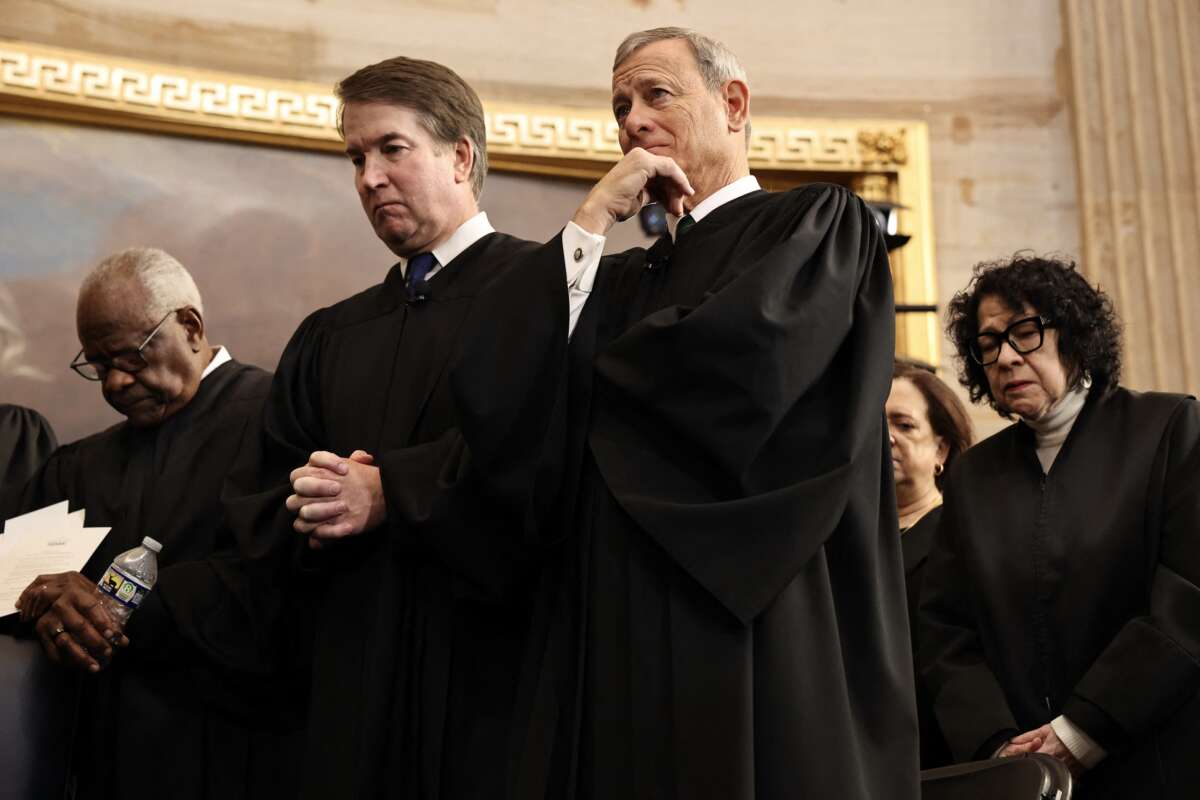
A new poll demonstrates that a majority of Americans disapprove of the United States Supreme Court, following the end of a judicial term that saw multiple rulings eroding civil rights and expanding presidential powers for Donald Trump.
The Economist/YouGov poll, conducted July 3-6 (just days after the final Supreme Court ruling was issued on June 30), found that only 36 percent of U.S. voters approved of the way members of the court were collectively handling their jobs. Conversely, 50 percent of respondents said they disapproved.
A plurality of respondents, 45 percent, said that the Supreme Court’s rulings during this term gave the presidency too much power, while 29 percent said they gave just the right amount of power to the president, and 9 percent said they gave too little.
Favorability ratings for each justice indicated a marked preference among voters for liberal bloc members. Elena Kagan received a net-positive 6-point approval rating, while Ketanji Brown Jackson received a +8-point net favorability and Sonia Sotomayor received +11 points. Meanwhile, all six conservative bloc members received net-negative favorability ratings, ranging from -7 points for Samuel Alito to -15 points for Amy Coney Barrett. Chief Justice John Roberts received a -11-point favorability rating.
Opinions from this year’s term were varied. In some cases, the Supreme Court did put a check on Trump’s presidential powers, such as when justices ruled that his attempt to reinterpret the 14th Amendment’s birthright citizenship clause through executive order was illegal. The court also ruled that Trump’s declaration of “national emergencies” to justify his global tariffs were unlawful.
However, multiple rulings from the court expanded Trump’s powers, and denied civil and human rights to entire groups of people, including:
- A ruling gutting aspects of the Voting Rights Act, allowing states in the South to gerrymander Black-majority districts out of existence;
- A decision ruling in favor of state bans on trans athletes;
- Finding that the president has the legal authority to fire officials on independent commissions without having to provide just cause;
- Rulings diminishing immigrant rights, including allowing the Trump administration to turn away asylum seekers at the U.S.-Mexico border, removing the Temporary Protected Status (TPS) for 350,000 Haitians and 6,000 Syrians, and weakening protections for permanent residents;
- A decision limiting the ability of U.S. residents to sue pesticide companies for illnesses or injuries they experience while using their products;
- And allowing states to restrict the religious liberties and freedoms of non-Christians.
Over the past year, Democratic lawmakers have introduced bills aiming to hold Supreme Court justices accountable for ethics violations, restore transparency and recusal standards, and limit how long justices can serve.
The Supreme Court Ethics and Investigations Act, introduced in late February by Rep. Dan Goldman (D-New York) and Sen. Cory Booker (D-New Jersey), would create a “dedicated investigative body within the Supreme Court that would provide transparency and accountability through exhaustive investigations into alleged ethical improprieties and reports to Congress on its findings.”
The Supreme Court Ethics, Recusal, and Transparency Act, introduced in May by Rep. Hank Johnson (D-Georgia) and Sen. Sheldon Whitehouse (D-Rhode Island), requires justices “to adopt a binding code of conduct and create a mechanism to investigate alleged violations of the code of conduct and other laws.” The bill also seeks to “end the practice of justices ruling on their own conflicts of interest, and require justices to explain their recusal decisions to the public.”
And the Reform of Bench Eligibility Act, also introduced in May by Rep. Johnny Olszewski (D-Maryland), would limit justices to 18-year tenures. The bill also seeks to ensure a regular rotation of new justices every two years (two appointments per president) in order to limit the political nature of appointments and retirements on the bench.
“Faith in the court depends on its legitimacy as a fair and independent institution,” Olszewski said in a statement introducing his proposal.
None of the bills introduced would require a constitutional amendment, as Article III of the Constitution allows Congress to regulate the Supreme Court.
Press freedom is under attack
As Trump cracks down on political speech, independent media is increasingly necessary.
Truthout produces reporting you won’t see in the mainstream: journalism from the frontlines of global conflict, interviews with grassroots movement leaders, high-quality legal analysis and more.
Our work is possible thanks to reader support. Help Truthout catalyze change and social justice — make a tax-deductible monthly or one-time donation today.