Honest, paywall-free news is rare. Please support our boldly independent journalism with a donation of any size.
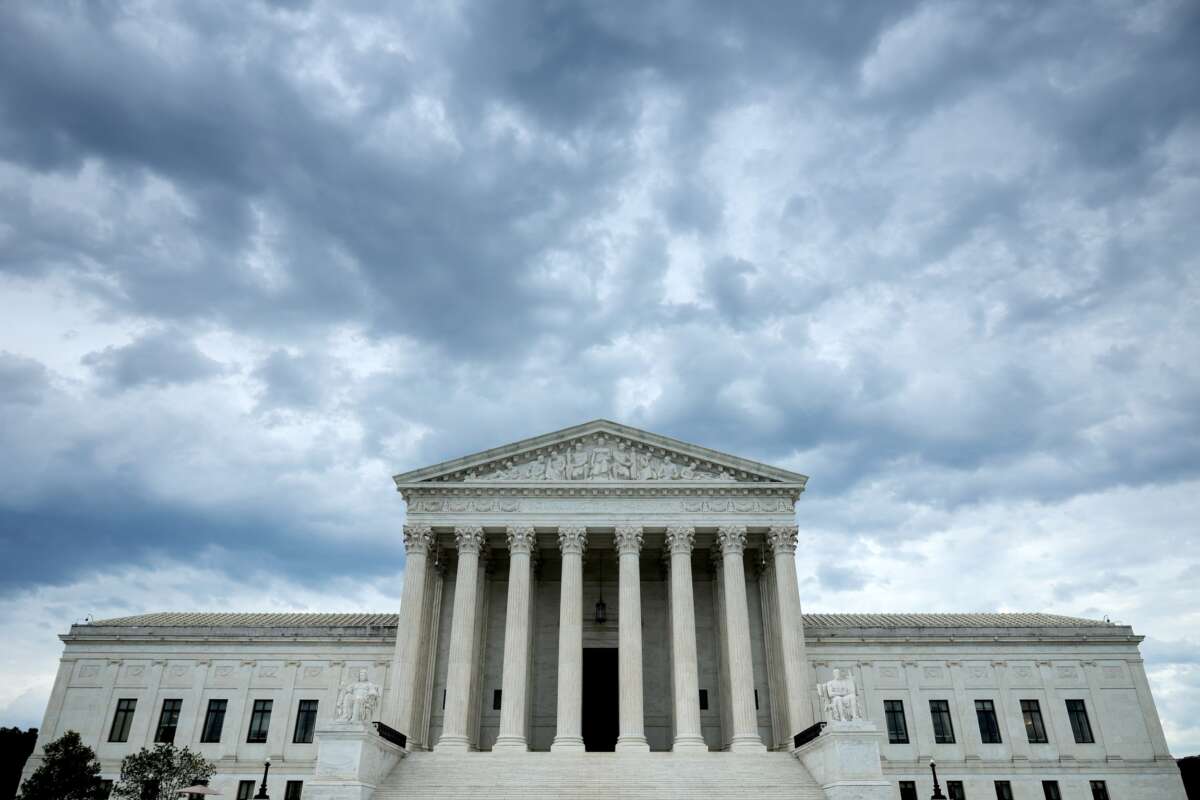
In a Monday morning decision, the U.S. Supreme Court ruled against a formerly incarcerated individual, denying his right to sue the state of Louisiana for violating his Rastafarian beliefs by forcibly shaving his hair.
The case is notable in that, while this iteration of the high court has made numerous decisions defending right-wing Christians’ purported First Amendment religious freedoms, it is denying the same level of protection to non-Christians whose rights have been blatantly violated.
Damon Landor was nearing the end of a five-month prison sentence in 2020 when he was transferred to another facility. Upon entering, he showed officials a court ruling demonstrating that his dreadlocks, grown down to his knees over nearly a decade, were tied to his religious beliefs.
The intake guard examined the copy of the order, then threw it in the trash, making it impossible for Landor to show the warden that his hair should not be cut. Prison staff later handcuffed Landor to a chair and shaved his dreadlocks.
“My locks are a part of me and part of who I am. So when they cut off my hair, they cut off my crown,” Landor explained in a statement to USA Today.
Landor sought to sue the officials responsible for violating his religious rights, citing the Religious Land Use and Institutionalized Persons Act of 2000 (RLUIPA). Lower courts denied him the ability to sue, and the Supreme Court upheld those decisions in a 6-3 ruling.
The ruling was along partisan lines, with all six conservative justices agreeing with the majority opinion and three liberal justices dissenting. Justice Neil Gorsuch authored the majority ruling, finding that spending rules in the U.S. Constitution disallowed lawsuits like Landor’s, based on RLUIPA, from seeking financial compensation.
“Under the Spending Clause, Congress lacks regulatory authority to impose liability” on those who violate RLUIPA,” Gorsuch wrote, adding that Landor’s case cannot proceed against the state “any more than a breach of contract action might proceed against a defendant who never formed a contract.”
Justice Ketanji Brown Jackson penned the dissent to the majority’s ruling, stating that the conservative justices were adopting “the peculiar position that Congress is powerless to create, and a State is powerless to accept, the natural next step” of a RLUIPA complaint — “a damages remedy against officials who violate that directive.”
“Landor had federal law on his side. And he did everything he could do in real time to ensure that prison officials knew that,” Jackson recognized.
“It is not I but the majority that jettisons ‘a long line of this Court’s precedents,'” Jackson wrote, citing Gorsuch’s ruling, adding that the majority opinion is an empty “formalism” that contains a “parade of horribles.”
The consequences of this ruling are predictable, Jackson added, stating that people who are imprisoned like Landor will “be left remediless” in similar situations in the future.
Americans United for Separation of Church and State President and CEO Rachel Laser reacted to the ruling in a statement shared with Truthout, saying:
Today’s U.S. Supreme Court decision endangers the religious freedom of incarcerated people, like Damon Landor, who are particularly vulnerable to abuse and having unnecessary burdens placed on their religious exercise.
“Once again, we see a court that will bend over backward for the religious freedom of Christians, but allows the government to trample the religious freedom of non-Christians,” Laser added. “We can only hope this faulty decision doesn’t embolden more prison officials to ignore the religious-freedom rights of incarcerated people to observe their faith as long as they don’t harm others.”
25 Years of Truthout: An important fundraising appeal
This September, Truthout is celebrating 25 years of publication. For over two decades, we have been a trusted source for fiercely independent journalism thanks to readers like you.
As we look to the next 25 years, we have launched a special fundraising campaign. Looking to a sustainable future for our publication, we have a fundraising goal of $52,000 in the next 72 hours.
We are asking for your support at this juncture because we face greater threats than ever before in our organizational history. Trump and his MAGA allies are determined to control the information ecosystem, and movement-based organizations are subject to dangerous censorship and scrutiny.
If you can support Truthout with a one-time or monthly donation, you will make a significant impact on our work and our legacy. Anything you can do makes a difference!