Truthout is a vital news source and a living history of political struggle. If you think our work is valuable, support us with a donation of any size.
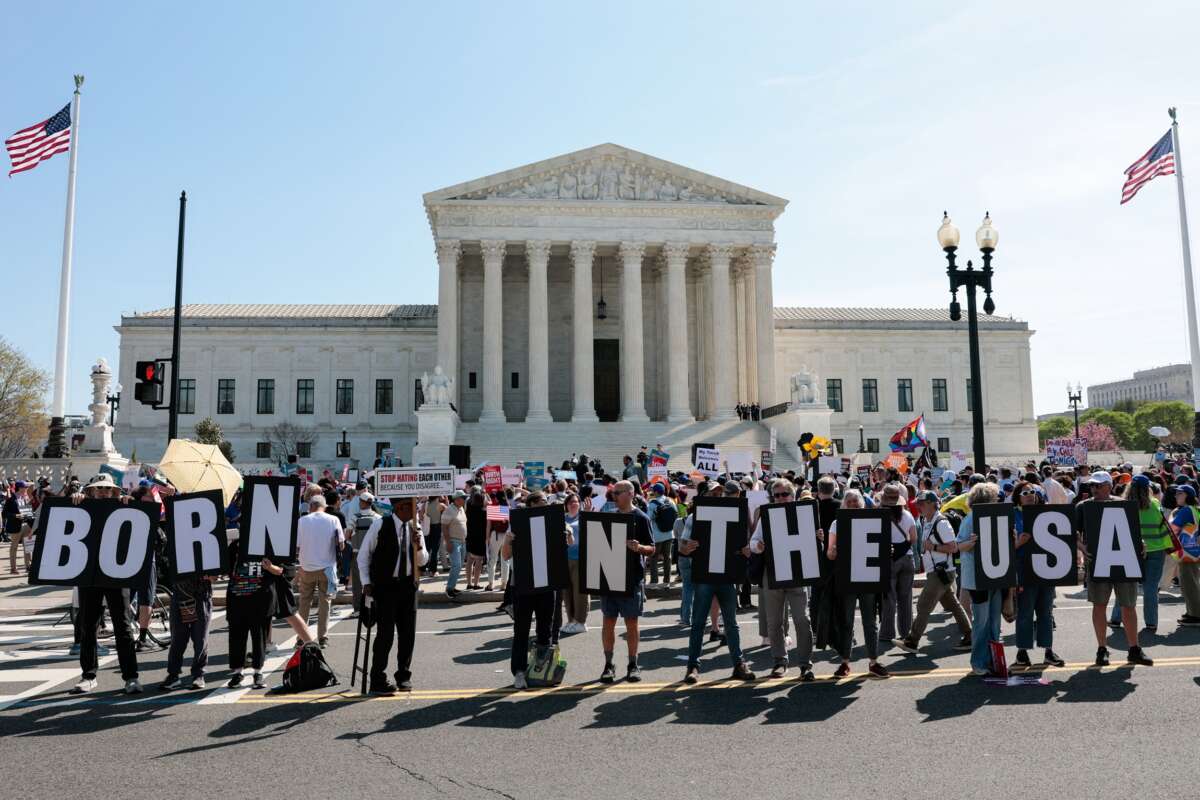
The U.S. Supreme Court has rejected President Donald Trump’s attempt to reinterpret the 14th Amendment of the U.S. Constitution, finding that the executive order he issued on the first day of his second term in office — which sought to unilaterally redefine birthright citizenship — was improper and unlawful.
In a 6-3 ruling on Tuesday in a case titled Trump v. Barbara, Chief Justice John Roberts, writing for the majority opinion of the court, found that Trump’s executive order could not redefine the birthright citizenship clause.
Trump’s order, “Protecting the Meaning and Value of American Citizenship,” was issued on January 20, 2021. In it, the president wrongly claimed that the 14th Amendment “has never been interpreted to extend citizenship universally to everyone born within the United States.”
Trump explained that the new policy of the United States — unilaterally established by executive fiat — would be that:
[N]o department or agency of the United States government shall issue documents recognizing United States citizenship, or accept documents issued by State, local, or other governments or authorities purporting to recognize United States citizenship, to persons: (1) when that person’s mother was unlawfully present in the United States and the person’s father was not a United States citizen or lawful permanent resident at the time of said person’s birth, or (2) when that person’s mother’s presence in the United States was lawful but temporary, and the person’s father was not a United States citizen or lawful permanent resident at the time of said person’s birth.
Several states and immigrant rights organizations sued to block the order from being enacted. The Supreme Court agreed to take up the case late last year, restricting enforcement of Trump’s edict until a final ruling was made.
Tuesday’s decision keeps that block in place, with the majority finding that the executive order could not reinterpret the meaning behind the constitutional amendment.
In his written opinion, Roberts noted that the 14th Amendment wasn’t just written to address freed Black persons following the Civil War, as Trump and his supporters have argued. Rather, the “goal was even grander — to put the ‘great question of citizenship’ ‘beyond the legislative power’ altogether, to settle the issue once and for all.”
Roberts also dismissed the Trump administration’s argument that children born to immigrants in the U.S. were not “subject to the jurisdiction” of this country.
“The amendment dictates that “any child who was born ‘under the protection of’ the United States — that is, any child for whom no extraterritorial fiction applied — was made a citizen, for he owed a natural ‘allegiance’ (and thus ‘obedience’) to the Nation,” Roberts said, adding that the framers of the amendment “extended [the promise of citizenship] to ‘every free-born person in this land.’”
“We keep that promise today,” Roberts added.
Roberts’s opinion was endorsed by liberal bloc Justices Sonia Sotomayor, Elena Kagan, and Ketanji Brown Jackson. Conservative bloc Justice Amy Coney Barrett also agreed with the ruling.
Justice Brett Kavanaugh agreed in part with Roberts’s findings, but disagreed that the 14th Amendment prevented Trump from redefining the meaning behind the birthright citizenship clause. Kavanaugh cited an obscure U.S. statute to claim that Congress, not the president, could change the amendment’s meaning.
“Congress could…enact new legislation establishing exceptions to birthright citizenship for children born to foreign citizens unlawfully or temporarily in the country,” Kavanaugh said. “But Congress has not yet done so.”
The idea appears to have Trump’s endorsement. Around the time the ruling was rendered, the president shared to his Truth Social account a link to a right-wing news article expressing a similar viewpoint.
In a post later in the day, Trump said that he planned to take that route.
“The Supreme Court upheld Birthright Citizenship, which is too bad for our Country, but we can easily make it up in Congress through Legislation, with the support of the President, that has now been determined during this process,” Trump wrote. “No long and unwieldy Constitutional Amendment is necessary!”
Jackson issued a concurring opinion to the majority, in which she addressed the dissenting opinion written by Justice Clarence Thomas, who had argued that the 14th Amendment’s birthright citizenship clause was only meant to address the issue of freed Black Americans after the Civil War.
“That narrow vision of the Fourteenth Amendment bears little relationship to the history of its ratification,” Jackson wrote, adding:
Yes, Black Americans had suffered a singular wrong. And yes, they had ‘fought and bled’ for the Union, paying a steep price for their freedom. But the delegates did not rest on these laurels. Rather, they drew upon the moral and political force of the universal principles that were already core to the Nation’s identity.
“Freed Blacks did not advocate for a unique set of rules that catered only to their situation,” Jackson wrote, noting that the contention arguing otherwise by Thomas and endorsed by the president is “ahistorical.”
“This alternative account pitches Black Americans against immigrants when the advocates who promoted the Fourteenth Amendment did no such thing,” Jackson reiterated. “Freed Blacks fought for the shared humanity of all people.”
Lawmakers, legal observers, and immigrant rights organizations reacted to the decision.
The ruling was announced while Speaker of the House Mike Johnson (R-Louisiana) was responding to questions from reporters. Upon hearing that the ruling was in, Johnson said, “Oh dear,” and rolled his eyes.
Calling the amendment “grossly abused,” Johnson added: “I’m very disappointed in that outcome.”
The Democratic National Committee (DNC) reacted positively to the ruling, calling it a sharp rebuke of Trump’s anti-immigration policies.
“Since his first days in office, Donald Trump has sought to recycle racist, debunked legal arguments to strip away the constitutional rights of American citizens born to immigrant parents. Today, he failed,” the DNC said.
Elie Mystal, justice correspondent for The Nation, warned that the matter wasn’t going away so easily.
“The birthright issue is not going away,” Mystal wrote on Bluesky. “The right hasn’t really begun *organizing* around getting rid of the citizenship clause. Like Roe, this will be their fight for a generation. And if the Democrats just say “we won” and ignore it, like Roe, the Republicans will eventually win.”
A coalition of nonprofit organizations — including the American Civil Liberties Union, the Asian Law Caucus, and the Democracy Defenders fund, which collectively brought forward one of the lawsuits against Trump’s executive order — praised the outcome.
“The court’s decision reaffirms a fundamental American promise — if you are born here, you are a citizen,” said ACLU National Legal Director Cecillia Wang, who argued the case before the court this spring.
“The Constitution, not the president, defines who is a citizen. And the 14th Amendment makes clear that every child born on U.S. soil is a citizen,” said Janai Nelson, president and director-counsel of the Legal Defense Fund.
“We cannot and will not turn our attention away from the fact that what should have been a 9-0 decision instead revealed that four justices agreed to varying degrees with the president’s desecration of the Constitution,” Nelson added. “Nonetheless, today, we applaud this significant win.”
Media that fights fascism
Truthout is funded almost entirely by readers — that’s why we can speak truth to power and cut against the mainstream narrative. But independent journalists at Truthout face mounting political repression under Trump.
We rely on your support to survive McCarthyist censorship. Please make a tax-deductible one-time or monthly donation.