Support justice-driven, accurate and transparent news — make a quick donation to Truthout today!
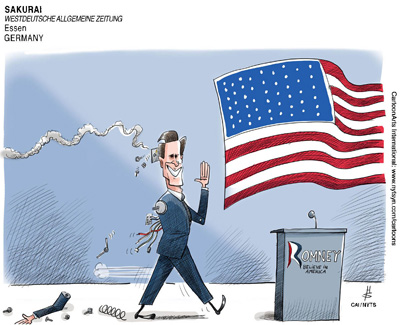
As many people have been pointing out, Mitt Romney’s talk about the “47 percent” was no different from what you hear all the time from Rush Limbaugh and the like. But bear in mind that Mr. Romney was talking to the financial super-elite, and gave every appearance of believing what he said. (I’m usually scornful of analyses based on how someone “comes across,” and would never put much weight on it, but the Mitt Romney of this video was a lot looser and more articulate than the guy we usually see.)
What this strongly suggests is that the Masters of the Universe, and Master Mitt himself, really believe all this stuff — which is pretty remarkable. His “lucky ducky” trope about people who depend on the government and pay no federal income tax is clearly, obviously nonsense. Equally obviously, it was originally created in an effort to dupe people who didn’t know better.
It was and is what the novelist George Orwell called, in “1984,” “prolefeed”: junk aimed at the ignorant masses (ignorant by design) — the people who are ready to believe at a moment’s notice that we’ve always been at war with Eastasia.
In Mr. Orwell’s vision, however, the Party, and especially the Inner Party, wasn’t supposed to consume this same tripe. It was supposed to understand the true Party agenda and vision.
So it actually is a revelation to see Mr. Romney and friends obviously swallowing the prolefeed whole. The news here isn’t really about their lack of empathy; it’s about their raw ignorance.
The Political Economy of Redistribution
Mitt Romney is getting beaten up, and rightly so, for claiming that redistribution is un-American. Of course we redistribute, and we’ve been doing it on a substantial scale for generations.
Medicare, for example, is in effect a strongly redistributive program: it’s supported by a payroll tax (and other revenue) in which the amount you pay in depends on your income, but it supplies a benefit that depends only on your medical costs. From each according to his ability, to each according to his needs!
So no, President Obama isn’t a radical for suggesting that we should continue to do what we’re already doing; the real radicals are the people on the right who want to declare much of what our government has been doing these past three generations illegitimate.
The real question — arguably the central question of political economy — is how much to redistribute. And it’s both interesting and important to try to understand how that decision gets made.
There’s a substantial literature that makes use of something like the following model:
1. The government levies taxes on everyone — say, as a constant proportion of income.
2. It uses that revenue to pay for a benefit that everyone receives.
3. Voters choose parties based on which offers a tax/benefit program closest to the one that maximizes their own utility.
4. The end result reflects the preferences of the median voter.
This kind of model suggests that the median voter will, in fact, want redistribution as long as his or her income — median income — is less than average income, because in that case he’ll have more to gain than to lose from a bit of redistribution. And this condition is always met because income distribution is skewed to the right (there are people with incomes $1 million above the median, but none with incomes $1 million below the median).
But in that case, won’t the median voter favor complete redistribution, with all income taxed away and then handed out as benefits?
No, because of incentives: too high a tax rate will discourage effort and reduce overall incomes. So there’s a trade-off that leads to some equilibrium level of redistribution.
O.K., it should be obvious that while this model is pretty, it falls down badly in the realism department. For one thing, median-voter models of politics suggest that the parties should converge on similar policies; in fact, they’re polarized.
Beyond that, the model suggests that higher income inequality should lead to more redistribution.
What we see in practice, however, is that European countries with relatively low inequality do much more redistribution than the United States, with its high inequality — and that as the United States has gotten more unequal, its tax and transfer system has grown less, not more redistributive.
I don’t think we have a full explanation of these awkward facts.
But the model is still useful for thinking about the political world we live in.In particular, imagine yourself as a hired gun for the right tail of the income distribution.
What would you do in an effort to stop median voters from realizing that they would benefit from a more European-style system?
Well, you’d do everything you could to exaggerate the disincentive effects of higher taxes, while trying to convince middle-income voters that the benefits of government programs go to other people.
And at the same time, you’d do everything you could to disenfranchise lower-income citizens, so that the median voter would have a higher income than the median citizen.
So far, efforts along these lines have been remarkably successful in the United States.
But operatives on the right are clearly worried that their three-decade run of success may be coming to an end.
An urgent fundraising appeal: We still need to raise $9,000
Truthout is one of only a few platforms for justice-oriented, grassroots journalism. Today, we face an existential threat.
Due to Google’s launch of AI search, we’ve seen a drastic plunge in our site traffic and, as a result, our revenue. We lost 15 percent of our readership overnight. This was a readership we painstakingly built over decades, and it vanished because Google chose corporate greed over a healthy democracy.
We are fundraising right now to meet our basic operating expenses. If you can support Truthout with a one-time or monthly donation, you will make a significant impact on our work. Anything you can do makes a difference — we appreciate your support.