Truthout is an indispensable resource for activists, movement leaders and workers everywhere. Please make this work possible with a quick donation.
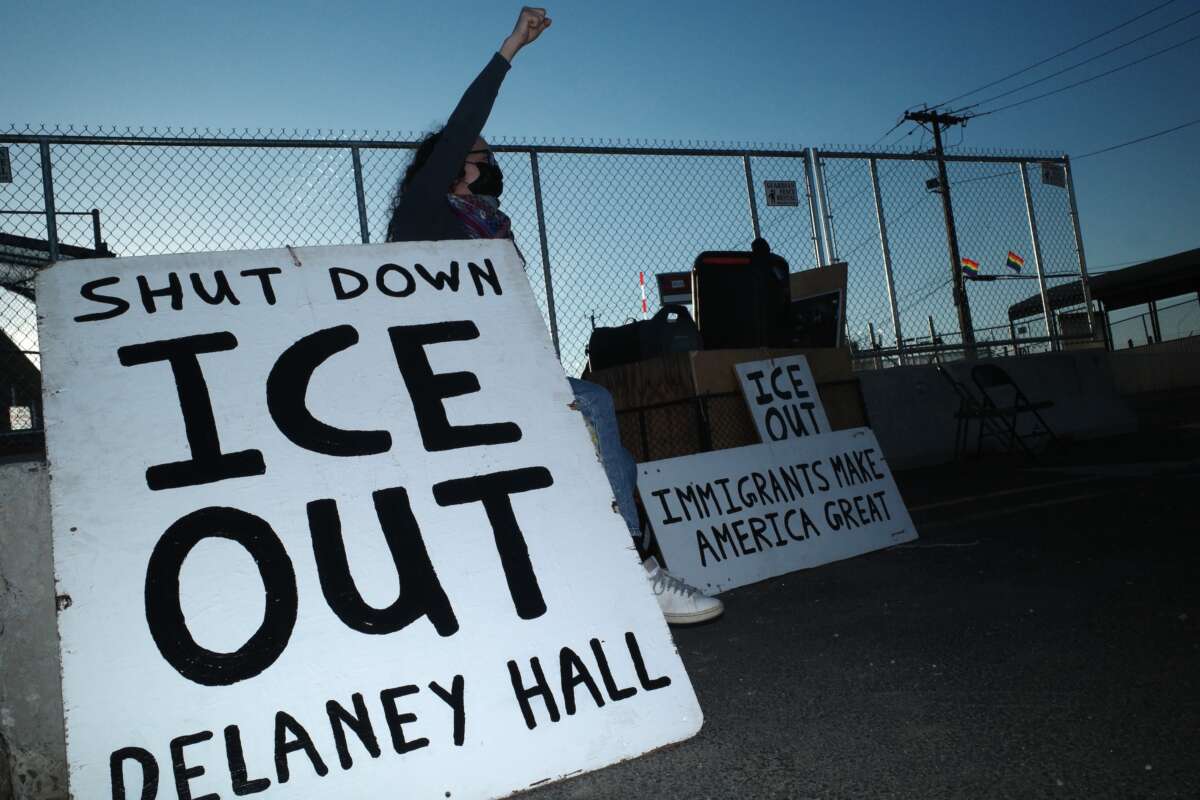
Nearly 40 women have joined the hunger strike at Delaney Hall immigrant jail in Newark, New Jersey, releasing a new set of gender-specific demands as the strike enters its fourth week.
On June 11, dozens of women detained in unit 1 of the jail announced that they were joining the hunger strike. Their demands include improving conditions in the facility; the release of female detainees, beginning with those who are under 21 years old, mothers, and women with medical conditions; and the firing of a guard who they say has sexually assaulted at least 10 women detained in the facility.
The facility is run by for-profit prison company GEO Group, which operates the detention center under a $1 billion contract with Immigration and Customs Enforcement (ICE).
“We are mothers, daughters, sisters. We are women that are being unjustly imprisoned. We are here to demand justice,” the women participating in the hunger strike stated in a video from the jail.
Some of their demands demonstrate the lack of basic sanitation in the facility: One demand is for the jail to provide safe drinking water. Other demands focus on replacing GEO Group medical staff with trained, qualified nurses, and replacing GEO Group security personnel, who have reportedly beaten and teargassed hunger strikers in retaliation for their organizing.
Women detained at Delaney have filed 10 complaints against one GEO Group staff member, a female guard, accusing her of sexual assault. Despite their demands for her to be fired, she has remained employed.
On May 22, over 300 people detained in the immigration jail launched a hunger and labor strike, and were met with retaliation that included beatings, teargas, and transfers, culminating in the transfer of the majority of the hunger strikers last week. The recent announcement by women being detained essentially marks a renewal of the hunger strike after ICE reportedly transferred over 200 of the hunger strikers from Delaney Hall beginning last weekend.
The transfers of between 200 and 400 of the detainees comes as New Jersey has found itself unable to quell the protests that emerged in solidarity with the hunger strikers imprisoned at Delaney Hall. For weeks, protesters outside the facility have attempted to stop the transfer of detained hunger strikers, and faced off against ICE and police. New Jersey Gov. Mikie Sherrill (D) replaced ICE with state police followed by local police, but the protests still did not subside, and anger mounted at her lack of action in addressing the demands of the hunger strikers.
Paulo Almiron, media coordinator for New Jersey-based Resistencia en Acción, told Truthout that the transfers have been conducted at night to avoid protesters. Local police installed fences at the immigration jail’s driveways, blocking protesters’ ability to gather there.
“However, this doesn’t mean that the strike is over,” he said. “Relatives are still reporting that their loved ones are abstaining from work at the facility.” And the women’s strike “should be treated as a continuation of the same strike,” which, he says, “has always been a decentralized effort because of the separation of detainees in different wings.”
Doctors have also spoken out about their concern over the conditions facing the hunger strikers at Delaney.
Kate Sugarman, a doctor of family medicine and a steering committee member of the New York Lawyers for the Public Interest medical providers network, spoke to Truthout about the teargassing of detainees, which occurred on May 28.
“When people are teargassed, for example, in outdoor protests, they require immediate attention,” he said. “But if someone is teargassed within an ICE jail we know they do not have access to clean water, showers, eye flushes, medical attention, etc. For example, it was well documented several years ago in the Farmville ICE jail how the health of detained people suffered significantly after being teargassed because they were denied the above treatments.”
Chanelle Diaz, a professor of medicine at Columbia University Medical Center, told Truthout that:
The people on hunger strike at Delaney Hall have told us exactly why they are refusing food: medical neglect, water unfit for consumption, food past its expiration date, bathrooms that are unusable, 95 percent of bond hearings denied, and a system that tells them they have no rights here. They are parents whose children need them, many with no criminal record, held for months to over a year without due process.
“By going on hunger strike they are reasserting their humanity by putting their bodies on the line,” she went on. “That tells you the degree to which detention has stripped everything else away.”
“To put your life on the line, to accept the risk of serious bodily harm or death, is to refuse ICE’s terms of your erasure. They are demanding to be seen as people deserving of rights in a place that is trying to make them disappear.”
Media that fights fascism
Truthout is funded almost entirely by readers — that’s why we can speak truth to power and cut against the mainstream narrative. But independent journalists at Truthout face mounting political repression under Trump.
We rely on your support to survive McCarthyist censorship. Please make a tax-deductible one-time or monthly donation.