Support justice-driven, accurate and transparent news — make a quick donation to Truthout today!
Winter in Minnesota is notoriously harsh, lasting until mid-spring and marked by below-freezing temperatures, heavy snowfall, and intense winds. It is a common misconception that survival requires either hibernation or migration, but blue jays roost communally to conserve warmth through the cold nights, and white-tailed deer congregate in wintering yards, finding safety in numbers. Surviving in hostile climates, whether environmental or political, is impossible in isolation.
This is a lesson that Minnesota’s Somali community knows well. In recent months, they have been the target of a racist and relentless tirade of abuse from the highest offices of the United States. The Trump administration’s inflammatory rhetoric against Somali immigrants has been coupled with the rescinding of Temporary Protected Status for Somali nationals, funding freezes to social services that many in the community rely on, and what acting Immigration and Customs Enforcement (ICE) Director Todd Lyons has claimed is the largest immigration enforcement operation ever.
Rather than retreat and wait for the administration to find a new scapegoat, the community’s response has been to create an ecosystem of care that does more than proclaim to “love your neighbor” — members of the Somali community, alongside allies across community lines, are building the means necessary to protect and defend each other.
Surviving in hostile climates, whether environmental or political, is impossible in isolation.
Cedar-Riverside, also known as the West Bank and occasionally referred to as Little Mogadishu, is a Minneapolis neighborhood that is home to the highest concentration of Somali people in the state. Burhan Israfael, a community organizer and Cedar resident, says the fear in the current moment is palpable.
“It’s tough,” he told Truthout. “There’s no such thing as a normal life anymore, especially for people who are directly affected.”
Israfael says his once-bustling neighborhood is now a ghost town. “Uncles used to go to cafes to unwind, and that doesn’t happen anymore,” he told Truthout. “They’re taking their coffee to-go and staying home.”
This is not just anecdotal; businesses in the surrounding Somali enclaves, centers of both commerce and connection, are experiencing significant decreases in revenue.
Many in the community initially responded to Donald Trump’s insults with jokes, dismissing them as another example of the theatrical cruelty that has defined his presidency. But it quickly became clear that the federal government was set on attacking the community in earnest this time. As thousands of armed federal agents — including masked agents from both ICE and Customs and Border Protection (CBP) — descended on the Twin Cities after the launch of “Operation Metro Surge” in early December, Israfael realized, “Trump’s not just trolling. He’s serious about making a move on us.”
As ICE and CBP agents terrorized their friends and disappeared more and more of their neighbors, it was clear that no one was coming to save them. Doing nothing wasn’t an option. “We’re not going to retreat into the shadows,” Israfael said.
In early December, a group of Cedar residents held an emergency meeting to discuss how to keep their community safe. Out of that meeting, the Cedar Riverside Protection Alliance was born: a rapid response network of Somali youth whose devotion to each other and the place they call home outweighed their fears. People power is their most important resource — one that is renewable and that no hostile politician can contain.
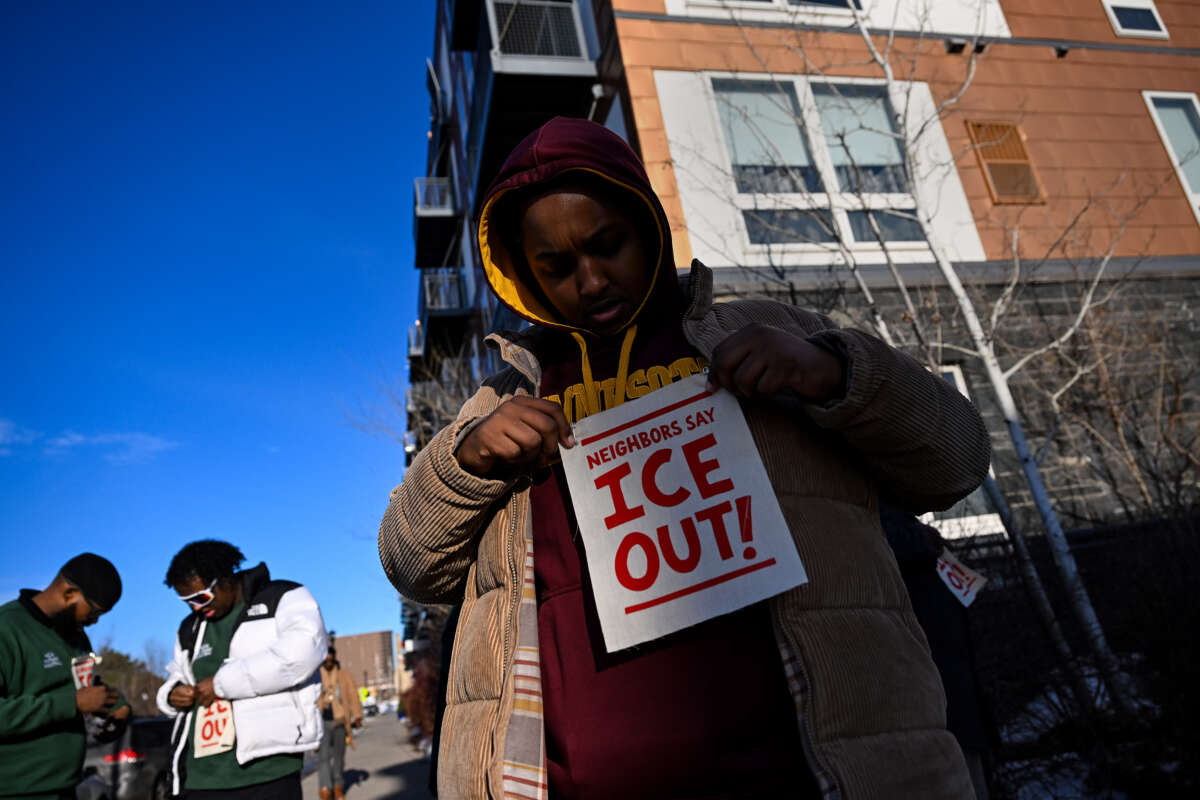
Despite freezing temperatures, volunteers conduct round-the-clock neighborhood patrols. Their brightly colored safety vests flash against the white snow.
Despite freezing temperatures, volunteers conduct round-the-clock neighborhood patrols. Their brightly colored safety vests flash against the white snow, making them easily identifiable. An offshoot of this organizing is the “Mamas of Cedar,” a group of Somali mothers who join patrols and educate residents about their rights. They attribute much of their success to the fact that they know their neighbors, and more importantly, their neighbors know them. They are the antithesis of the faceless agents of the state whose terror hinges on their anonymity. Despite Trump and his supporters’ efforts to make Somalis feel like they are the ones who don’t belong in Minnesota, it is vastly clear to Twin Cities residents that it is the growing mass of masked federal agents, nameless and accountable to no one, that is trespassing in their state.
Beyond the Cedar Riverside Protection Alliance’s more public displays of solidarity lies what Israfael calls “an underground network of support.” Volunteers raise funds for legal fees for families separated by ICE, deliver groceries to those sheltering in place, pick up prescriptions for vulnerable elders, provide child care and coordinate rides for schoolchildren, and even open their homes to those in need. These acts of care and community are no less militant than the protests that dominate headlines.
Israfael is heartened by this grassroots organizing, and by the number of allies who are standing with the Somali community and willing to put themselves in harm’s way. The parliament of the streets continues as anti-ICE actions spread and confrontations escalate. Some have run out of patience for the symbolic gestures of solidarity coming from elected officials. “People can’t eat symbols,” Israfael said.
Ellen, an organizer with the anti-imperialist collective Behind Enemy Lines, who asked to be identified only by her first name due to fear of state targeting, says the Somali community is being scapegoated “for the social and economic problems of the Twin Cities.” She situates the recent wave of racist anti-immigrant attacks on Somalis within the longer history of U.S. intervention in the Horn of Africa, noting that most Somali immigrants arrived in the United States through forced migration, driven by the U.S.’s insatiable appetite for war. “When we ask, ‘Who is our common enemy?’ people realize the problem isn’t migrants, but the system that displaces them in the first place,” Ellen told Truthout.
To understand what is happening in Minneapolis, one must zoom out and trace the global network of power and capital that — through bureaucrats, financial oligarchies, and militaries — usurps the resources, industries, and governments of the Global South. The U.S. and its allies have exploited and terrorized generations upon generations of Somali people. This exploitation has spanned from the colonization of Somalia by the British, French, and Italians in the 19th century; to Cold War power struggles between the United States and the Soviet Union as they vied for political and military influence in the region; to the 1993 battle in Mogadishu known as the “Black Hawk Down Incident,” in which hundreds of Somalis were killed in a military operation marketed as a peacekeeping mission; to the ongoing U.S. “war on terror” initiated by President George W. Bush in 2001 and expanded by both the Obama and Trump administrations, in which drone strikes routinely kill civilians with impunity; to Trump’s current terrorization of the Somali community in Minnesota through the anti-immigrant “Operation Metro Surge.”
After decades of overt and covert political domination that has infringed on Somalia’s political, economic, and cultural sovereignty, the Behind Enemy Lines collective asks a rhetorical question: “If the U.S. can be so entitled to invade and exploit Africa as if God granted it to them, why aren’t Somalis entitled to a home in the very nation that displaced them?”
On December 27, 2025, a bitingly cold and foggy day, Ellen and other members of the Behind Enemy Lines collective canvassed several neighborhoods in the Twin Cities to talk to residents, build relationships, challenge anti-Somali propaganda, and show solidarity. They distributed posters emblazoned with the Somali flag and the message Stand with Somalis in the Twin Cities! U.S. out of the Horn of Africa! which shop owners displayed in storefront windows.
Volunteers raise funds for legal fees for families separated by ICE, deliver groceries to those sheltering in place, pick up prescriptions for vulnerable elders, coordinate rides for schoolchildren, and even open their homes to those in need.
The day after Christmas, a social media video alleging widespread fraud at Somali-run child care centers in Minneapolis drew national attention and was amplified by right-wing influencers and politicians, including JD Vance and Kash Patel, leading to violence, vandalism, and attempted break-ins at many of these facilities. State inspections confirmed these centers were legitimate, but the allegations quickly became fuel for a federal crackdown that started in Minneapolis but has since spread. Day care owners in Seattle have experienced similar harassment, and Lewiston and Portland in Maine have become the locus of another immigration enforcement campaign called “Operation Catch of the Day,” aimed at the state’s Somali residents.
Ellen calls the recent attacks on Somali-owned day cares and allegations of rampant fraud a “racist” and “reactionary” distraction from the fact that the federal government under Trump is shoveling money into the war machine while divesting from the institutions that support and sustain life for ordinary Minnesotans.
While the vast majority of Somali immigrants in Minnesota — and across the U.S. — are naturalized citizens, that is a distinction that many organizers say offers little protection. According to a pamphlet from the Behind Enemy Lines collective, “good vs bad; legal vs illegal; immigration only exists and is deemed a crisis because of what US Imperialism has done around the world to uproot and destroy people’s ways of life.”
Israfael told Truthout that the struggle of the Somali community in the Twin Cities is connected to the struggles of everyone else who is being targeted by the Trump administration, including Indigenous people who are being increasingly harassed and detained by ICE. “The propaganda and policies of this administration are meant to divide us and confuse us about who the real enemy is,” Israfael said. “This is a shared struggle.”
At protests across the Twin Cities, Somalis have showed up with snacks and spiced tea to warm cold hands in the frigid temperatures. Meanwhile, in a viral TikTok video, Fatuma Hersi, an impassioned Somali mother, recently urged more young people to join the protests, saying: “We will speak up, we will fight back, and we will defend ourselves from Trump and his plans.”
Hersi’s daughter, Zamzam, 26, says her mother’s bravery is inspiring. “She has always taught me to stand up for myself and what I believe in,” Zamzam told Truthout, adding that watching her Somali community in Minnesota rise up and demand dignity has deepened her pride. The Twin Cities are the only home she’s ever known, and despite the tension and tear gas in the air, she said, “there’s nowhere else I’d rather be.”
The Trump administration’s goal of silencing and siloing the Somali community has backfired. In the face of danger, neighbors and allies are finding safety in acts of collective defiance. Each time someone refuses to abdicate their rights to rogue officers or abandon their responsibility to others, new forms of power take shape, upending the hierarchies that dictate who is worthy of dignity and protection.
What survives a Minnesota winter does not do so by chance, but through cooperation and resilience, a truth echoed in a popular Somali proverb: When people come together, they can mend even a crack in the sky.
In winter, black-capped chickadees form mixed-species foraging flocks to increase their chance of survival. Woodpeckers, warblers, sparrows, and nuthatches learn to decipher the chickadee’s distinct calls; certain whistles signify the presence of sustenance while others warn of approaching predators. They are infamous for their distinctive spring song, which signifies the end of the brutal season, when snow and ice begin to thaw and the days grow longer and brighter.
It is here in Minnesota, the ancestral lands of the Dakota people whose tribal name means friend or ally, in the heartland of the U.S. and through a biting winter, where hope and collective power take root and bloom.
Press freedom is under attack
As Trump cracks down on political speech, independent media is increasingly necessary.
Truthout produces reporting you won’t see in the mainstream: journalism from the frontlines of global conflict, interviews with grassroots movement leaders, high-quality legal analysis and more.
Our work is possible thanks to reader support. Help Truthout catalyze change and social justice — make a tax-deductible monthly or one-time donation today.