
Part of the Series
Moyers and Company
Truthout is a vital news source and a living history of political struggle. If you think our work is valuable, support us with a donation of any size.
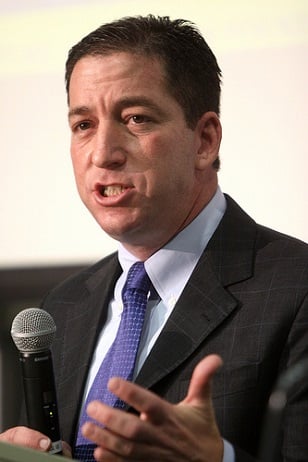 Gage Skidmore / Flickr)” width=”308″ height=”462″ />Glenn Greenwald speaking at the Young Americans for Liberty’s Civil Liberties tour at the University of Arizona in Tucson, Arizona. (Photo: Gage Skidmore / Flickr)There’s been a lot of discussion about how Edward Snowden should be prosecuted. But there’s another question: What should happen to journalists who published the information Snowden leaked, among them Guardian columnist Glenn Greenwald and filmmaker Laura Poitras?
Last month, The Washington Post reported that the government had searched Fox News reporter James Rosen’s personal emails and obtained his phone records, as well as the records of other Fox employees, while investigating a leak. In a 2010 affidavit requesting permission to do so, the FBI claimed Rosen was “at the very least” an “aider, abettor and/or co-conspirator” with a government advisor, Stephen Jin-Woo Kim. Later that year, Kim was indicted under the Espionage Act for telling Rosen that the intelligence community thought North Korea would respond to U.N. sanctions with more nuclear tests — information Rosen used in an article.
In the wake of Snowden’s disclosures — which Director of National Intelligence James Clapper claims have caused “huge, grave damage” — will the government take the next step and press charges against the journalists as well as the leaker?
“It would be completely unprecedented if that were to happen. Everyone was pretty outraged when James Rosen was just named in a court document as a potential co-conspirator, and he wasn’t even indicted,” said Trevor Timm, a lawyer and activist with the Electronic Frontier Foundation who, like Greenwald and Poitras, is a founding board member of the Freedom of the Press Foundation. An attempt to prosecute, he said, “wouldn’t pass muster under the First Amendment. Obviously, that doesn’t mean the Justice Department wouldn’t try.”
Timm noted that, earlier this month, Attorney General Eric Holder said, “The department has not prosecuted, and as long as I’m attorney general, will not prosecute any reporter for doing his or her job.” But that did not stop Representative Peter King of New York, the chairman of the House Subcommittee on Counterterrorism and Intelligence, from calling for Greenwald to face charges. “Greenwald, not only did he disclose this information, he has said he has names of CIA agents and assets around the world and threatening to disclose that,” King said. Greenwald quickly responded on Twitter that he had never said any such thing.
“It’s really disturbing King would make that claim and literally make up facts to justify it,” said Timm. “He’s a congressman who sits on the chair of a powerful committee. He has a responsibility to not make those comments. He’s flagrantly misinterpreting the First Amendment.” In a response to King’s claim yesterday that Greenwald’s reporting threatened American’s security, Timm cited Justice Hugo Black’s concurring opinion in New York Times Co. v. United States, which allowed the Times and The Washington Post to publish the Pentagon Papers.
“The word ‘security’ is a broad, vague generality whose contours should not be invoked to abrogate the fundamental law embodied in the First Amendment,” Black wrote. “The guarding of military and diplomatic secrets at the expense of informed representative government provides no real security for our Republic.”
Greenwald told The Washington Post’s Greg Sargent that, though he’s spoken to lawyers in case he does end up facing prosecution, he’s not too worried. “We know that as journalists we have the right to report on what the government is doing,” he said. “I can’t imagine that anyone other than Peter King” thinks otherwise.
In an interview with Salon, Poitras also said she’s ready to weather a possible government investigation. “If there’s fallout, if there’s blowback, I would absolutely do it again, because I think this information should be public,” she said. “Whatever part I had in helping to do that I think is a service.”
“People take risks,” she added. “And I’m not the one who’s taking the most in this case.”
Timm said he didn’t think that reports about intelligence officials worrying that Snowden may defect to China will change the journalists’ situation. “Government officials may just be trying to spin the story to the media to make Snowden look like a person he’s not,” he said. Even if Snowden did defect, Timm said, he wouldn’t have any secrets to reveal that the Chinese government didn’t already know from hacking American servers.
“The only people who don’t know about what Edward Snowden is revealing is the American public,” Timm said.
An urgent fundraising appeal: 7 Days to raise $44,000
Truthout is one of only a few platforms for justice-oriented, grassroots journalism. Today, we face an existential threat.
Due to Google’s launch of AI search, we’ve seen a drastic plunge in our site traffic and, as a result, our revenue. We lost 15 percent of our readership overnight. This was a readership we painstakingly built over decades, and it vanished because Google chose corporate greed over a healthy democracy.
We are fundraising right now to meet our basic operating expenses. If you can support Truthout with a one-time or monthly donation, you will make a significant impact on our work. Anything you can do makes a difference — we appreciate your support.