Did you know that Truthout is a nonprofit and independently funded by readers like you? If you value what we do, please support our work with a donation.
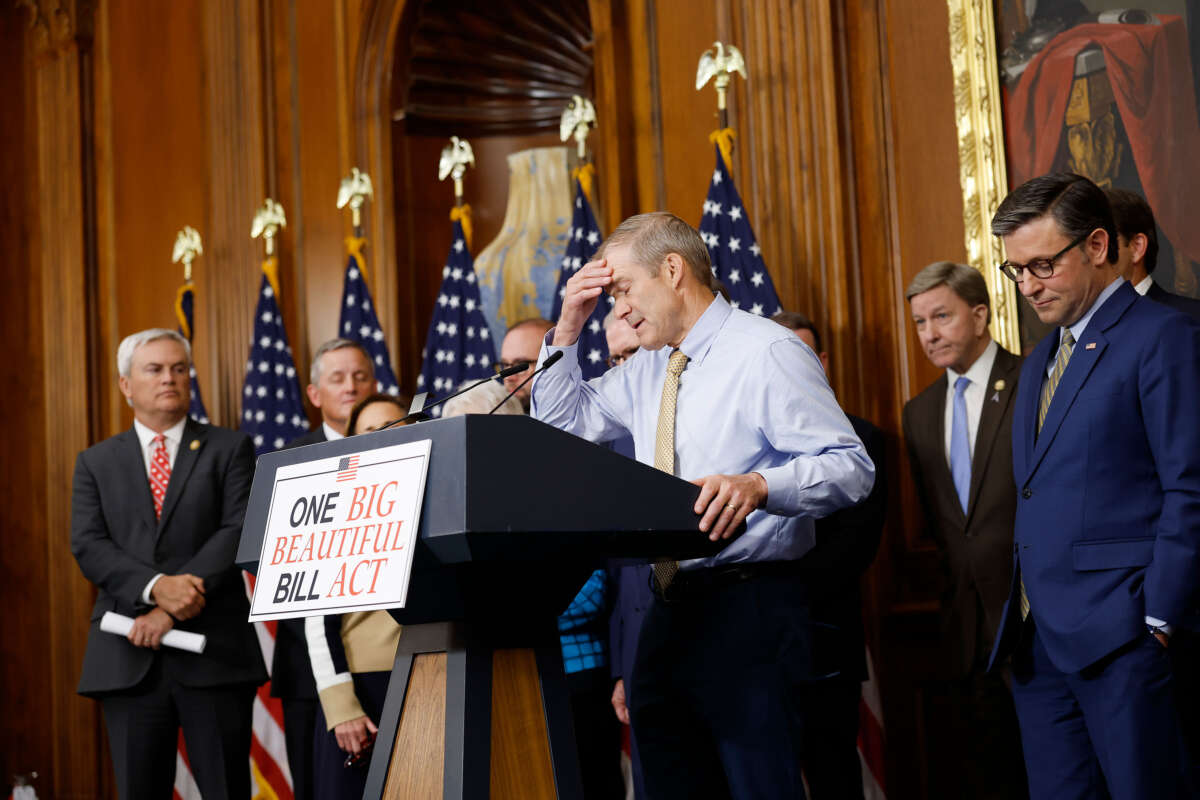
New polling data indicates that a majority of Americans are opposed to Republicans’ budget reconciliation bill, oftentimes referred to by President Donald Trump as the “Big, Beautiful Bill,” with only a quarter of voters viewing it positively.
According to a Quinnipiac University poll published earlier this week, 53 percent of Americans are opposed to the legislation. Twenty-seven percent support the bill, while 20 percent expressed no opinion or said they didn’t know enough about it to have a stance.
Notably, while support among Democratic-leaning voters is unsurprisingly low (with just 2 percent backing the legislation and 89 percent opposed), Republican voters aren’t nearly as supportive of the reconciliation package as they have been of other Trump priorities in the past. To be sure, a solid majority of Republican-leaning voters — 67 percent — back the bill, but 10 percent are opposed, with another 22 percent expressing no opinion.
One major aspect of the bill is hundreds of billions of dollars in cuts to health care funding, including Medicaid. According to the poll, a plurality of voters, 47 percent, want increases to Medicaid rather than cuts. Forty percent of voters want Medicaid spending to stay about the same, while just 10 percent want cuts to happen.
Among partisan voters, 69 percent of Democrats want Medicaid increased, while 27 percent want funding levels to remain the same; just 2 percent want to see cuts happen. Republicans, meanwhile, are also reluctant to support cuts to Medicaid, with only 18 percent backing them. Twenty-one percent of GOP voters want funding levels increased, while 56 percent want funding kept at its current level.
The reconciliation bill’s cuts to health programs, including Medicaid and the Affordable Care Act (ACA), would indeed be devastating. According to an independent analysis from researchers at Yale University and the University of Pennsylvania, cuts to those programs would lead to around 16 million people losing access to health care coverage, ultimately resulting in around 51,000 preventable deaths per year for at least the next 10 years.
The “Big, Beautiful Bill” would also include a redistribution of wealth that would benefit America’s richest income earners at the expense of low-income workers. According to the Congressional Budget Office’s latest nonpartisan analysis, provisions in the bill would result in a decrease in the wealth of the poorest 10 percent of households by almost 4 percent, amounting to around $1,600 in wealth lost annually for those families. Meanwhile, the richest 10 percent of households would see a 2.3 percent increase in their wealth each year, or $12,000 of increased wealth annually.
Critics of the reconciliation package, including Sen. Bernie Sanders (I-Vermont), have lambasted the legislation for slashing social safety net programs and for redistributing wealth from the poor to the wealthiest individuals in the U.S.
“In the wealthiest country in the world, we should be guaranteeing health care to all as a human right, not taking health care away from millions of seniors and working families to pay for tax breaks for billionaires,” Sanders said earlier this month.
We lost 15 percent of our traffic overnight.
We now have three full months of data since Google changed its search to feature AI results. The numbers are worse than we anticipated. Overall readership that comes to Truthout through Google is down 54 percent against last year. The number of new readers who discover Truthout via Google searches is down 49 percent, and returning users from Google are down 51 percent.
We lost 15 percent of our readership overnight. This was a readership we painstakingly built over decades, and it vanished because Google chose corporate greed over a healthy democracy.
We anticipate a loss of roughly $500,000 in online revenue as a result of this massive traffic plunge in the next year alone.
The only way we can keep publishing is with strong reader support. We are asking you to start a monthly donation to Truthout today — anything you can do, whether $5 or $25, makes a difference.