Did you know that Truthout is a nonprofit and independently funded by readers like you? If you value what we do, please support our work with a donation.
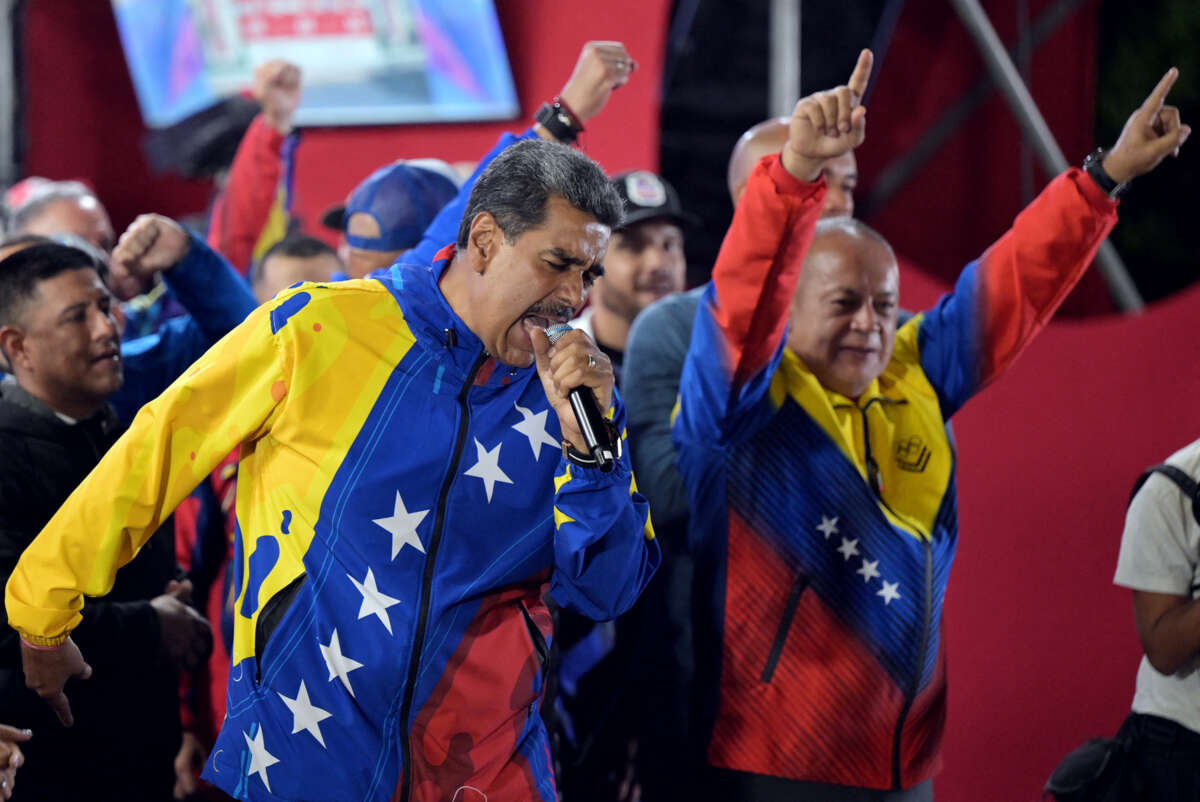
Venezuelan President Nicolás Maduro won reelection to a third term on Sunday with just over 51% of the vote in what one group of independent election observers described as a “fair and transparent” contest, despite loud claims of fraud by the right-wing opposition — a narrative readily boosted by Western corporate media outlets.
The Consejo Nacional Electoral (CNE), Venezuela’s election authority, said Maduro won 51.2% of the vote with 80% of polling places counted. Edmundo González, an ex-diplomat and the primary opposition candidate, won 44.2% of the vote.
Opposition leader María Corina Machado, who was barred from running in the election, claimed without evidence that González won 70% of the vote. Surveys conducted ahead of Sunday’s contest showed González with a substantial lead over Maduro, but Jake Johnston of the Center for Economic and Policy Research (CEPR) noted that “since 2015, pollsters have overestimated opposition support” in Venezuela “by an average of 29.5 percentage points.”
Nearly 60% of Venezuela’s electorate of over 21 million people turned out for Sunday’s race, according to figures from CNE, which faced calls from experts and political leaders in the region — including left-wing Chilean President Gabriel Boric — to release detailed election results in the interest of transparency.
The U.S.-based National Lawyers Guild (NLG) said in a statement that its delegation of five election observers “visited several polling sites in Caracas and La Guaira and shared notes and information with the 910 electoral observers present from 95 countries and many organizations, including the Carter Center, the United Nations, the African Union, and the Latin American Council of Electoral Experts.”
NLG’s president, Suzanne Adely, said Sunday’s elections “were not only fair and transparent but also represented an example of popular civic participation.”
“Their successful outcome is a triumph for the Venezuelan people,” Adely added, “especially considering the level of U.S. interference and attempted sabotage of the democratic process, particularly through sanctions and coercive economic measures aimed at producing ‘regime change’ in Venezuela.”
Speaking after CNE’s announcement, U.S. Secretary of State Antony Blinken said the United States has “serious concerns” that the tallied result “does not reflect the will or the votes of the Venezuelan people” — a response that drew swift backlash, given longstanding efforts by the United States to overthrow the Latin American nation’s elected government and crush its economy with sanctions.
As The Washington Post’s Jeff Stein and Federica Cocco reported last week, “Sanctions on Venezuela… contributed to an economic contraction roughly three times as large as that caused by the Great Depression in the United States.”
And who knows "the will of the Venezuelan people" better than the US Secretary of State? https://t.co/XLFDkaXOS8
— Venezuelanalysis (@venanalysis) July 29, 2024
Nearly 12 years ago, when Maduro’s predecessor President Hugo Chavez was running for reelection, CEPR’s co-director Mark Weisbrot reminded readers why the U.S. government continued to “demonize” the idea of democracy in Venezuela despite former U.S. President Jimmy Carter himself calling the Latin American nation’s election system “the best in the world.”
“In Washington, democracy has a simple definition: does a government do what the State Department wants it to do?” Weisbrot wrote at the time. “The State Department tries to keep its eyes on the prize: Venezuela is sitting on 500 billion barrels of oil, and doesn’t respect Washington’s foreign policy. That is what makes it public enemy number one, and gets it the worst media coverage.”
25 Years of Truthout: An important fundraising appeal
This September, Truthout is celebrating 25 years of publication. For over two decades, we have been a trusted source for fiercely independent journalism thanks to readers like you.
As we look to the next 25 years, we have launched a special fundraising campaign. Looking to a sustainable future for our publication, we have a fundraising goal of $92,000 in the next 8 days.
We are asking for your support at this juncture because we face greater threats than ever before in our organizational history. Trump and his MAGA allies are determined to control the information ecosystem, and movement-based organizations are subject to dangerous censorship and scrutiny.
If you can support Truthout with a one-time or monthly donation, you will make a significant impact on our work and our legacy. Anything you can do makes a difference!