Honest, paywall-free news is rare. Please support our boldly independent journalism with a donation of any size.
A federal judge has placed an indefinite injunction on President Donald Trump’s executive order seeking to redefine the birthright citizenship clause found within the 14th Amendment of the U.S. Constitution.
Trump issued the order on the first day of his second term in office, asserting that the 14th Amendment “has never been interpreted to extend citizenship universally to everyone born within the United States” — a claim that is contradicted by 12 decades of Supreme Court precedent and subsequent federal rulings since then.
The first clause of the 14th Amendment reads:
All persons born or naturalized in the United States, and subject to the jurisdiction thereof, are citizens of the United States and of the state wherein they reside.
Trump’s order seeks to limit who can be considered a citizen by redefining the term “subject to the jurisdiction thereof,” claiming that individuals born in the U.S. to noncitizen parents are not under that designation.
After the executive order was issued, a coalition of civil rights groups representing five pregnant women whose children could be detrimentally affected by the order filed a lawsuit in a Maryland-based federal court, alleging that Trump’s action was illegal.
“This executive order is such a departure from settled law,” said Joseph Mead, an attorney for the plaintiffs, during a court hearing on the order. “It’s so abrupt and such a departure from what we’ve been doing for over a century.”
U.S. District Judge Deborah Boardman issued a preliminary injunction on the order last month. On Wednesday, she extended that order to last throughout the time it would take to hear the case in full, indicating that the plaintiffs have a high likelihood of winning the case.
“The United States Supreme Court has resoundingly rejected the president’s interpretation of the Citizenship Clause of the 14th Amendment,” Boardman said in announcing her ruling. “In fact, no court in the country has ever endorsed the president’s interpretation. This court will not be the first.”
She added:
Today, virtually every baby born on U.S. soil is a citizen upon birth. That is the law and tradition of our country. That law and tradition will remain the status quo pending the resolution of this case.
Within the ruling itself, Boardman took special care to note Supreme Court precedent dating all the way back to 1898, in a case involving a man named Wong Kim Ark, who was born in the United States to two Chinese immigrants. When Wong left the country temporarily and tried to return, he was told he had no legal right to do so, as the U.S. government did not deem him a legal citizen.
The Supreme Court rejected the government’s argument in that case, citing a straightforward reading of the 14th Amendment and common law precedents to rule that Wong was, indeed, a citizen.
In her ruling this week, Boardman noted that the Justice Department, arguing in favor of Trump’s executive order, didn’t dispute the final ruling in United States v. Wong Kim Ark, but rather tried to redefine the words written in the 14th Amendment. The president cannot change that interpretation through a simple executive order, Boardman wrote, and lawyers for the government provided no compelling reason as to why he should be able to do so.
“The government cites no case decided after Wong Kim Ark that supports the President’s interpretation of the Fourteenth Amendment. And there is none,” Boardman said in her ruling.
The precedent was clear, she added, stating that, “in the 125 years since Wong Kim Ark, the Supreme Court has never questioned whether a child born in the United States — whose parents did not have lawful status or were in the country temporarily — was an American citizen,” and that, “in other cases, the Supreme Court never has intimated that the immigration status of parents might affect whether their U.S.-born children are citizens at birth.”
“The President’s novel interpretation of the Citizenship Clause contradicts the plain language of the Fourteenth Amendment and conflicts with 125-year-old binding Supreme Court precedent,” Boardman wrote.
An appeal to the U.S. 4th Circuit Court of Appeals would be the next step for the Justice Department to take if it wishes to challenge Boardman’s ruling. The department hasn’t indicated yet whether it will do so, but an appeal seems likely, given Trump’s attacks on immigrant communities in the U.S. since taking office.
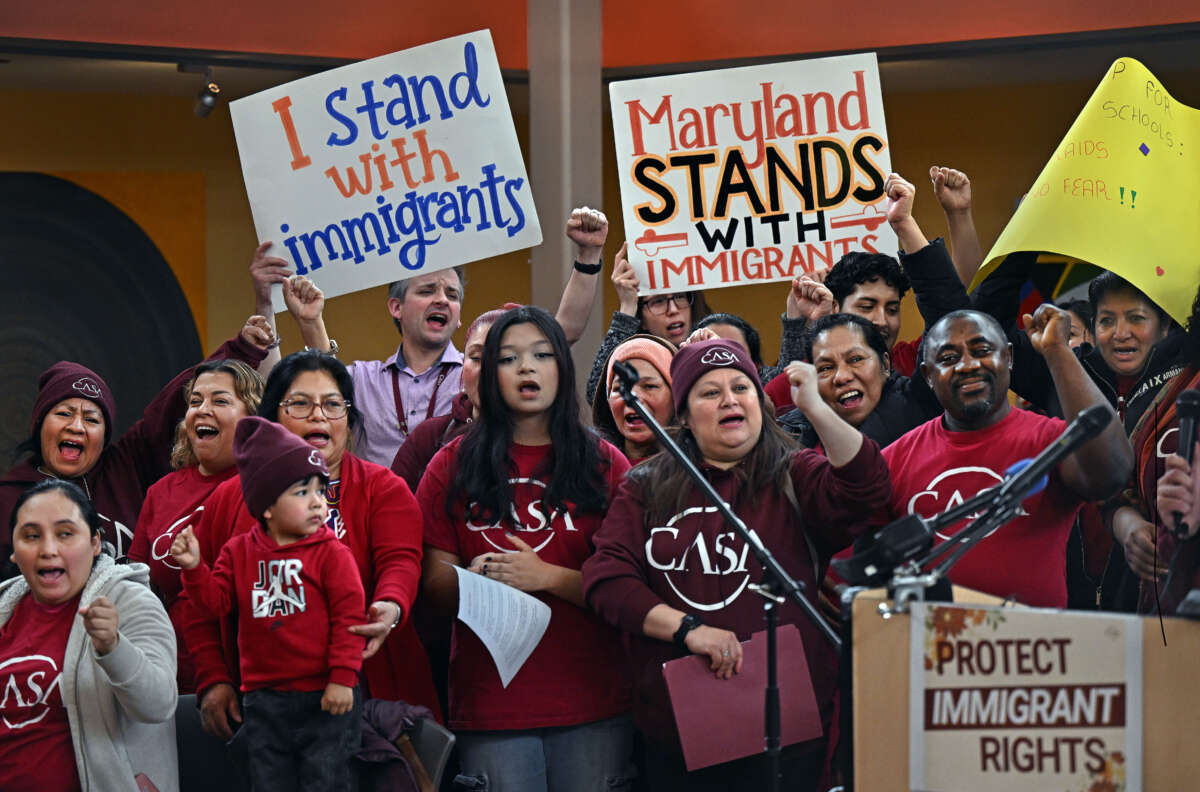
George Escobar, chief of programs and services for CASA, one of the organizations that represented the pregnant women in the lawsuit, heralded the ruling.
“This is the level of fight that will be required for the next four years of the Trump administration. The pregnant women who took this case up against President Trump — and so many immigrants across the country — can breathe easier knowing that their precious children are citizens and afforded the full rights that come with that,” Escobar said in a statement to NBC News.
Press freedom is under attack
As Trump cracks down on political speech, independent media is increasingly necessary.
Truthout produces reporting you won’t see in the mainstream: journalism from the frontlines of global conflict, interviews with grassroots movement leaders, high-quality legal analysis and more.
Our work is possible thanks to reader support. Help Truthout catalyze change and social justice — make a tax-deductible monthly or one-time donation today.