Truthout is an indispensable resource for activists, movement leaders and workers everywhere. Please make this work possible with a quick donation.
Iran has been under a government-imposed internet blackout for the last week, and very little information has emerged.
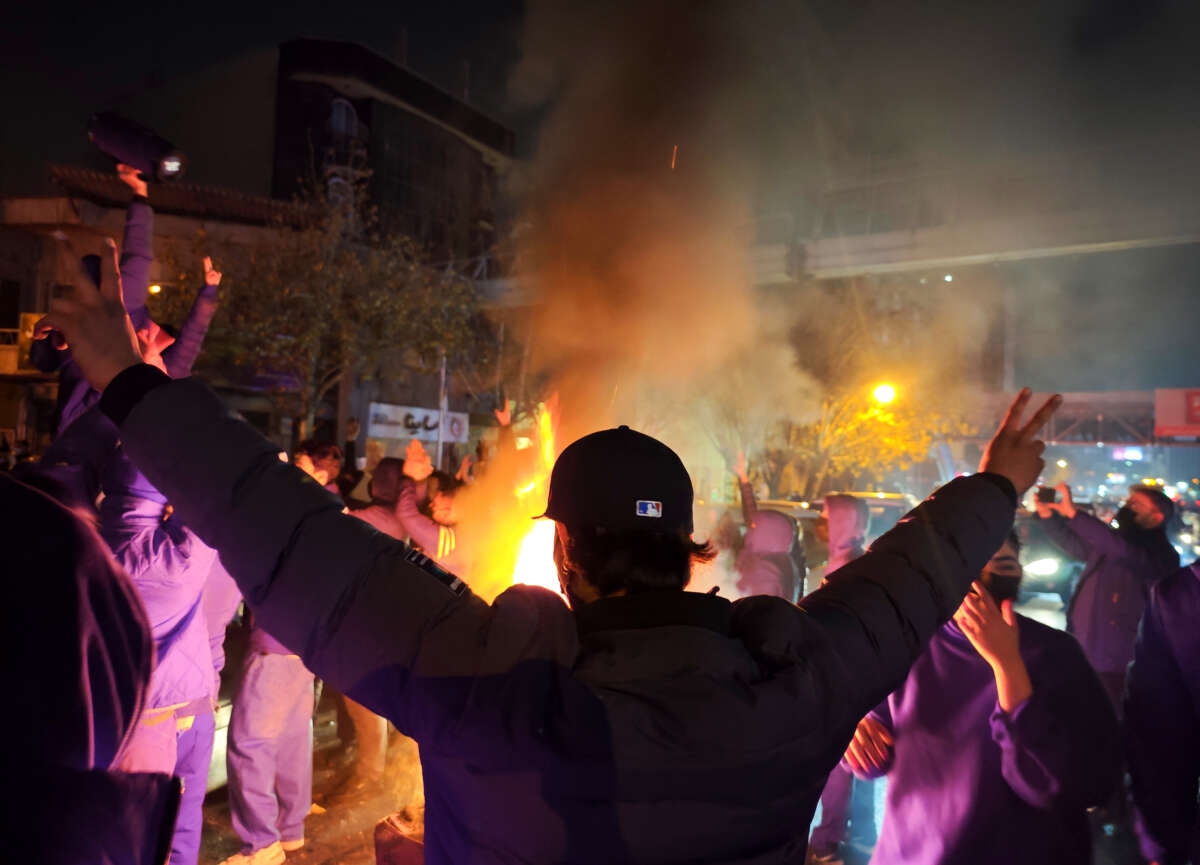
What we do know is that thousands have been killed since authorities launched a crackdown on protests that have spread across the country since late December. What started as anger centered in Tehran’s grand bazaar over the rapid fall in the value of Iran’s currency quickly spread to wider demands for political freedom. Authorities initially offered a series of economic compromises, including subsidies on basic goods, to help Iranians deal with skyrocketing inflation. But protests spread to small towns. And by January 8, a new wave of demonstrations unfolded, and authorities responded with violence on a wide scale.
The footage that emerged initially showed huge crowds in major cities like Tehran and Mashhad. But in the days since, those have given way to videos of sobbing families trying to identify the bodies of loved ones at overflowing morgues, or crowds chanting “death to the dictator” as they bury loved ones. Estimates of the number of Iranians slain are now above 2,500.
Protesters’ families are not the only ones grieving. Authorities claim that more than 100 members of the security forces have been killed. State TV has been filled with footage of morgues, as well. In one video, a reporter’s voice cracks as he laments the deaths of “ordinary people” killed by “rioters.” This is the line repeated by authorities, who claim armed groups backed by foreign powers have taken advantage of the people’s legitimate grievances.
It might be easy to dismiss these claims as propaganda if it were not for statements by Israeli authorities claiming Israel has agents operating on the ground. Reza Pahlavi, the son of the deposed shah of Iran, who has allied himself with Israeli Prime Minister Benjamin Netanyahu, dismissed reports of thousands of dead protesters by saying, “This is a war, and casualties are inevitable.”
Trump has spent the last two weeks looking at options to strike Iran after promising that if Iran’s government hurt protesters, he would intervene to save them.
But this is not a war. These are popular protests by Iranians increasingly desperate amid a collapsing economy and enraged at a corrupt political leadership that represses freedom of speech and political participation. But foreign intervention — whether that be through military strikes or infiltration of protests — risks subverting these demands and turning protesters into pawns of foreign powers.
Six months ago, Israel and the U.S. launched a war on Iran. The war did not free Iranians, but it did kill more than 1,000 people and left tens of thousands homeless. Those who survived found themselves in a far worse economic situation than before.
Yet today there are renewed calls from members of the Iranian diaspora and U.S. politicians for Donald Trump to “do something” to help Iranians. Trump has spent the last two weeks looking at options to strike Iran after promising that if Iran’s government hurt protesters, he would intervene to save them.
Trump has indicated that he could gear up to play his favorite role: savior.
But it is hard to believe that a leader who clamps down on his own people and justifies militarized forces killing protesters in the U.S. has the interests of Iranians in mind.
It is even less believable given that Trump is directly responsible for the situation Iranians find themselves in.
The current economic crisis was caused by a rapid decline in the value of Iran’s currency, a direct result of Iran’s lack of access to foreign reserves. This is an “imposed crisis,” economist Esfandyar Batmanghelidj argues, “uniquely caused by U.S. sanctions.” It was aggravated by EU “snapback” sanctions that came into effect in the fall, limiting Iran’s access to foreign reserves.
It is hard to believe that a leader who clamps down on his own people and justifies militarized forces killing protesters in the U.S. has the interests of Iranians in mind.
All of this has been nearly a decade in the making, since Trump imposed a policy of what he called “maximum pressure” designed to make Iran’s economy collapse. The economic pain that Iranian protesters are experiencing is the direct result.
Trump has shown that he loves to create crises and start wars so that he can “solve” them and proclaim himself a peacemaker. He has repeatedly said he deserves a Nobel Peace Prize for his efforts. And he knows that if he could strike a deal with Iran’s leaders, he could claim to bring “peace” between Iran and the U.S. There are signs that he is engaged in or considering backdoor negotiations with Iran.
But as Trump’s invasion of Venezuela just a week ago shows us, the U.S. president is most concerned with getting business deals for the United States. His focus on getting access to oil — even by stealing it from Venezuela — is a far higher priority than ensuring Venezuelans get the right to decide their own future through free elections.
The reason is obvious: Most Venezuelans would probably not vote to hand over their country’s natural resources to the United States. Similarly, it is unlikely that Iranians would freely vote to hand over their natural resources to the United States.
After all, the anger on Iran’s streets is directed not only at Supreme Leader Ali Khamenei but also at the Islamic Revolutionary Guard Corps (IRGC), which Iranians blame for taking control over the country and treating it like its own private economic playground.
And although it might seem counterintuitive to Americans, Trump’s sanctions have been crucial in increasing the IRGC’s power over Iran’s economy. The IRGC is a parallel military force to Iran’s regular army. But it emerged as a major economic force when it helped reconstruct Iran’s cities after the 1980-88 Iran-Iraq War. That fueled the growth of companies affiliated with the IRGC that acquired concrete factories, quarries, construction companies, and many other types of economic enterprises.
There is a perception outside Iran that the country has a state-controlled economy. But in the 2000s, then-President Mahmoud Ahmadinejad became a darling of the International Monetary Fund as he sold off huge chunks of the state economy; later presidents have also paid heed to the controversial financial institution, and have been met with rounds of protest over increasing inequality as a result. Former commanders and politicians with links to the IRGC began buying off state enterprises at favorable rates. While most Iranians suffered due to sanctions, IRGC-linked firms were able to draw on their political connections to weather the storm and take command of the economy.
Trump appears to be using the protesters on the street as leverage in a game of pressure against the Iranian government.
U.S. sanctions hurt private enterprise and cut Iranians off from the global banking system. They also tanked the country’s currency, which disproportionately hurt wage earners in the middle and working class as well as among the precariously employed poor. While wealthier Iranians invested in assets like land, homes, and cars that saw their value rise along with inflation, the rest of the country saw their absolute wealth rapidly decline.
And in recent years, Iranians have watched the children of the elite, whom they’ve termed “Aghazadeh” (roughly meaning children of those in power), become flashier and showier with their money. Consumer culture flourished in Iran’s major cities, even as the rest of the country seemed to fall further and further down the economic spiral.
One of the most iconic images of this early wave of protests was of youth grabbing bags of rice and tossing the grains in the air after looting a branch of Ofogh Kourosh, a chain supermarket linked to the IRGC. The target was no accident; crowds targeted specific shops and institutions and symbolically sought to overturn the IRGC’S monopoly on Iran’s economy.
But the economic is political. And redistribution of wealth can’t happen without access to political power.
The Uprising Changes
The threat of foreign intervention has never been far from Iranians’ minds. Trump made his first threats to strike at the beginning of Iran’s latest round of protests. When he attacked Caracas and abducted President Nicolás Maduro, one of Iran’s few allies on the world stage, some analysts also interpreted it as an implicit warning to Iran’s leadership from the U.S. president.
Some Iranians are attracted to Reza Pahlavi, whom they perceive as close to Trump and thus as someone who could potentially help overthrow the government.
This faction is but one of many among Iranians both inside and outside Iran. And their right-wing views are anathema to many other Iranians, who saw Reza Pahlavi’s support for Israel’s June 2025 attack as treachery and who view the oppressive rule of his father as best confined to the dustbin of history. This is especially true among Iran’s ethnic minorities, who are nearly half of the country’s population, and who were particularly repressed by the brand of Persian ethnic nationalism that the Pahlavis introduced in Iran.
Numerous civil society organizations have released statements backing the protesters’ economic and political demands while warning that foreign intervention would lead to chaos.
Six women’s organizations from Kurdistan deemed the uprising a continuation of the “Woman, Life, Freedom” revolt a few years earlier, decrying the “massacre and brutal suppression” of protests, urging that “freedom” could only come through the “collective will.” The statement condemned the return to monarchism advocated by Reza Pahlavi. The Bus Drivers’ Union of Tehran similarly praised the uprising but cautioned Iranians not to be taken by fantasies of restoring the past.
These takes reflect growing fears among progressive Iranians that right-wing forces from outside the country are trying to take ownership of the struggle. These fears were confirmed on Thursday, January 8, the date on which Reza Pahlavi called for supporters in Iran to take to the streets.
Thursday is the beginning of the Iranian weekend, and Iranians had already planned to protest. But by making the call, Pahlavi intimated that all of those demonstrators in the streets that night were his supporters.
Videos suggest many tens of thousands of people protested that night, in the widest expansion of protests since the beginning of the uprising.
Pahlavi has repeatedly claimed that defectors in the security forces support him and are ready to rally to the people’s side. That didn’t happen. But authorities pointed to his calls for an uprising as proof that the protests were being stage-managed from abroad and reason to unleash violence on the crowds.
The last time Iran sat down at the negotiating table with the U.S., Israel and the U.S. launched a surprise attack on Iran.
Trump vacillates between claims that “help is on the way” to Iranian protestors and pulling back. He appears to be using the protesters on the street as leverage in a game of pressure against the Iranian government. Iran’s government has responded by treating the protests as such. This is the sad truth of the current situation: Both Trump and the Iranian government view the Iranian people as pawns in their own political game.
Iran’s government finds itself in a dead end. There is no way to fix the economy without the U.S. lifting sanctions. It can only lift sanctions if the U.S. agrees to negotiate. The last time Iran sat down at the negotiating table with the U.S., Israel and the U.S. launched a surprise attack on Iran.
Iranians from across the political spectrum are unhappy with the current situation. And it’s not just the protesters on the street. Millions of Iranians voted for Saeed Jalili in the last election, a hard-line candidate who could be seen as indexing support for the regime more broadly. But they, too, are dissatisfied by the current status quo.
Like many other Iranians across the political spectrum, they are also terrified of instability, war, and chaos. They have seen what happened to neighboring countries like Afghanistan and Iraq that the U.S. bombed in order to “free.” Yet ironically, the regime’s supporters are willing to overlook the killing of protesters if it means long-term stability.
But the killings on the streets of Iran will not bring stability; they will only bring more division and more hatred. By violently repressing protests, Iran’s government is creating conditions that breed the exact social and political collapse it claims to be trying to avoid.
And if Trump or Reza Pahlavi make good on their promises to bring a real war to Iran, or to attempt to incite armed groups in the country to rise up, this could fuel a civil war — one in which the Iranian government fired first.
Lessons From the Uprising
Iranians have shown tremendous courage in taking to the streets again and again, year after year. Thousands have risked their lives, and given their lives, for a more just economic and political order.
When people ask me what repeated uprisings in Iran over the last two decades have achieved, I always point out that each uprising has been built on years of political organizing underneath the surface that is invisible from outside the country.
Iranians face a double bind between domestic oppression on one hand and foreign oppression on the other.
The feminist uprising under the “Woman, Life, Freedom” movement that began in 2022 was a result of years of grassroots feminist organizing on the ground. And even if it seemed to have failed from afar, inside Iran, it produced a social transformation that profoundly reshaped the country and forced the government to retreat from some of the draconian forms of social policing that it had enforced for decades.
Each uprising builds on the ones before it, introducing new demands and dynamics.
The current uprising reveals how the needs for economic reforms and the limits of the capitalist order will necessarily lead to resistance and revolt. Political freedom and economic welfare are intertwined, whether in Iran, the United States, or anywhere else.
Iranians deserve global solidarity. Not because their struggle is unconnected from our own. But because we are all fighting despots and wannabe-despots in our own context.
Iran is not the only place that appears to be facing down military occupation and martial law; those words have been used to describe conditions in Minneapolis and other cities where Immigration and Customs Enforcement (ICE) and the National Guard have been deployed by Trump as part of his crackdown on immigrants across the country.
Iranians face a double bind between domestic oppression on one hand and foreign oppression on the other. But that is not a reason to pity them. It is a reason to honor their struggle and learn from it.
As one anti-ICE protester in the U.S. said over the summer: “Regime change starts at home.” At a time when millions of people in the U.S. feel less control than ever over their government and are witnessing a rapid degradation of democratic norms, we should be looking to people resisting authoritarianism the world over for inspiration in our own struggle.
Press freedom is under attack
As Trump cracks down on political speech, independent media is increasingly necessary.
Truthout produces reporting you won’t see in the mainstream: journalism from the frontlines of global conflict, interviews with grassroots movement leaders, high-quality legal analysis and more.
Our work is possible thanks to reader support. Help Truthout catalyze change and social justice — make a tax-deductible monthly or one-time donation today.