Truthout is an indispensable resource for activists, movement leaders and workers everywhere. Please make this work possible with a quick donation.
Warning: This article contains spoilers.
Near the end of Sinners, there is a moment that Hollywood rarely permits. The character Smoke guns down a gang of Ku Klux Klan members who have come to murder his people — and then, with hands still trembling, he cradles his newborn child in his arms.
Watching it, something strange and powerful stirred within me — as if the film were bending time, reaching across generations to reply to a story I recently learned in my journey to understand my family history.
A few years ago, my dad, Gerald Lenoir, made a stunning discovery: He found the Mississippi plantation where our family had been enslaved and the land where they lived after emancipation. In the process, he also discovered that the ancestors of the legendary bluesman J. B. Lenoir were likely enslaved on that same plantation.
That news bent me like a blue note on a National guitar.
I’ve spent much of my life devoted to the blues — I play harmonica in the band The Blue Tide — and this discovery was a revelation that bound me to the music’s tradition of protest and truth-telling in a way words can scarcely capture. After several trips there with my dad and brother, I brought my kids to Jayess, Mississippi, where we dedicated a headstone to my great-great-grandparents, Thomas and Laura Lenoir, who had been enslaved nearby.
At the ceremony, a woman in her nineties approached and told me she had once been friends with my great-great-grandmother Laura. The fact that I was talking to someone who had been friends with a person who had once been enslaved was stunning.
This history isn’t distant. It’s breathing right beside us.
Then she told us a story I will never forget. During Jim Crow, the Ku Klux Klan burned down the preschool that Black families in Jayess had built for their children in an effort to drive them off their land. But the community didn’t run. They armed themselves, rebuilt the school in a tent, and stayed. They fought back and held onto their land.
That’s why that scene in Sinners hit me so hard.
For families who have passed down stories of surviving the Klan — and the trauma and resilience of those encounters through their blood — that moment on screen was not just witnessed. It was remembered in the body.
Cultural critic bell hooks once wrote that enslaved Black people were often punished simply for looking at white slaveowners, and she wondered how that traumatic history shaped “Black parenting and Black spectatorship.” Out of that history, hooks argued, Black audiences developed what she called an “oppositional gaze” — a way of watching films critically, aware of how Hollywood has long distorted or erased Black life. Instead of forcing Black viewers to watch themselves through a white lens, Sinners centers Black memory, Black defiance, and Black love.
In doing so, the film also understands something the writer Amiri Baraka captured in his landmark study Blues People: “Blues means a Negro experience.” He understood that the blues is not merely music but the historical expression of Black life in America. Sinners takes that insight seriously.
The Blues Summons Monsters and Opens Portals
Set in 1932 Clarksdale, Mississippi, Sinners follows Smoke and Stack (both portrayed by Michael B. Jordan), twin brothers who return home from Chicago after years working in Al Capone’s criminal empire to open a juke joint.
They recruit a band of extraordinary musicians, including their cousin Sammie “Preacher Boy” Moore (played with electrifying grace by actor-musician Miles Caton in his film debut), a blues guitarist and preacher’s son; Delta Slim (poignantly portrayed by Delroy Lindo), a piano and harmonica player; and Pearline (Jayme Lawson), a blues singer who catches Sammie’s eye and lands a gig at Smoke and Stack’s juke joint.
Smoke and Stack purchase an old sawmill from a white man, who hides the fact that he is the local head of the Ku Klux Klan, and turn it into their juke joint. That evening it becomes a sanctuary for Black residents of Clarksdale — a place where music, laughter, and community create moments of magic and freedom.
Inside Smoke and Stack’s juke joint, Sammie’s music does something astonishing: It bends the space-time continuum, transforming the room into a portal. West African griots appear — playing, drumming, dancing — their sound threading across centuries. Then Sammie’s blues music opens up a portal to the future that ushers in an electric guitarist in the tradition of Jimi Hendrix or Parliament, followed by a hip-hop DJ scratching a record, a break dancer, and Black women twerking that echo the African women also on the dance floor. Even the dancing Chinese ancestors of Grace Chow (Li Jun Li) and her husband Bo (Yao) — shopkeepers in Clarksdale who help with supplies for the juke joint — are summoned into the space, showing that this musical connection has no borders.
The sequence becomes one of the great scenes in cinematic history and one of the greatest tributes to Black musical genius ever expressed. In a few electrifying minutes, the film does something that has rarely been accomplished: It makes visible the living genealogy of Black music — from African rhythms to the blues to rock to hip-hop — revealing it not as a series of separate genres but as a single river of creativity flowing through centuries of struggle and survival.
But sanctuaries can attract predators.
As the film’s opening narration proclaims, “There are legends of people born with the gift of making music so true it can pierce the veil between life and death, conjuring spirits from the past and the future … This gift can bring healing to their communities — but it also attracts evil.”
True solidarity — one capable of liberating everyone, Sinners suggests — cannot be built on colorblind fantasies. It must be forged through an uncompromising struggle against white supremacy.
Clarksdale is haunted — not only by the specter of the Ku Klux Klan, but by another terror that does not simply want to take Black life, but devour Black creativity. It is Sammie’s extraordinary gift for the blues that cracks open the veil between worlds and entices evil, drawing the cunning, complex, and sometimes sympathetic vampire Remmick (Jack O’Connell) and his followers to the juke joint — setting the stage for a night where music, history, and horror collide.
As the community resists the vampire attack, they turn to Annie (the magnetic Wunmi Mosaku), a hoodoo matriarch whose knowledge of rootwork and ancestral protection is needed in the struggle to save Black lives and Black culture.
Remmick, an Irish musician who also knows the sting of colonization and discrimination, goes to the juke joint seeking entry so he can harness the power of Sammie’s blues to reunite him with beloved ancestors he could not save centuries ago. There he makes a passionate case for the Black musicians to join his side:
We believe in equality and music. Can’t we just for one night all be family? … I am your way out. This world already left you for dead. Won’t let you build, won’t let you fellowship. And we will do just that. Together. Forever.
When the Black people in the juke joint refuse to trust Remmick and deny him entry, the scene could be read as a rejection of multiracial unity — an argument that Black culture must remain separate and that alliances across race are doomed to betrayal. But that is not the film’s message. The price of joining Remmick’s “family” and gaining immortality is that Black people relinquish the power of the blues, their memory, and their roots. It is “colorblind” racism in its most seductive form: a system that claims to see “no race” while devouring everything that makes a people distinct, powerful, and whole. Remmick’s offer is not genuine solidarity; it is a form of erasure. True solidarity — one capable of liberating everyone, Sinners suggests — cannot be built on colorblind fantasies. It must be forged through an uncompromising struggle against white supremacy.
North or South, the story was often the same: Black artists created the music that changed the world while others reaped the profits.
The use of vampires to make this point is brilliant. As China Miéville writes in Theses on Monsters, “Epochs throw up the monsters they need. History can be written of monsters, and in them.” Sinners takes that seriously. The vampires haunting Clarksdale are not generic ghouls — they are born of this place, this time, this terror. They feed not just on blood, but on Black creativity. They are the monsters that ripping off Black artists requires: elegant and seductive, yet parasitic.
Sinners refuses to forget the price Black musicians have paid for every riff, every howl, every aching note of the blues — leaving the audience wondering who is more terrifying: the vampires or the Klan. The brutality of white violence in Mississippi was perhaps best captured by blues legend J.B. Lenoir, who sang in his song “Born Dead”:
Why was I born in Mississippi
When it’s so hard to get ahead?
Every Black child born in Mississippi
You know the poor child was born dead.
In just a few lines, Lenoir captured the crushing reality of what it meant to be Black and poor in the Jim Crow South: to be born under siege, fighting for breath, with the odds stacked against you from your first cry. Lenoir knew that reality well. Like many Black southerners during the Great Migration, he left Mississippi and carried the blues north to Chicago, where the music helped transform American culture. But the promise of escape was often more illusion than liberation. Even though Lenoir had a hit song and toured Europe with many blues greats, like many Black blues artists of his era, he was never properly compensated for the songs that helped shape American music. By the late 1960s, living in Chicago, Lenoir had to work a second job as a dishwasher just to survive.
North or South, the story was often the same: Black artists created the music that changed the world while others reaped the profits — sometimes recording more lucrative versions of the very songs Black musicians wrote. As Imani Perry writes in Black in Blues, “The blues were marketed, copyrighted, and taken out of their home grounds, and heard without being listened to, as though there were neither anguish nor art, just entertainment.” As Smoke tells his younger cousin Sammie — who dreams of escaping the oppression and lack of opportunity in Mississippi — “Chicago ain’t shit but Mississippi with tall buildings instead of plantations.” Or as Malcolm X once said, “Stop talking about the South. As long as you are South of the Canadian border, you are South.”
Black Women Got Their Mojo Workin’
With the vampires at the door of the juke joint, it is Annie who shows the community how to fight back; and it is significant that in Sinners, as often in real life, it is a Black woman who carries the wisdom, strategy, and spirit needed for survival.
From Sojourner Truth to Harriet Tubman to Claudia Jones to Ella Baker to Angela Davis — and countless ordinary Black women whose names history rarely records — Black women have long stood at the front lines of the freedom struggle, providing the essential knowledge, organizing, and leadership. Annie is the embodiment of that tradition.
Sinners treats Black women’s wisdom and guidance with unmistakable reverence.
Annie’s spiritual practice of hoodoo — the African American folk spiritual tradition born from West and Central African religions, Indigenous knowledge, and the brutal necessity of survival under slavery — is shown to be sacred ancestral knowledge that protects her community. (The film’s portrayal of hoodoo was shaped by the guidance of Yvonne Chireau, a professor emerita of Black Studies and Religion at Swarthmore College.)
Sinners treats Black women’s wisdom and guidance with unmistakable reverence. Director Ryan Coogler’s wife, Zinzi Coogler (née Evans), was a lead producer deeply involved in the development process — and it shows. The film is alive with the same electricity Black women blues singers once carried onto the stage in the early 20th century. During the 1920s — what scholars call the “classic blues” period — Black women dominated the blues stage and recording industry. As Angela Davis argues in Blues Legacies and Black Feminism, these singers were doing something radical: reclaiming their bodies and desires in public after centuries in which Black women’s bodies had been treated as property.
Under slavery, enslavers routinely raped Black women and forced them to bear children to increase the enslaved labor force. Emancipation did not end the violence. In the Jim Crow era that followed, Black women remained at the bottom rung of the social order, still vulnerable to exploitation, poverty, and sexual abuse.
Against that backdrop, blues women’s voices were revolutionary.
Artists like Ma Rainey, Bessie Smith, Mamie Smith, Victoria Spivey, and Lucille Bogan sang openly about desire, pleasure, independence, bisexuality, and lesbian love — with fearless honesty that defied white supremacist codes of respectability. As Davis explains:
Sovereignty in sexual matters marked an important divide between life during slavery and life after emancipation … Gertrude ‘Ma’ Rainey and Bessie Smith … preached about sexual love, and in so doing they articulated a collective experience of freedom, giving voice to powerful evidence that slavery no longer existed.
These women used the blues to assert sexual autonomy and emotional emancipation in a world that had long denied them both — and Sinners carries that legacy forward. The Black women in the film are not passive figures — they are agents of their own pleasure and power. Their sexuality is not hidden or sanitized; it is vibrant, joyful, rebellious. It refuses to be stolen, shamed, or silenced.
Sinners gathers what this country has tried to forget: the chain gangs, the terror of the Klan, the monstrous theft of Black creativity, the spiritual knowledge that kept a people alive, the laughter that survived, and the music that carried those memories forward.
When Annie’s husband Smoke returns after a long absence, she initiates intimacy, reaching out to reclaim love, body, and spirit on her own terms. And in one of the film’s juke joint scenes, Pearline’s voice pours into the night like a river — and after electrifying the crowd, she is later shown receiving sexual pleasure from Sammie. It is a moment of mutuality and affirmation: a celebration of Black women’s right to desire, to be desired, and to experience joy without shame.
As bell hooks observed, too often when Black women appeared in Hollywood films, “our bodies and being were there to serve — to enhance and maintain white womanhood as object of the phallocentric gaze.” In Sinners, Black women are not background figures serving a broader project of white hegemony and its intersection with sexism — they are carriers of knowledge, power, and desire, shaping the fate of their community.
Sin Verses Love
In an era of mass book bans and laws that prohibit almost half of public school students in the U.S. from learning about systemic racism and honest accounts of Black history, Sinners gathers what this country has tried to forget: the chain gangs, the terror of the Klan, the monstrous theft of Black creativity, the spiritual knowledge that kept a people alive, the laughter that survived, and the music that carried those memories forward.
In one unforgettable scene, Delta Slim rides with Sammie and Stack past a chain gang laboring by the side of the road. As the prisoners’ work song drifts through the air, he recounts the lynching of a dear friend. When the story ends, he offers no sermon or explanation. Instead, he lets out a low, aching moan and begins humming along with the rhythm of the chain gang’s song. In interviews, Lindo later revealed that the moan was spontaneous — a reminder that the blues has always sprung from improvisation, memory, and the raw expression of lived experience.
To Sammie’s father Jedidiah (played by the incomparable Saul Williams), the preacher who warns his son against the blues, the dancers, drinkers, lovers, and musicians of the juke joint are sinners. But the film ultimately rejects that judgment, insisting the real demons are white supremacy, racial violence, and the theft of Black creativity. Even though Preacher Boy leaves the confines of his dad’s church, the blues — rather than damning his soul — allows him to tell his story to the world.
As the legendary blues bassist and songwriter Willie Dixon once said, “The blues is truth.” Sinners lets that truth sing.
Sinners is a blues poem. It is a freedom cry. It is a love letter.
And the soundtrack is sizzling. In one of the film’s most beautiful surprises, legendary Chicago blues guitarist Buddy Guy appears at the end as an older Sammie — a moment that knocked me out the first time I saw it. In a closing-credits scene, Guy shares the stage with Christone “Kingfish” Ingram, the two of them representing the living history and future of the blues. The soundtrack itself features some of the greatest living blues and roots artists alive, including Rhiannon Giddens, Justin Robinson, Bobby Rush, Cedric Burnside, and Eric Gales, with Lawrence “Boo” Mitchell and Jake Blount serving as some of the film’s music consultants. The result is a soundtrack and musical world that feels like the blues itself — alive, rooted, and in conversation across generations.
Perhaps only a force as powerful as love could have created such a cinematic achievement. Ryan Coogler has said the seed for Sinners was planted by an uncle who loved the blues and spent hours sharing those records and stories with him. After his uncle passed away, Coogler made his first pilgrimage to Mississippi to learn more about the culture that produced the music his uncle cherished — a journey that echoes my own recent trips South to learn more about my family’s roots and the land where my ancestors lived and labored.
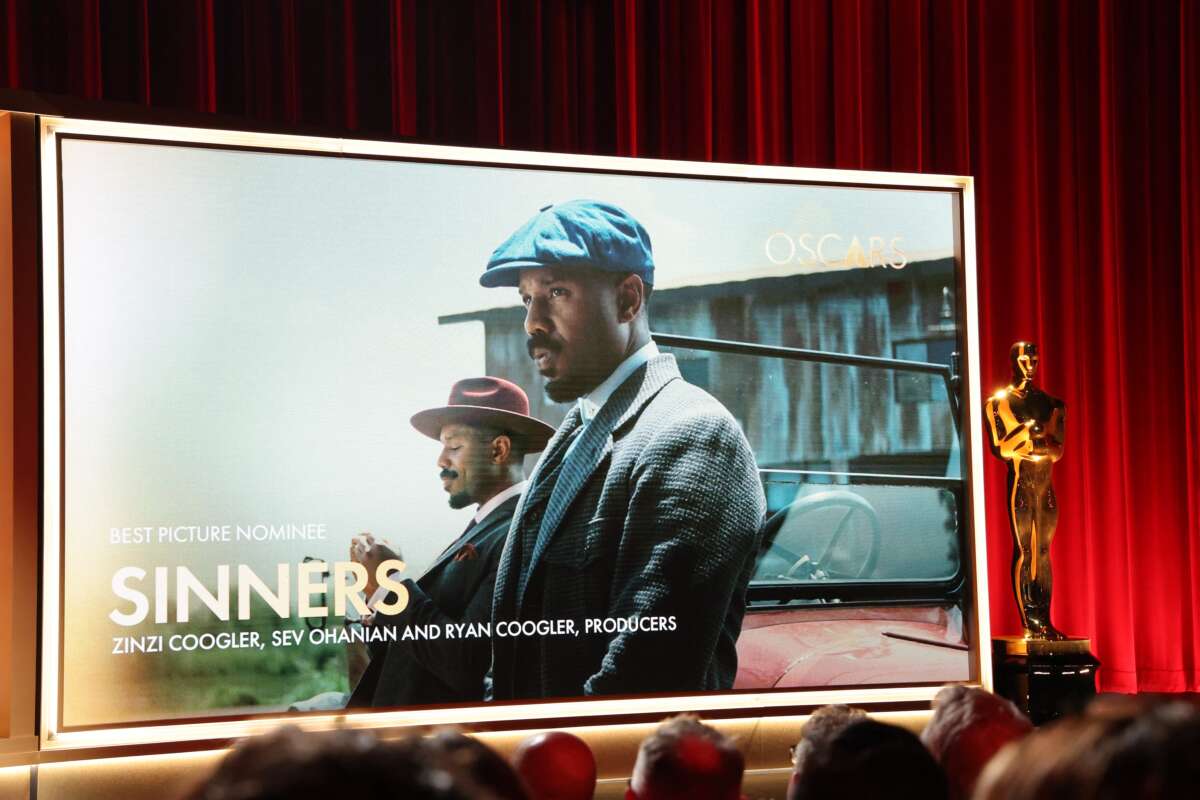
Sinners deserves to win Best Picture and every one of the record 16 Oscars for which it has been nominated. But it cannot be judged only as a film. It is a blues poem. It is a freedom cry. It is a love letter — to Coogler’s uncle, to the blues, and to ancestors like mine who endured that brutal world in Mississippi and still left behind a culture so powerful that no vampire could ever drain its lifeblood.
An important fundraising appeal: 6 Days to raise $39,000
Thank you for reading Truthout today. We have a brief message before you go.
Unfortunately, donations are down for Truthout at a time when media faces immense pressure. Yet, grassroots media is vital in the fight against Trump’s authoritarian reign. Our mandate to tell the truth, share strategies for resistance, and speak against fascism grows more urgent each day. We must appeal for your support.
If you can support Truthout with a one-time or monthly donation, you will make a significant impact on our work. Please donate during our fundraiser.