Part of the Series
Struggle and Solidarity: Writing Toward Palestinian Liberation
Truthout is an indispensable resource for activists, movement leaders and workers everywhere. Please make this work possible with a quick donation.
Approximately 92 percent of homes in the Gaza Strip have been destroyed since October 7, 2023. According to United Nations estimates, around 436,000 housing units have been damaged or destroyed as a result of Israeli airstrikes and military operations.
Less than a week after the war began, on October 13, 2023, Israeli forces issued evacuation orders for northern Gaza, forcing over 1 million Palestinians to move southward to areas such as Khan Younis and Al-Mawasi, which were presented to residents as “safe zones.” However, these areas were not prepared to accommodate such a massive influx of displaced people, lacking the infrastructure and health services needed to cope with successive waves of displacement.
As the bombing continued and evacuation orders expanded, residents flocked to the Al-Mawasi area from across the Gaza Strip — from northern and central Gaza, and especially the eastern border areas near the fence. The neighborhoods along the eastern border were among the first to experience heavy shelling due to their geographic location, and my family was among those forced to leave under constant fear and repeated warnings.
Later, on January 3, 2024, the building that housed our home was bombed and leveled. It was an eight-story building occupied by 32 families. In an instant, it was turned to rubble, leaving all those families homeless — another number added to the destruction statistics. Behind each figure is a home, memories, and a life destroyed in an instant.
Before the war, Al-Mawasi was known as a quiet coastal stretch west of Khan Younis, comprising open agricultural land, sandy and uneven, with scattered plastic houses and seasonal farms. It was not an urban area or a densely populated center but an open space used for farming, with proximity to the sea.
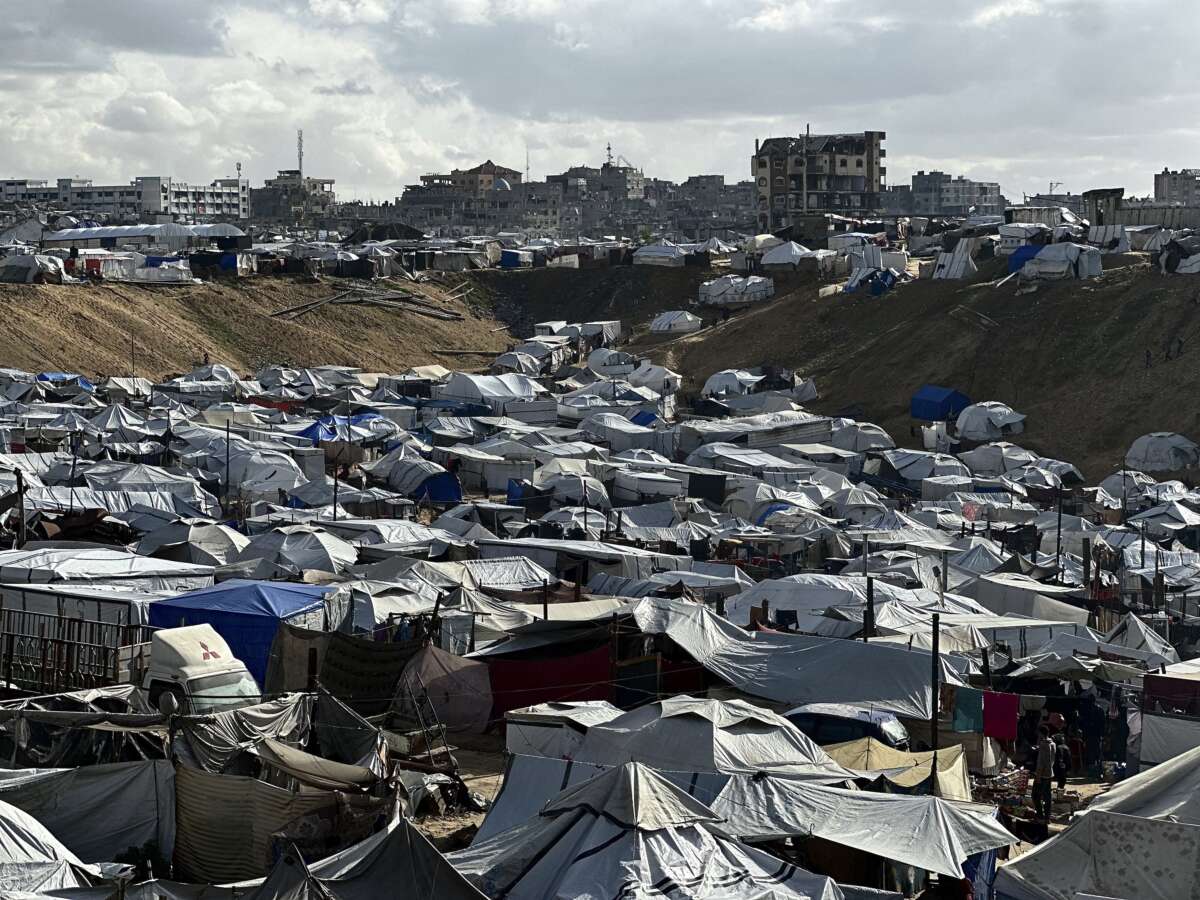
However, with the start of mass displacement orders, these open lands quickly became one of the most crowded areas in the Gaza Strip. Within weeks, tents covered nearly every empty space. There was no longer “open land,” but instead rows of fabric and nylon, tents pressed tightly against one another with barely any space in between.
How can such a place be considered a “safe zone” when it lacks the most basic necessities for life? No proper sewage systems, no organized infrastructure, no spacing between families, and not even enough room to pitch a new tent. Many families had nowhere to set up their tents, let alone space to store water or build a makeshift toilet nearby.
Al-Mawasi transformed from open agricultural land into a chaotic tent city, unplanned, unprotected from heat or cold, and without any health system capable of preventing disease spread.
I spoke with several current and former residents of Al-Mawasi about the struggles they face under these conditions. These are just a few stories out of thousands who continue to suffer in Gaza’s tent camps.
“Illness Has Become Part of Our Daily Life”
Hussam is a 10-year-old boy who has suffered from unhealthy conditions in Al-Mawasi, developing severe skin rashes and allergies due to insects and the environment inside the tents. His mother, Samira Al-Ali, a mother of four, says Hussam’s daily suffering has never stopped since they were forcibly displaced from northern Gaza:
My husband was killed at the start of the war in an airstrike on our home in northern Gaza. We lost everything, our home was destroyed, and we moved to Al-Mawasi into a small tent that does not protect from sun or rain, and Hussam suffers from constant itching and rashes. There is no safe place for children to play, and the heat, dust, and insects make life very difficult.
Samira, with tears in her eyes, describes how moving to Al-Mawasi was not a real solution but a continuation of relentless suffering:
We thought Al-Mawasi would be safe, but the reality is completely different. The tents are overcrowded, each family clings to the next, there is no space to set up a new tent, not even for water containers or a toilet. Life here is extremely hard, and illness has become part of our daily life.
“The Heat, Sand, and Wind Make Life Nearly Impossible”
Saleh Al-Swafiri, 75, and his wife Nasreen, 74, lost all their children at the start of the war when their home in northern Gaza was destroyed in an airstrike. Unhoused, they joined other families in Al-Mawasi, facing new daily challenges despite claims that the area was “safe.”
Saleh describes, with a trembling voice:
Every day we have to walk long distances to fetch water from far points, and cooking on a fire has become an exhausting task for our bodies. There are no flat spaces to pitch tents, no health facilities, not even a small area to rest or move around. Everything here is difficult, everything is exhausting.
Nasreen adds:
We lost our children, and our suffering here grows every day. The tent is cramped, the heat, sand, and wind make life nearly impossible, and we need water, food, and medicine, but the conditions make accessing them nearly impossible.
Their story reflects the immense physical and psychological pressure facing elderly residents in Al-Mawasi, where the open land, extreme overcrowding, and lack of services make daily life a continuous struggle for survival.
Support With Camp Organization Could Alleviate Some of This Suffering
Samah Al-Kurd, a mother of one with a husband, like many of the other families I interviewed for this piece, initially fled to Al-Mawasi after her apartment in a high-rise in Al-Zahra (in central Gaza) was destroyed. She lived for a year and a half in tightly packed tents on uneven sandy ground in Al-Mawasi, without reliable access to drinking water, health services, or basic facilities.
Later, however, she had an eye-opening experience that made clear how more humanitarian support could alleviate some of the suffering that Palestinians living in makeshift camps are currently experiencing: She participated in a project run by the Egyptian Committee, a state-affiliated organization, which established an organized camp for displaced families from Al-Zahra in central Gaza. The camp contains approximately 200 tents and provides essential facilities: water reaches each tent, two meals are distributed daily to each family, and cleaning supplies and vouchers are regularly supplied.
Samah explains the stark difference between the camps:
Even amid destruction, in Al-Zahra I felt safety and order. Everything was organized, the tents had spacing, and food and water were reliably available. This is completely different from Al-Mawasi, where overcrowding is severe, tents touch each other, and every day [its residents] struggle to secure basic needs.
Her experience highlights the importance of planning and organization in camps and shows how replicating this approach in other areas could improve life for thousands of displaced families, instead of relying on chaotic, overcrowded settlements that only increase suffering.
The reality in Gaza’s informal displacement camps shows that open land alone is insufficient to provide a decent life for the displaced. Severe overcrowding and lack of infrastructure and basic services make these camps into environments full of health and living hazards. Organized camps, like Al-Zahra, demonstrate that even simple planning and access to water, food, and essential services can significantly alleviate suffering. Ensuring safe and organized living conditions for displaced people is not a luxury — it is a fundamental human right that must be met immediately.
An important fundraising appeal: 48 Hours to raise $22,000
Truthout is one of only a few platforms for justice-oriented, grassroots journalism. Today, as political censorship from the right intensifies, we have no choice but to ask for your help.
We are fundraising right now to cover our basic operating expenses. If you can support Truthout with a one-time or monthly donation, you will make a significant impact on our work. Anything you can do makes a difference — we appreciate your support.