Did you know that Truthout is a nonprofit and independently funded by readers like you? If you value what we do, please support our work with a donation.
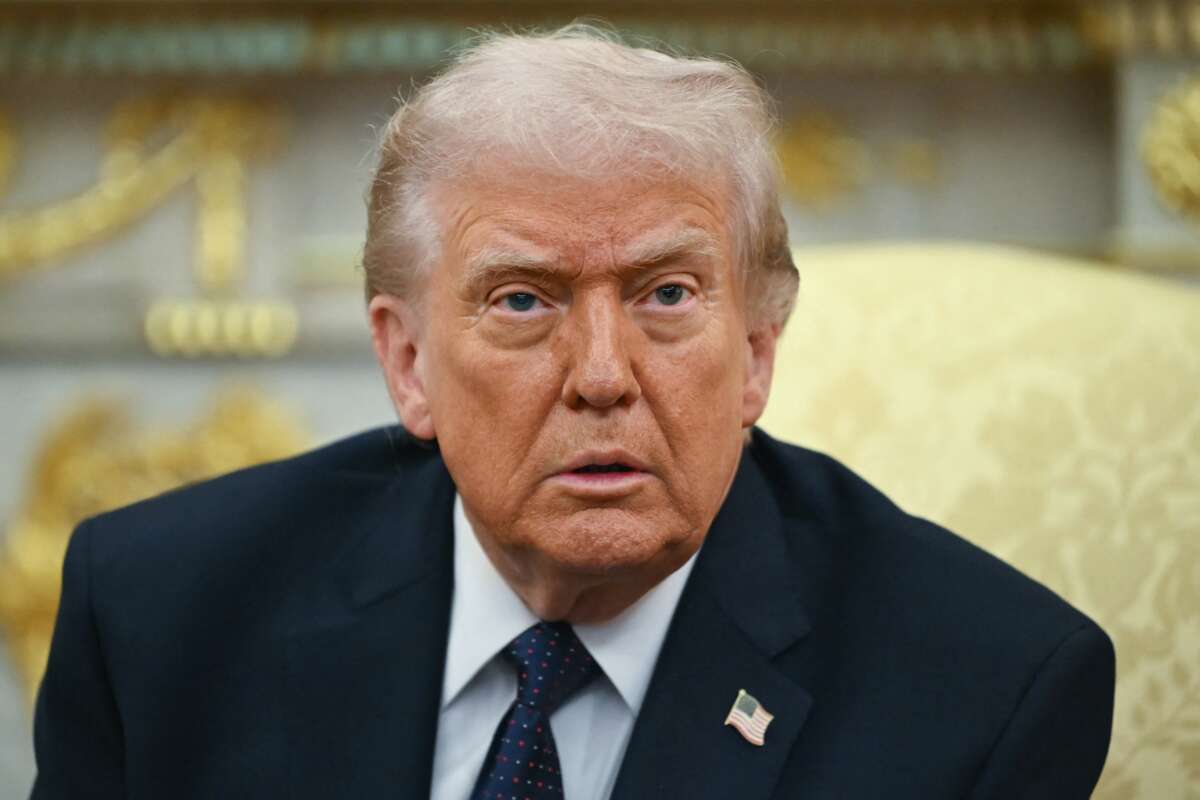
In an interview on Thursday, President Donald Trump insisted that he should be involved in selecting the next leader of Iran, dismissing the idea that Iranians should have final say over their country’s leadership.
Speaking to Axios, Trump decried the idea of Mojtaba Khamenei, son of deceased former Supreme Leader Ayatollah Ali Khamenei, becoming the country’s next leader. (Several media reports falsely suggested that Mojtaba Khamenei had already been selected for the role.)
Khamenei “is unacceptable to me,” Trump said, adding that he considered him “a lightweight.”
Trump also said that he should have a say in who becomes leader of Iran.
“I have to be involved in the appointment, like with Delcy [Rodriguez] in Venezuela,” Trump said, referring to the acting president of Venezuela, who assumed control after the U.S. removed Nicolas Maduro from power earlier this year.
Trump’s disregard for the sovereignty of the people of Iran is undemocratic, experts say.
“He is fine with a symbolic figure taking over Iran as long as this person pursues Trump’s policy preferences,” explained Trita Parsi, executive vice president at the Quincy Institute, adding, “It does not appear that he will find that person from within the existing Iranian system.”
Trump’s desire to handpick Iran’s new leader suggests that his previous calls for “freedom” for Iranians were a ruse.
“All I want is freedom for the people,” Trump said late last month.
Following the U.S.-Israeli assassination of the elder Khamenei, temporary leadership is currently in charge in Iran, under a temporary council model until a new Supreme Leader can be chosen. The Assembly of Experts, an 88-member legislative body whose members are elected every eight years (though their eligibility is determined by the Guardian Council and the Supreme Leader himself), is set to select a new Supreme Leader sometime in the near future.
Mojtaba Khamenei is indeed considered a contender to replace his father as Supreme Leader. However, whether he is a top contender is unclear.
The likelihood that Khamenei will assume the role is hampered by the fact that his father had rejected the idea of a person’s direct family members assuming control of the country following a Supreme Leader’s death, including his own. Selecting Khamenei could also reignite demonstrations from Iranians, many of whom had been protesting before the war, demanding a change in leadership. On the other hand, selecting Khamenei could also send a message of defiance to the U.S.
Trump’s comments suggest that regime change was indeed a major reason why the U.S. and Israel launched their joint war against Iran, despite Trump administration officials publicly denying that they were pursuing such a goal.
In an interview with Politico, Trump claimed that Americans were happy with his decision to attack Iran and with how he’s conducted the war so far.
“People are loving what’s happening,” Trump said.
Polling suggests otherwise.
According to a recent CNN/SSRS poll, 59 percent of Americans are opposed to Trump’s decision to attack Iran. In separate questions from the survey, 60 percent said they do not believe the president has a plan for the war, and 59 percent say they do not trust Trump “to make the right decisions about U.S. use of force in Iran.”
We lost 15 percent of our traffic overnight.
We now have three full months of data since Google changed its search to feature AI results. The numbers are worse than we anticipated. Overall readership that comes to Truthout through Google is down 54 percent against last year. The number of new readers who discover Truthout via Google searches is down 49 percent, and returning users from Google are down 51 percent.
We lost 15 percent of our readership overnight. This was a readership we painstakingly built over decades, and it vanished because Google chose corporate greed over a healthy democracy.
We anticipate a loss of roughly $500,000 in online revenue as a result of this massive traffic plunge in the next year alone.
The only way we can keep publishing is with strong reader support. We are asking you to start a monthly donation to Truthout today — anything you can do, whether $5 or $25, makes a difference.