Part of the Series
Struggle and Solidarity: Writing Toward Palestinian Liberation
Honest, paywall-free news is rare. Please support our boldly independent journalism with a donation of any size.
Ceasefire is a relief. After two years of surviving war, we can finally breathe — but that doesn’t mean our suffering is over. For many of us, it’s only just begun. The tents, and the people still living in them, stand as a heavy reminder that our struggles are far from over. After two years of immense destruction by the Israeli military, most families in Gaza are now living in tents — nylons and fabric that don’t protect them either from summer or winter.
In tent life, there is an unlivable war — a war that doesn’t begin with bombs, but with the absence of everything that makes life human. It is a war whose weapons are the denial of clean water, the lack of hygiene, the absence of toilets, dignity, and safety. I am not writing this as a distant witness. No — I am writing this from within it. From the ground. From inside the tent. These are not stories I’ve heard; these are the sensations I experience.
One month living in a tent was enough for me to understand the immense sanitation disaster and horrific conditions that make displaced people feel suffocated by everything around them. This kind of news doesn’t make headlines, and you might not have heard about it. But it is a silent kind of violence — one that kills us every day.
I am here to tell you how my people — including my family — are facing the devastating consequences of the sanitation crisis in these tents.
Thousands of makeshift tents at displacement camps all across Gaza are full of families seeking refuge.
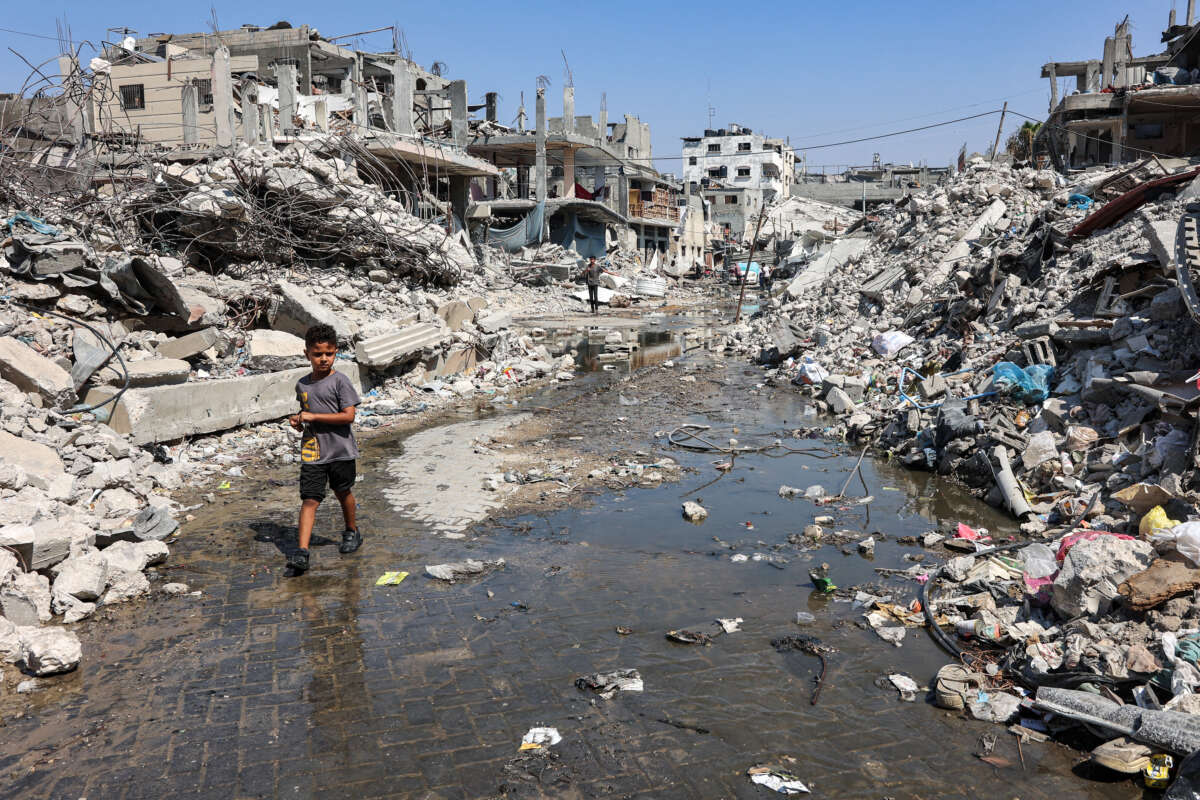
A lack of sufficient toilets, access to clean water, and the presence of open sewage are catastrophic consequences faced by displaced Palestinians — conditions that have persisted since the early months of Gaza’s displacement crisis.
After spending over a month in Gaza City under Israeli occupation, 39-year-old Asma Mohammad and her family fled to the central Gaza Strip, seeking refuge in Al-Nuseirat Camp to escape the ongoing Israeli offensive. Speaking to me via WhatsApp, she described the daily struggle to access basic sanitation. “I have to walk nearly half an hour just to reach the bathroom,” Asma said. “I stopped drinking coffee or tea so I wouldn’t have to walk so far to use a filthy toilet that’s shared by hundreds of people.”
This is something that touches our dignity. I know what she meant because I am experiencing the same thing. Here where I am in az-Zawayda, in central Gaza, men spend a whole week building a bathroom — a toilet. It takes so long because there is no sewage system anywhere anymore. Israel has destroyed the vast majority of sewage facilities in every part of Gaza.
“We can only get water once a week — if we’re lucky, maybe twice.”
People have tried to find a solution to this disaster, but it’s not really a solution — it’s the spread of a new disease. They dig deep, endless holes to replace proper sewage systems, but these holes only create more health risks.
The sanitation crisis in Gaza worsened rapidly during the summer months. Foul odors spread across the entire camp — the only shelter available for thousands of Palestinian families. “It is unbearable,” Amsa once told me. “I escaped from the heat inside the tent,” she added.
Asma and her five family members were lucky enough to get a toilet basin and dig a hole near their tent. But it doesn’t just take effort — it costs money that no family surviving through war can afford: $600 to $700 to build a basic toilet, and that’s without considering the worsening sewage situation.
The struggles don’t end there. Accessing clean water has become a harsh new challenge for most Palestinian families — not only during the war, but even now, after the ceasefire.
“We can only get water once a week — if we’re lucky, maybe twice,” said Refaat Abu Jami, 24, a writer and journalist now displaced in a tent at Al-Mawasi site.
He has been displaced from his home in Khan Younis since the early months of the war. “We live in fear of disease spreading in the horrible conditions we face inside the tent,” Refaat said. “There is no possibility of having a clean or sufficient water supply to keep anything sanitized,” he added in a WhatsApp message.
With no proper sanitation infrastructure, many families are forced to share makeshift toilets. In areas near my camp, I personally witnessed long lines — 20 to 30 people — just waiting to meet their most basic needs. There was no privacy, no security, nothing.
There are no toilets, no running water, no sanitation facilities — nothing to protect children from disease.
Sharing one toilet with so many people is unimaginable. It strips away our dignity and increases the risk of disease, especially for children and the elderly. “It feels like a nightmare when I stand in the toilet line,” my brother Baraa once told me.
These are the details that media outlets, and even most displaced Palestinians themselves, will never tell you. I’m shedding light on them because I feel a deep sense of responsibility — as someone who both witnesses and lives through these disasters.
For mothers, keeping their children clean and healthy is a constant challenge. Living in tents pitched on sand, dust and dirt find their way into every corner. There are no toilets, no running water, no sanitation facilities — nothing to protect their children from disease. Most mothers are forced to walk to the beach just to collect water to wash their children.
“I’m not used to seeing my children like this. I’m exhausted,” said Hadeel Ahmad, a 35-year-old displaced mother who left her home and now lives in a tent.
Winter is now at the door, and we are all overwhelmed trying to protect our tents from the leaking rainwater. “For multiple nights last winter, I didn’t sleep. I was up all night trying to keep our belongings safe from the rain,” said Refaat.
Despite everything we have lived through, even the weather became a threat.
Sanitation should be a basic right — not a luxury. Digging holes instead of having toilets is a reality far removed from anything normal or humane.
The war never truly ends for those of us living in tents. Every morning, we wake to the same suffocating atmosphere, surrounded by disease, dust, and the unbearable stench of open sewage.
This is a silent kind of suffering. I am not just witnessing it — I am living it. And I am telling you: It is unbearable. We are dying in silence because of the smallest things — things so basic, so human — that no one has done anything to change.
Press freedom is under attack
As Trump cracks down on political speech, independent media is increasingly necessary.
Truthout produces reporting you won’t see in the mainstream: journalism from the frontlines of global conflict, interviews with grassroots movement leaders, high-quality legal analysis and more.
Our work is possible thanks to reader support. Help Truthout catalyze change and social justice — make a tax-deductible monthly or one-time donation today.