Support justice-driven, accurate and transparent news — make a quick donation to Truthout today!
Everything evolves. It’s the movement of life through time. Those things that are fit for purpose evolve into something even more fit, better adapted and more powerful; those that don’t fall by the wayside, or worse, sputter along.
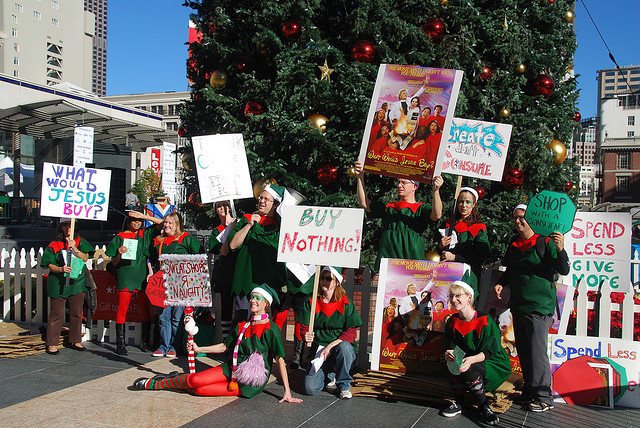
Buy Nothing Day, first conceived in Mexico in 1992, and taken to scale by Adbusters magazine, is a wonderful, powerful idea. It has captured the imaginations of thousands of people, all across the world, and bound them together around the idea that deep and lasting happiness cannot be packaged and sold, and it certainly doesn’t come in a can of Coke or at the wheel of the latest Audi. It’s an appeal to reject the sort of ludicrous and hyperbolic claims that have come to define corporate marketing, and to acknowledge the smothering, unaccountable, often violent power of large corporations in all of our lives. Buy Nothing Day has become an invaluable vehicle to channel energy toward one of the most pressing issues of our time. This year, Black Friday (the same day) also promises to serve as a vehicle of protest and refusal for communities rising up against anti-blackness.
But it has its limitations, three of which stand out. Perhaps there’s a way for its already powerful momentum to take shape into an even more powerful form.
Beyond Negative Logic
First, by being inherently “anti” and focusing on the word “nothing,” it subtly validates the lies that corporate marketing preaches. Without buying, one infers, there is a gap – literally nothingness. That’s the logic of the corporate marketing department. The really powerful and radical truth is that there is freedom in having a day (or a life) in which you do not depend on the acquisition of physical objects for meaning. That thought is in there right now, but it is obscured, and therefore less powerful than it could be. Moving into the more positive space is radical because it reclaims the idea of happiness; it doesn’t define it against the enemy’s logic, which, as any cognitive scientist will tell you, is a way of activating and validating their frame. We are not fighting for “nothing.” We are fighting for freedom, and therefore everything.
The second limitation is that it can exclude some of the people it could most powerfully include. It speaks best to people who live in the world of crass overconsumption. Tell people who are struggling to put food on the table to buy nothing one day as a political act and you will quite rightly get told to wise up. Consumption is not a simple negative; overconsumption, yes; mindless consumption, yes; consumption for its own sake, yes; but consumption per se, no. To claim otherwise is to ignore the reality that billions of us live with every day, all around the world.
Which leads to the third and perhaps most important limitation: the brute politics. This is about limiting the control of private, profit-above-all-else interests, and there is nowhere in this battle more important than the impoverished parts of the world, east and west, north and south. To use a frame that excludes people on those front lines is both deeply limiting, and somewhat inauthentic.
The Psychopathic 1%
Right now, the psychopathic tendencies of the corporate elite are leading them to do everything they can to deepen and consolidate their control, and thereby their ability to extract wealth from some of the poorest parts of the world. And they are very good at it, which is how we have ended up in a situation where, by 2011, 110 of the largest 175 economic entities on earth were corporations, and how they’ve managed to hoard more than $26 trillion – yes, with a “t” – of the profits they have drawn from the labor and resources of people all over the world through tax havens. And it’s how they are subverting democracy the world over. Research from Harvard’s Safra Center for Ethics shows that, in the United States, where so many large corporations are based, there is up to a 220 percent return on investment (ROI) for lobbying Congress, the definition of buying political influence, which is another way of saying, corruption (i.e. the use of public power for private gain).
The people on the sharpest end of this corruption are the workers who are not paid a living wage, the people who are stranded without decent health care or education because they are denied massive tax revenues from the sale of the natural resources extracted from under their feet, and the children whose minds are warped by highly sophisticated advertising training them to believe that the next plastic toy is more important to happiness than love, security or appreciation of Mother Earth. That is the political impetus behind what we’ve been calling Buy Nothing Day, and it could not be more important.
Could these three limitations be overcome if we reframed this concept as a global Independence Day? Independence from corporate control; independence from the idea that we are merely what we consume; independence from the demented screech of corporate advertising; independence from the life-denying tendencies of late stage capitalism.
Fighting the Propaganda Machine
Those two words, standing on their own, are not a perfect, complete frame. They do not, for example, have the “it does what it says on the tin” quality of Buy Nothing Day. But then, Buy Nothing Day has always needed some extra padding to draw out its full meaning and power. Also, at least to start with, it will definitely compete for meaning with national Independence Days in countries all over the world. But that dynamic can also serve the cause. Independence Day is a statement of pride, of autonomy, of self-defined identity. If we can popularize the idea of independence being independence as the 99%, as the majority across borders and boundaries, as a statement of unity against a common foe, then we can continue to break down the serfdom of corporate power that is intertwined with nationalism and other dividing forces that ultimately serve the power elites only.
At the core of Independence Day, we will continue to reject global corporations and their marketing propaganda. This November 28 and 29 is a moment for us to not only be conscious of the cognitive assault of over 3,000 advertising messages directed toward each one us every day, but to also actively engage in the meme wars. To delegitimize corporate power and corporate ability to do business in our countries. To boycott products at every possible touch point. To take back our public spaces from corporate advertising. To culture jam wherever we see the tentacles of multinational brands. To even question the balance between needs and wants in our own lives. And to reclaim our sovereignty by forging new relationships with each other, engaging in the gift and barter economies, building cooperative structures and deifying the commons over private ownership.
The deep meaning of Buy Nothing Day must live and grow. Of that there is no doubt; it makes too powerful a contribution in the fight for a more just and equal world. As Independence Day, we hope it finds a longer life and a larger global constituency.
Press freedom is under attack
As Trump cracks down on political speech, independent media is increasingly necessary.
Truthout produces reporting you won’t see in the mainstream: journalism from the frontlines of global conflict, interviews with grassroots movement leaders, high-quality legal analysis and more.
Our work is possible thanks to reader support. Help Truthout catalyze change and social justice — make a tax-deductible monthly or one-time donation today.